Buyer's Guide · October 2026
Best Competency and Skills Matrix Software in 2026
A practical guide to competency and skills matrix software, AG5, Skills Base, MuchSkills, Cornerstone, Disprz, Gloat, Kahuna, Poka, TalentGuard and iMocha, sorted by the job they do, with real pricing, independent ratings, and where each one fits.


The verdict
- Best for a competency framework your managers use
- Sageo, turns your values into level-by-level role expectations and runs calibrated reviews against them, for teams of 10 to 1,000, at EUR 6 per seat.
- Best for frontline and manufacturing compliance
- AG5, a purpose-built, audit-ready skills matrix with certification tracking and ISO reporting for regulated shop floors.
- Best low-cost, self-serve skills matrix
- Skills Base, a genuine free tier and sub-5-dollar paid plans, with the strongest independent ratings among the pure-play tools.
Bottom line. Match the tool to the job: Sageo for a competency framework and reviews in a growing company; AG5, Kahuna or Poka for frontline compliance; Skills Base or MuchSkills for a lightweight visual matrix; TalentGuard for enterprise career-pathing; and Cornerstone, Gloat, Disprz or iMocha when skills live inside a larger learning, mobility or assessment platform.

For founders, people leaders and operations managers trying to replace a spreadsheet skills matrix, or to finally see what their teams can actually do. "Skills matrix software" is not one product. It covers at least four: lightweight visual matrix tools, frontline and manufacturing compliance platforms, enterprise talent-intelligence suites, and competency-framework tools. This guide sorts the real tools by the job they do, with honest pricing, independent ratings, and where each one fits.
A note on who wrote this
Sageo builds competency frameworks and runs performance reviews against them, so we sit at the competency end of this market and are one of the tools this guide touches. We wrote it straight: most of the products here do a different job from Sageo, a few overlap, and we say which is which. Ratings and pricing were compiled in October 2026 from vendor sites, G2, Capterra and third-party data. Treat them as directional and confirm before you buy.
1. Which competency or skills matrix software should you choose?
Pick the tool that matches the job you are hiring it to do:
- Replace an Excel matrix on the shop floor
- AG5, purpose-built for frontline and regulated operations, with audit-ready certification tracking and ISO reporting.
- A cheap, dedicated skills matrix for any team
- Skills Base, with a genuine free tier and paid plans from 2.25 to 4 dollars per user per month.
- A design-led visual skills map
- MuchSkills, strong for consulting and professional-services staffing, with a skill-versus-interest view.
- Validate deskless competency and certifications
- Kahuna Workforce or Poka, for industrial, connected-worker and regulated operations.
- Skills inside a full enterprise suite
- Cornerstone, Gloat or Disprz, if you are 1,000-plus and buying the whole learning, mobility or workforce platform.
- Measure skills with validated assessments
- iMocha, assessment-first evidence rather than self-ratings.
- A competency framework tied to reviews and careers
- Sageo for teams of 10 to 1,000 (frameworks generated from your values, plus calibrated reviews), or TalentGuard for enterprise career-pathing and succession.
The thread that runs through all of them: a skills matrix is only as good as the thing it measures against. Tools that start from a clear, role-based standard and keep the data current stay useful. Tools bolted onto stale self-ratings decay fast.
2. What counts as skills matrix software?
The ten tools here split into four categories with different buyers, prices and risks.
- Pure skills-matrix tools
- Lightweight, self-serve and low cost, where the matrix itself is the product. Skills Base, MuchSkills.
- Frontline and deskless platforms
- Built for shop-floor and regulated workforces, with proficiency validation, certification tracking and audit-readiness. AG5, Kahuna Workforce, Poka.
- Enterprise talent-intelligence suites
- Skills capability embedded in large learning, mobility and workforce-planning platforms, where the matrix is a byproduct. Cornerstone, Gloat, Disprz.
- Competency-framework and assessment tools
- Framework-and-measurement engines. One centred on competency, career and succession, one on validated assessment. TalentGuard, iMocha, and Sageo at the competency-plus-reviews end.
3. How do the tools compare?
| Tool | Category | Core job | G2 | Pricing |
|---|---|---|---|---|
| Sageo | Competency + reviews | Competency framework from your values, plus calibrated reviews | n/a | EUR 6 PEPM, published |
| AG5 | Frontline platform | Live frontline skills matrix with audit compliance | 4.6 (66) | Quote; ~€99 to €699/mo tiers |
| Skills Base | Pure matrix tool | Dedicated low-cost skills matrix and gap analysis | 4.5 (29) | Free; $2.25 to $4/user |
| MuchSkills | Pure matrix tool | Visual skills mapping with interest and gaps | ~4.7 (11) | Quote; fee plus per-user |
| Cornerstone | Enterprise suite | AI Skills Graph inside a full HCM suite | 4.0 (991) | Quote; ~$15 to $25 PEPM est. |
| Disprz | Enterprise learning | Learning platform with a skills-intelligence layer | 4.4 (96) | Quote; enterprise |
| Gloat | Enterprise marketplace | AI internal mobility on a skills graph | 4.4 (34) | Enterprise quote; six-figure+ |
| Kahuna Workforce | Frontline platform | Validate deskless competency and certifications | 4.9 (50) | Quote; ~$5 to $12/user est. |
| Poka | Frontline platform | Connected-worker platform with a skills matrix | 4.6 (229) | Quote; ~$30/user est. |
| TalentGuard | Competency framework | Competency framework, career pathing and succession | 4.6 (4) | Quote |
| iMocha | Assessment tool | Validated skills assessment feeding gap dashboards | 4.4 (276) | Quote; ~$400/mo est. |
4. How does each tool compare, in depth?
Sageo (reference profile)
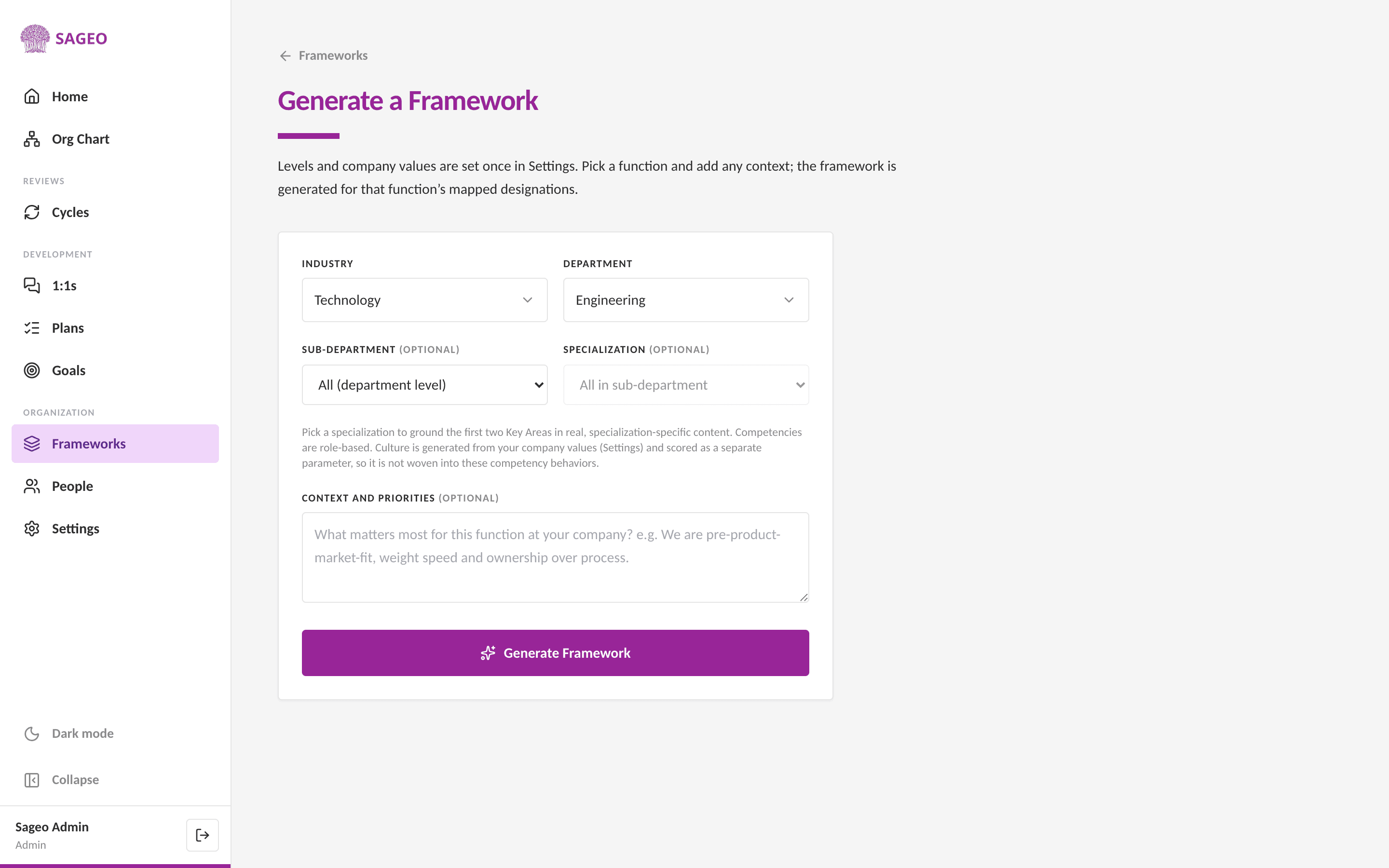
Sageo sits at the competency end of this market. Instead of starting from a blank skills taxonomy, it turns your company values into a competency framework with level-by-level expectations per role, then runs calibrated 360 reviews, development plans and monthly 1:1s against that same framework. The point is not a grid of discrete skills, it is a role-based standard your managers actually use, with an audit trail behind every rating. We include it here as the reference the other tools are measured against.
- Category
- Competency framework plus performance reviews
- Best fit
- 10 to 1,000 employees
- Pricing
- EUR 6 per seat per month, all modules, published
- Ratings
- Newer product; limited public review footprint
Key features
What Sageo does, end to end:
Competency framework generator
turns your values and levels into IC and manager expectations, level by level, in about an hour.
Level-by-level role expectations
a matrix that measures people against a defined standard, not a self-rated checklist.
Calibrated 360 reviews
self, manager, peer and upward feedback scored against the framework, with calibration across managers.
AI development plans
turns review gaps into multi-quarter plans linked to goals.
Private-by-design AI
names and identifiers are stripped before any model call; a person approves every AI output.
Audit trail
an immutable record of how each rating and promotion call was made.
Use cases
Where a growing company gets the most from Sageo:
- Generating a competency framework from company values instead of buying a static matrix.
- Running calibrated review cycles that hold up to scrutiny.
- Turning review gaps into development plans tied to goals.
- Making levels, pay and promotion decisions defensible under GDPR and the EU AI Act.
Ideal customer profile
Sageo fits best when this describes your company:
- Size
- 10 to 1,000 employees.
- Industries
- technology, SaaS, professional services and other knowledge-work teams.
- Buyers
- founders, CPOs and heads of people.
- Stack
- sits alongside any HRIS as the competency and performance layer.
Pricing
One published, all-inclusive price:
EUR 6 per seat per month, every module included.
10-seat minimum, no implementation fee.
No separate charge for AI, frameworks, reviews or development plans.
What users say
What early users value, and what to keep in mind:
Praised
- speed from company values to a working competency framework.
- flat, all-inclusive pricing with no add-ons.
Watch out for
- it is not a shop-floor skills matrix or certification-compliance tool.
- a newer product without a large public review footprint yet.

See how Sageo actually works
An interactive walkthrough of frameworks, 360 reviews, calibration, and monthly 1:1s.
Explore the Walkthrough AG5
AG5
AG5 is an Amsterdam-based skills and requirements platform built to replace Excel skills matrices for frontline and regulated operations. A central, folder-based skills library feeds a live employee-versus-skill matrix with required, achieved and gap views, and the certification tracking and audit reporting that regulated manufacturers need. Its strongest claim is that non-technical users can stand up a usable matrix in a couple of clicks.
- Category
- Frontline and deskless platform
- Best fit
- 200 to 40,000 frontline employees
- Pricing
- Quote-only; indicative tiers from roughly €99 to €699 per month
- Ratings
- G2 4.6 (66); Capterra 4.4 (shared 14-review pool)
Key features
AG5 is built around the live matrix and the audit trail behind it:
Live skills matrix
build a visual people-versus-skills grid in a couple of clicks, with gap and required views.
Certification tracking
expiry alerts, auto-removal of lapsed staff from qualified pools, and an Expert Finder.
Audit reporting
ISO, GMP, FDA, IATF and HACCP-ready exports with an audit trail.
Integrations
around 97 live HRIS, LMS and BI connectors, including deep SAP SuccessFactors.
Frontline app
native iOS and Android access for the shop floor.
AI skills merge
its one named AI feature, for de-duplicating and tidying the skills library.
Use cases
Where AG5 earns its keep:
- Replacing fragile Excel skills matrices on a production line.
- Proving certification and training compliance in an ISO or customer audit.
- Finding who is qualified for a task or shift, fast.
- Flagging skill gaps and routing them to LMS training.
Ideal customer profile
AG5 fits best when this describes your operation:
- Size
- 200 to 40,000 employees, mostly frontline.
- Industries
- manufacturing, food and beverage, logistics, chemicals, automotive, aerospace.
- Buyers
- operations, plant and quality managers, plus L&D.
- Stack
- an HRIS such as SAP SuccessFactors, with an LMS for training.
Pricing
Quote-led, with vendor-indicative euro tiers:
Team roughly €99 per month, up to 100 employees.
Business roughly €399, Professional roughly €699 per month.
Enterprise custom. No permanent free version; pilots negotiable.
What users say
The recurring themes from reviews, good and bad:
Praised
- easy for non-technical users and a strong Excel replacement.
- responsive support and fast implementation.
Watch out for
- weak reporting and dashboards.
- a feature-light mobile app versus the web, and rigidity when editing rating scales.
How AG5 compares to Sageo
Different jobs. AG5 is a frontline, compliance-grade skills matrix for regulated shop floors; Sageo is a competency framework tied to performance reviews for office and knowledge-work teams. There is almost no overlap: if you need audit-ready certification tracking on a production line, buy AG5; if you need a competency standard your managers review against, that is Sageo.
 Skills Base
Skills Base is an Australian tool dedicated to skills matrices and gap analysis for frontline and operational teams, at a low entry cost. You build a custom skills taxonomy, assess proficiency, visualise a comparison-grid matrix, and track certification currency. 2026 adds an AI layer (a chat assistant, a predictive Insights engine, and an MCP server). It is the most accessible way to get off a spreadsheet.
- Category
- Pure skills-matrix tool
- Best fit
- Small teams to mid-market operations
- Pricing
- Free up to 25 users; paid 2.25 to 4 dollars per user per month
- Ratings
- G2 4.5 (29); directory 5.0 on a single shared review
Key features
A focused, matrix-first feature set:
Custom skills taxonomies
define your own skills (capped at 250 on the free tier).
Skills-matrix reports and gap analysis against role requirements
Proficiency targets, assessment dates, and certification expiry alerts
AI layer
Sam AI chat, predictive Insights, and an MCP server.
API access from the Teams tier upward
Comparison-grid "CompareSkills" view across people and teams
Use cases
Where Skills Base fits:
- A first, cheap move off an Excel skills matrix.
- Mapping proficiency and gaps for an ops, engineering or IT team.
- Tracking certification currency without a heavy platform.
- A dedicated matrix alongside an existing HRIS or LMS.
Ideal customer profile
Skills Base fits best when this describes your team:
- Size
- small teams through to mid-market and enterprise ops.
- Industries
- engineering, manufacturing, IT, and HR or L&D functions.
- Buyers
- team leads, L&D and operations managers.
- Stack
- light; integrates via API from the Teams tier.
Pricing
Among the few here with published prices:
Free for up to 25 users and 250 skills, a genuine permanent tier.
Teams at 2.25 dollars per person per month.
Enterprise at 4 dollars, with a custom Ultimate tier above it.
What users say
The recurring themes:
Praised
- ease of use and cost-effectiveness.
- strong gap identification and responsive support.
Watch out for
- a dated interface and setup or taxonomy effort.
- limited reporting and customization, and awkward export then re-import.
How Skills Base compares to Sageo
Adjacent, not the same. Skills Base visualises a grid of discrete skills and gaps; Sageo defines the role-based competency standard first and runs reviews against it. Many teams could use Skills Base for a lightweight skills inventory and Sageo for the competency framework and performance cycle; they solve different halves of the problem.
 MuchSkills
MuchSkills is a Swedish, design-led, visualization-first skills-intelligence tool that maps and searches what people can do. Skills profiles (technical, soft, certifications) are rendered as interactive maps, matrices and gap views across people, teams and sites, with a distinctive skill-interest dimension that separates ability from aspiration. It is the prettiest tool here and the one built for consulting benches.
- Category
- Pure skills-matrix tool
- Best fit
- Consulting and professional-services teams; proven at tens of thousands
- Pricing
- Quote-only: annual platform fee plus a per-user price
- Ratings
- Directory 5.0 (7 vendor-referred); G2 around 4.7 (11)
Key features
Visualization and staffing lead the feature set:
Visual skills matrix and gap analysis across people, teams and sites
Skill-interest toggle and job-focus highlighting
ability versus aspiration.
AI skill graph, role builder and development plans
CV Inventory and Team Builder for consulting staffing and proposals
Around 30 to 46 HRIS connectors, with SSO and SCIM on every plan
Open API for custom integrations
Use cases
Where MuchSkills shines:
- Staffing a consulting bench against a client brief.
- Building proposals and RFQs from a searchable CV inventory.
- Mapping ability versus interest to plan development.
- Giving leaders a clean visual read of team capability.
Ideal customer profile
MuchSkills fits best when this describes your firm:
- Size
- small firms through to public-sector deployments of tens of thousands.
- Industries
- consulting, professional services, and technology teams.
- Buyers
- HR or L&D, resourcing and practice leads.
- Stack
- HRIS connectors plus SSO and SCIM on every plan.
Pricing
Quote-only, with a two-part structure:
An annual platform fee plus a per-user price.
Tiers: Starter, Professional, Consulting Suite, Compliance and Enterprise.
No public figures; a free plan is unconfirmed.
What users say
The recurring themes:
Praised
- a clean, intuitive interface and clear dashboards.
- responsive support and useful gap insight.
Watch out for
- no built-in LMS and no native mobile app.
- limited formal assessment and ongoing data-upkeep burden; a very small company.
How MuchSkills compares to Sageo
Complementary. MuchSkills is a visual skills map and staffing tool; Sageo is a competency framework and review engine. If your core need is seeing and searching capability for project staffing, MuchSkills is purpose-built; if it is defining role expectations and running performance cycles, that is Sageo.
 Kahuna Workforce
Kahuna is a Houston SaaS that captures, assigns, assesses and validates frontline skills and competencies. Its tagline, "validate competency, not just completion," is the point: blended assessments (checklists, quizzes and on-the-job sign-off) produce validated, role-based proficiency, shown as a team matrix and heatmap of gaps. It is built for deskless, regulated, technical workforces where proof matters.
- Category
- Frontline and deskless platform
- Best fit
- 1,000 to 10,000-plus deskless users
- Pricing
- Quote-only; estimated 5 to 12 dollars per user per month
- Ratings
- G2 4.9 (50); thin elsewhere
Key features
Validation and certification are the core:
Skills Manager
a team matrix and skill heatmap of gaps.
Blended, observed competency assessments with sign-off
CertIQ
AI and OCR capture of certifications and credentials.
Capability planning
demand modelling against the workforce.
Ladder career and clinical advancement paths
API-first integrations, including a Workday Certified Integration and Indeavor scheduling
Use cases
Where Kahuna is used:
- Validating that frontline staff are competent, not just trained.
- Capturing and tracking certifications and credentials at scale.
- Modelling capability against upcoming demand or projects.
- Running clinical or technical advancement ladders.
Ideal customer profile
Kahuna fits best when this describes your operation:
- Size
- 1,000 to 10,000-plus users.
- Industries
- energy, manufacturing, healthcare and field service.
- Buyers
- operations, workforce and compliance leaders.
- Stack
- Workday and other HR systems via API-first integrations.
Pricing
Quote-only per user:
Estimated around 5 to 12 dollars per user per month.
One-time implementation from roughly 19,000 to 420,000 dollars by scope.
Perceived as a higher-cost, enterprise purchase.
What users say
The recurring themes:
Praised
- integrates with existing HR systems and captures specialised operational skills.
- strong implementation support and capability forecasting.
Watch out for
- no current-versus-target headcount view in the team matrix, and rigid UI logic.
- slow localization and a thin review base outside G2.
How Kahuna compares to Sageo
Different job. Kahuna validates deskless, regulated competency with observed sign-off and certification capture; Sageo builds a competency framework and runs office performance reviews against it. They share the word "competency" but serve different workforces, with little practical overlap.
 Poka
Poka
Poka is an AI-augmented connected-worker platform for frontline manufacturing (owned by IFS), where the skills matrix is one module in a plant-wide suite of digital work instructions, training, forms and huddle boards. The matrix shows skills by shift and site in real time, with competency validation, certification expiry tracking and closed-loop training. You buy the platform, and the matrix comes with it.
- Category
- Frontline and deskless platform
- Best fit
- Mid-to-large industrial manufacturers
- Pricing
- Quote-only; a single estimate near 30 dollars per user per month
- Ratings
- G2 4.6 (229); Capterra 4.7 (shared 15)
Key features
A full connected-worker suite, matrix included:
Real-time visual skills matrix by shift and site
Competency validation via auto-scored exams and SME endorsement
Certification expiry, recertification and audit history
Gap dashboard with skill targets, and qualified-only work routing
Closed-loop training tied to gaps
1,000-plus connectors to LMS, HRIS, ERP and MES
Use cases
Where Poka is used:
- Running a connected-worker platform across a plant, with skills as one piece.
- Validating competency and routing work only to qualified staff.
- Tracking certification expiry and recertification for audits.
- Delivering video work instructions and training on the floor.
Ideal customer profile
Poka fits best when this describes your plant:
- Size
- mid-to-large industrial manufacturers.
- Industries
- food, beverage, CPG and discrete manufacturing (Nestle, Danone, Tetra Pak, L'Oreal).
- Buyers
- plant and manufacturing operations leaders.
- Stack
- LMS, HRIS, ERP and MES via 1,000-plus connectors.
Pricing
Quote-only per user:
A single third-party estimate puts it near 30 dollars per user per month.
A free trial, but no public free version.
You are buying the whole platform, not a standalone matrix.
What users say
The recurring themes:
Praised
- cross-shift communication and quick access to procedures.
- effective video training and an intuitive experience.
Watch out for
- over-buying a full platform when you only need a matrix.
- "pricey," with a lengthy deployment and no documented graded proficiency scale.
How Poka compares to Sageo
Different world. Poka is a manufacturing connected-worker suite where the matrix is a feature; Sageo is a competency and review platform for office teams. A matrix buyer who picks Poka is really buying a plant-operations platform. There is effectively no overlap with Sageo's use case.
 Cornerstone
Cornerstone is a large HCM and learning suite ("Cornerstone Galaxy") where skills run through an AI Skills Graph rather than a standalone matrix. The graph (built on acquired Clustree and SkyHive technology) auto-infers more than 50,000 skills from profiles, titles and content to drive recommendations, gap scoring and internal mobility across learning, performance, succession and recruiting. The matrix is a byproduct of a much bigger platform.
- Category
- Enterprise talent-intelligence suite
- Best fit
- Mid-market to large enterprise and public sector
- Pricing
- Quote-only; full suite estimated 15 to 25 dollars PEPM
- Ratings
- G2 4.0 (991); Capterra 4.3 (232)
Key features
Skills sit inside a broad learning and talent suite:
AI Skills Graph
50,000-plus skills with auto-tagging.
Competency models, 360 reviews and skills-gap analysis
LMS and LXP, with extended-reality learning
Talent Marketplace for internal mobility
Visier-powered analytics
Workforce AI agents across the suite
Use cases
Where Cornerstone fits:
- Running enterprise learning and compliance training at scale.
- Driving internal mobility from inferred skills.
- Combining performance, succession and recruiting in one suite.
- Public-sector deployments needing FedRAMP.
Ideal customer profile
Cornerstone fits best when this describes your organisation:
- Size
- mid-market to large enterprise, 1,000-plus.
- Industries
- regulated enterprise and public sector.
- Buyers
- enterprise L&D, HRIS and talent leaders.
- Stack
- a core HRIS, with Cornerstone as the learning and talent suite.
Pricing
Quote-only, modules sold separately:
Learning estimated around 3.50 to 8 dollars PEPM.
Full talent suite estimated around 15 to 25 dollars PEPM.
Median annual contract near 20,000 dollars; no free trial.
What users say
The recurring themes:
Praised
- strong, customizable reporting and broad configurable functionality.
- detailed training tracking and stable, frequent updates.
Watch out for
- complex administration and a steep learning curve.
- a dated UX, slow performance, and inconsistent support.
How Cornerstone compares to Sageo
Different scale. Cornerstone is a heavy enterprise learning and talent suite; Sageo is a focused competency and review tool for teams of 10 to 1,000. They overlap conceptually on competency and performance, but Cornerstone is far larger, pricier and slower to deploy than Sageo's segment needs.
 Gloat
Gloat
Gloat is an enterprise AI talent marketplace and workforce-intelligence platform built on a skills knowledge graph. It matches employees to internal projects, gigs, mentorships and roles via skills inference, and surfaces gap and readiness data for workforce planning. A skills matrix is a byproduct of that inference, not the headline, and it only makes sense at scale.
- Category
- Enterprise talent-intelligence suite
- Best fit
- Large global enterprises, 1,000-plus
- Pricing
- Enterprise quote-only; six-figure-plus annual contracts
- Ratings
- G2 4.4 (34); Gartner Peer Insights 4.8 (7)
Key features
Internal mobility and workforce intelligence lead:
AI talent marketplace and internal gig economy
A custom, evolving skills knowledge graph with inference beyond self-report
Workforce Intelligence
readiness, gaps and flight risk.
Succession and capacity planning
Agentic HR AI agents across Teams, Slack and Copilot
Multi-step career-path recommendations
Use cases
Where Gloat fits:
- Standing up an internal talent marketplace at enterprise scale.
- Filling projects and gigs from inferred internal skills.
- Workforce planning against readiness and gaps.
- Mapping multi-step career paths for a large workforce.
Ideal customer profile
Gloat fits best when this describes your enterprise:
- Size
- 1,000-plus, typically much larger.
- Industries
- large global enterprises across sectors.
- Buyers
- CHROs and heads of talent and workforce planning.
- Stack
- a core HRIS, with Gloat as the mobility and intelligence layer.
Pricing
Enterprise-only economics:
Bespoke six-figure-plus annual contracts.
No SMB or self-serve tier.
Multi-month implementations to seed the marketplace.
What users say
The recurring themes:
Praised
- AI-driven internal matching and multi-step career-path recommendations.
- an intuitive employee experience.
Watch out for
- heavy upfront setup to seed the marketplace and multi-month implementations.
- over-scoped and over-priced for a buyer who only needs a matrix.
How Gloat compares to Sageo
Different job and scale. Gloat orchestrates internal mobility for very large enterprises; Sageo builds a competency framework and runs reviews for teams of 10 to 1,000. A matrix buyer at Sageo's scale would massively over-buy with Gloat; the overlap is minimal.
 Disprz
Disprz is a Chennai-based AI enterprise learning and upskilling platform (LMS plus LXP) with a "Skills Architect" intelligence layer. It defines a taxonomy, maps required skills to roles across 40 industries and 2,000-plus roles, and runs gap analysis, chiefly to drive content recommendations and learning paths rather than as an audit-grade matrix. It is a learning platform first.
- Category
- Enterprise talent-intelligence suite (learning-first)
- Best fit
- Mid-market and large enterprises with frontline or distributed teams
- Pricing
- Quote-only; perceived higher-cost
- Ratings
- G2 4.4 (96); Capterra 4.7 (shared 38)
Key features
Learning plus a skills layer on top:
Skills Architect
taxonomy plus role-to-skill mapping.
Organisational and individual gap analysis
AI-personalised learning pathways
Turo AI content creation across six formats
Mobile-first, offline-capable frontline enablement
A 100-plus provider content library
Use cases
Where Disprz fits:
- Upskilling frontline and distributed teams through learning.
- Mapping role-to-skill requirements to drive content.
- Personalising learning pathways from gaps.
- Authoring training content with AI.
Ideal customer profile
Disprz fits best when this describes your organisation:
- Size
- mid-market and large enterprise.
- Industries
- retail, banking and financial services, pharma, manufacturing.
- Buyers
- enterprise L&D and capability leaders.
- Stack
- used as the learning platform, with a skills layer on top.
Pricing
Quote-only:
No published tiers; perceived as a higher-cost platform.
Directory "per month" figures for it are unreliable artifacts.
Priced as an enterprise learning deal, not a standalone matrix.
What users say
The recurring themes:
Praised
- an intuitive, mobile-first interface and responsive support.
- strong skill identification and training recommendations.
Watch out for
- basic built-in quizzes and limited reporting depth.
- fewer HRIS integrations, occasional lags, and some outdated content.
How Disprz compares to Sageo
Mostly complementary. Disprz is a learning platform whose skills layer feeds content; Sageo is a competency framework and review engine. If the job is upskilling through learning, Disprz leads; if it is defining expectations and running reviews, that is Sageo.
 TalentGuard
TalentGuard is an Austin competency-management and skills-based talent-development platform, built around career pathing and succession with AI-generated role standards. HR defines competency and proficiency standards per role, assesses people against them, visualises gaps, and routes results into career paths, development plans and succession. It is the closest tool here to what Sageo does.
- Category
- Competency-framework tool
- Best fit
- Mid-market and enterprise talent programs
- Pricing
- Quote-only; directory figures conflict
- Ratings
- G2 4.6 (4); Capterra 4.8 (shared 4, dated)
Key features
A framework-to-decision engine:
Competency framework with skills and competency libraries
Proficiency levels and Talent Assessment, including 360s
Skills-gap analysis against an approved role standard
Career pathing
compare multiple paths side by side.
Succession planning and Talent Insights
WorkforceGPT AI role generation, plus certification tracking and reviews
Use cases
Where TalentGuard fits:
- Building a competency framework and proficiency model per role.
- Running career-pathing and succession programs.
- Generating role profiles with AI for HR to approve.
- Tying development plans to an approved role standard.
Ideal customer profile
TalentGuard fits best when this describes your organisation:
- Size
- mid-market and enterprise.
- Industries
- organisations running formal, skills-based talent programs.
- Buyers
- talent management and HR leaders.
- Stack
- a core HRIS, with TalentGuard as the competency and career layer.
Pricing
Quote-only, and hard to pin down:
Bundles plus a custom quote; a 90-day pilot.
A free WorkforceGPT role-generation tool.
Directory figures conflict wildly, so treat any single number with caution.
What users say
The recurring themes:
Praised
- deep functionality for the price and strong career-pathing and succession.
- intuitive, with fast deployment and high-touch support.
Watch out for
- a dated UI and integration friction.
- cost complaints and a very thin, dated review base; a small company.
How TalentGuard compares to Sageo
The closest head-to-head in this guide. Both build competency frameworks with proficiency levels, gap analysis and career development. TalentGuard leans into enterprise succession and career-pathing; Sageo leans into generating the framework from your values and running calibrated reviews and development against it, with published pricing, for teams of 10 to 1,000. Choose TalentGuard for heavy succession planning, Sageo for a framework-plus-review cycle that is fast to stand up.
 iMocha
iMocha is a Pune-based skills and work-intelligence platform whose core strength is validated skills assessment: a large library, coding simulations, live and AI interviews, proctoring and a patented AI-LogicBox. That evidence feeds skills inference, a Lightcast-normalized taxonomy, gap analysis and heatmaps, so it reframes the "matrix" as evidence-based dashboards rather than a self-rated grid.
- Category
- Skills-assessment tool
- Best fit
- Skills-first mid-to-large enterprises
- Pricing
- Quote-only; a basic tier commonly cited near 400 dollars per month
- Ratings
- G2 4.4 (276); Capterra 4.5 (30)
Key features
Assessment-first, with a skills layer on top:
A large validated assessment library with coding, live and AI interviews and proctoring
AI-LogicBox for open-ended, auto-scored skill validation
AI skills inference from HR and work data, on a Lightcast taxonomy
Skill-gap heatmaps and inventory dashboards
Work Intelligence
task-level AI-readiness.
Workday and SuccessFactors integration
Use cases
Where iMocha fits:
- Validating skills with tests rather than self-ratings.
- Screening and benchmarking candidates and employees.
- Building an evidence-based skills inventory and heatmap.
- Assessing task-level readiness for AI and automation.
Ideal customer profile
iMocha fits best when this describes your organisation:
- Size
- mid-to-large enterprise.
- Industries
- skills-first technology, services and enterprise teams.
- Buyers
- talent acquisition and talent-management leaders.
- Stack
- Workday or SuccessFactors, with iMocha as the assessment engine.
Pricing
Quote-only, with conflicting public figures:
A basic tier commonly cited around 400 dollars per month, billed annually.
Enterprise pricing custom.
Perceived as a higher-cost platform.
What users say
The recurring themes:
Praised
- a large pre-built assessment library that is quick to deploy.
- responsive support and at-a-glance capability bucketing.
Watch out for
- occasional grading errors and result latency.
- limited customization and no classic editable grid matrix.
How iMocha compares to Sageo
Complementary. iMocha measures skills with validated tests; Sageo defines the competency standard and runs reviews against it. iMocha gives you stronger evidence than self-rated tools, but it is not a competency-review platform. A team could use iMocha for validated assessment and Sageo for the framework and performance cycle.
5. How much does competency and skills matrix software cost?
Only two of these publish real prices. Skills Base lists a free tier (up to 25 users) and paid plans at 2.25 to 4 dollars per user per month. AG5 publishes indicative euro tiers (roughly €99 to €699 per month by headcount) but quotes formally. Everyone else is quote-only. Independent estimates put Cornerstone's full suite around 15 to 25 dollars PEPM, Kahuna around 5 to 12 dollars per user, Poka near 30 dollars per user, Gloat in the six figures and up, and iMocha from around 400 dollars per month. Sageo is a flat EUR 6 per seat with every module included and no implementation fee.
Watch three things. First, whether the matrix is a standalone product or a module you can only get by buying a much larger platform (Poka, Cornerstone, Gloat and Disprz are the latter). Second, one-time implementation fees, which run from a few thousand dollars to six figures on the enterprise and frontline tools. Third, whether the reviews you are reading are independent, since many directory ratings are the same handful of vendor-invited reviews surfaced three times.
6. What should you ask before you buy?
- What does the matrix measure against?
- A self-rated list, a validated assessment, or a role-based competency standard. The answer decides how much you can trust the output.
- Standalone or module?
- Some tools only give you a matrix inside a much bigger, pricier platform you may not want.
- How is proficiency validated?
- Self-report, manager sign-off, observed assessment, or test. Regulated work needs validation and an audit trail.
- How current will the data stay?
- Who updates it, how often, and whether it decays. A matrix nobody maintains is worse than none.
- Does it connect to decisions?
- Whether skills data feeds hiring, development, pay and promotion, or just sits in a dashboard.
- Are the reviews independent?
- Many directory ratings are the same vendor-invited reviews shown three times. Weight G2 volume over a 5.0 score on one review.
7. Where does Sageo fit?
We build Sageo, so here is the honest placement. Sageo is not a shop-floor skills matrix or an enterprise mobility suite. It sits at the competency end of this market: it turns your company values into a competency framework with level-by-level expectations, then runs calibrated reviews, development plans and 1:1s against it, for teams of 10 to 1,000. The closest tool here is TalentGuard, which is stronger on enterprise succession and lighter on the review workflow.
What Sageo helps with
- A competency framework generated from your values, not a blank skills taxonomy you fill in by hand
- Level-by-level expectations per role, so a skills matrix means something your managers actually use
- Calibrated performance reviews and development plans tied to the same framework
- A documented, auditable record of how each rating and promotion call was made
What you need elsewhere
- A shop-floor or certification-compliance matrix for regulated, deskless work (AG5, Kahuna, Poka)
- A lightweight visual skills map for a small team or a consultancy bench (Skills Base, MuchSkills)
- Validated skills assessments and testing (iMocha)
- Enterprise internal-mobility orchestration at 1,000-plus (Gloat, Cornerstone)
In short: if you want a skills grid for frontline compliance or a bench-staffing visual, buy one of the specialists. If you want a competency framework your managers actually use, tied to reviews and growth, that is what Sageo does.
See it in SageoThe competency framework behind a skills matrix that means somethingSee how Sageo turns your values into level-by-level expectations, then runs reviews and development plans against them.How was this guide researched?
Built in October 2026 from vendor sites and documentation, independent review platforms, and third-party pricing data. Most of these vendors are quote-only, so pricing is estimated and marked. Review pools on Capterra, GetApp and Software Advice are often the same shared, vendor-invited samples, so G2 volume is the more reliable independent signal.
- Vendor sites and docs
- Each product's own feature, integration and pricing pages, taken as the source for capabilities and list prices where published.
- G2
- Ratings and review counts, weighted by volume as the most reliable independent signal here.
- Capterra, GetApp and Software Advice
- Gartner Digital Markets directories; useful but frequently the same small, vendor-invited review pool surfaced three times.
- Gartner Peer Insights and TrustRadius
- Secondary enterprise sentiment for the larger platforms.
- Third-party pricing estimates
- Public transaction data and aggregators for quote-only vendors, treated as directional and excluding implementation.
Frequently asked questions
What is skills matrix software?
Skills matrix software maps who has which skills and at what level, usually as a grid of people by skills, so you can see gaps against what each role needs. Some tools stop at the visual matrix; others add certification tracking, validated assessments, or a full competency framework and performance reviews.
What is the best skills matrix software?
It depends on the job. AG5 is best for frontline and regulated compliance; Skills Base or MuchSkills for a lightweight visual matrix; Kahuna Workforce or Poka for deskless validation; iMocha for validated assessments; and TalentGuard or Sageo for a competency framework tied to careers and reviews, with Sageo aimed at teams of 10 to 1,000.
How much does skills matrix software cost?
Most vendors are quote-only. The published exceptions are Skills Base (free up to 25 users, then 2.25 to 4 dollars per user per month) and AG5 (indicative tiers of roughly €99 to €699 per month). Enterprise suites run far higher once implementation is included, while Sageo is a flat EUR 6 per seat with every module.
What is the difference between a skills matrix and a competency framework?
A skills matrix records who can do which discrete skills and at what level. A competency framework defines the expectations for each role and level first, the behaviours and abilities, then measures people against that standard. Sageo starts from the framework, which is what makes the matrix meaningful rather than a self-rated checklist.
Do I need skills matrix software or is a spreadsheet enough?
A spreadsheet works until the matrix goes stale, the proficiency scale drifts, or an auditor asks for evidence. Dedicated tools keep the data current, validate proficiency, track certification expiry, and connect skills to development and decisions. If skills gaps carry compliance or safety risk, move off the spreadsheet.

Written by
Deepti GuptaCo-founder, Sageo
18+ years building people functions from the ground up at Myntra, Freshworks and Dream11, scaling teams from 100 to 2,500 people and designing company-wide performance and compensation systems. Sageo automates the frameworks she has built by hand throughout her career.

Reviewed by
Vinayak RaviCo-founder, Sageo
19+ years of B2B SaaS go-to-market leadership. He built the organic growth engine at Freshworks through its rise to a public company and has led demand generation at some of the sector's fastest-scaling software startups.
Product names and logos are trademarks of their respective owners, shown here for identification only and not as endorsements.
All guides