Comparison · September 2026
The Best Lattice Alternatives for 2026
Eleven honest alternatives to Lattice, compared on price, features, and fit: Sageo, Leapsome, 15Five, Culture Amp, PerformYard, Betterworks, Engagedly, Workleap, HiBob, BambooHR, and Qualtrics.
The verdict
- Best all-in-one alternative for small and mid-size teams
- Sageo, generates the competency framework from your values, then runs the whole cycle for EUR 6 per seat with every module included and no annual floor.
- Best if you now need the HRIS Lattice is dropping
- HiBob or BambooHR, full systems of record with payroll and performance built in; HiBob for global mid-market, BambooHR for US SMBs.
- Best European all-in-one with native learning
- Leapsome, keeps its HRIS, adds a native LMS, and is built for GDPR and works councils.
Bottom line. Choose Sageo if you want Lattice's performance depth without the $4,000 floor, the add-on stacking, or a separate HRIS to maintain. If you now need core HR and payroll in one tool, look at HiBob or BambooHR. For a full European suite with learning built in, Leapsome.

Lattice is one of the best-known performance platforms in the mid-market, with more than 5,000 customers and a G2 rating of 4.6 across 4,000-plus reviews. It is a genuinely good product. So most teams do not go looking for an alternative because Lattice is bad. They go looking because of its $4,000 annual minimum, its stacking add-on prices, or the fact that it is sunsetting its own HRIS by mid-2026 and now expects you to run a separate system of record.
A note on who wrote this
Sageo publishes this comparison, and Sageo is one of the eleven products in it. So we held ourselves to three rules. Every Lattice and competitor figure comes from vendor pricing pages, G2, Capterra, and public procurement data, as of September 2026. Every Sageo claim comes from sageo.ai. And where another product is the better fit, we say so plainly. Section 6 is about when you should just stay on Lattice.
1. Which Lattice alternative should you choose?
The right alternative depends on what pushed you off Lattice in the first place: price at your headcount, the missing HRIS, or a feature Lattice does not go deep enough on. Match the reason to the shortlist below.
Quick picks
| If you are leaving Lattice because... | Look at | Why |
|---|---|---|
| The $4,000 floor and add-on stacking make it expensive at your size, and you still lack a real competency framework | Sageo | Generates a level-by-level framework from your values, then runs 360s, calibration, 1:1s and development plans. Every module for €6 per seat, no annual floor. |
| You now need the HRIS and payroll Lattice is dropping, in one system | HiBob, BambooHR | Full systems of record with core HR, payroll and lightweight performance built in. HiBob for global mid-market, BambooHR for US SMBs. |
| You want one European suite with performance, HRIS and native learning | Leapsome | The closest all-in-one to Lattice in Europe. Keeps its HRIS, adds a native LMS, GDPR and works-council tooling. |
| Manager habits and weekly cadence matter more than the framework | 15Five | Weekly check-ins, AI manager coaching, and High Fives recognition. From $4 per seat for engagement. |
| You want maximum review-cycle flexibility with setup and support included | PerformYard | Adapts to any review methodology, includes implementation and a dedicated success manager, no add-on games. |
| Engagement science and benchmarking are the priority, not reviews | Culture Amp, Qualtrics | Deeper people-science and benchmark datasets than Lattice. Both carry their own floors and higher price. |
| You run a large, matrixed enterprise on deep cascading OKRs | Betterworks | Enterprise OKR alignment with live DEI calibration and bidirectional Workday and SAP sync. |
| You want performance plus a real LXP, gamified recognition, and frontline tools | Engagedly | Talent suite with a learning experience platform, points and badges, and deskless enablement, at a mid-market price. |
| You just want lightweight, fast engagement and light performance | Workleap (Officevibe) | Low-complexity pulse surveys, anonymous feedback, and recognition from about $5 per seat. |
2. Why do teams look for a Lattice alternative?
Five reasons come up again and again in reviews and buyer conversations. None of them mean Lattice is a poor product. They mean it is priced and scoped for a particular kind of buyer, and if that is not you, the fit gets expensive or incomplete.
- The $4,000 floor
- Lattice enforces a strict $4,000 minimum annual contract value across every plan combination. A 20-person team on the $13 Foundations plan would pay $3,120 a year on paper, but still has to clear $4,000, which pushes the effective rate to about $16.66 per seat. Teams under roughly 30 people often find it cost-prohibitive.
- Add-on stacking
- The headline price is a base. Grow (career tracks and development) adds $4 per seat, and Compensation adds $6 per seat, on top of an $8 to $13 base. A full suite gets expensive quickly, and the modular math is hard to predict.
- Rigid OKRs
- A frequent complaint is that configuring cascading OKRs feels rigid, administrative, and overly complex compared with dedicated goal tools.
- Reporting limits
- Built-in analytics lack granular flexibility. Custom metrics often mean exporting raw CSVs and analysing them elsewhere.
- No more HRIS
- Lattice is sunsetting its native HRIS and payroll by mid-2026. It is now a talent layer that sits on top of a separate system of record, so you have to source, implement, and maintain that HRIS yourself.
The pattern. Lattice is built for growth-stage mid-market and enterprise companies, 100 to 5,000 employees, that already run a dedicated HRIS and already own a competency framework. If you are smaller, more price-sensitive, or still building the framework itself, the alternatives below tend to fit better.
3. How do you choose between them?
Three questions cut the field faster than a feature checklist.
Do you have a competency framework already?
Almost every tool here, Lattice included, is bring-your-own-framework: it operationalises a job architecture you must supply. Only Sageo generates the framework itself, from your company values, then a human edits and approves it. If "we have values on a slide but nothing written per level" describes you, that gap matters more than any other feature.
Do you need an HRIS in the same tool?
This is the question Lattice's 2026 HRIS sunset forces. If you want core records and payroll in one place, you are shopping for an HR suite (HiBob, BambooHR, or Leapsome's HCM), not a performance specialist. If you are happy to keep your system of record separate, a specialist (Sageo, 15Five, PerformYard) will be lighter and cheaper.
What will it actually cost at your headcount?
Watch for three things list prices hide: annual minimums, add-ons, and implementation fees. Lattice, Culture Amp, and Betterworks all carry floors around $4,000 to $4,500. BambooHR adds a mandatory implementation fee of 5 to 10 percent of year-one spend. Sageo and PerformYard are the transparent ends of the range: Sageo is one flat €6 per seat with no floor, and PerformYard includes setup.
4. What do the Lattice alternatives cost?
Entry pricing and minimums, from vendor pricing pages and buyer-reported data as of September 2026. Per seat per month unless noted. "Floor" is the minimum you pay regardless of headcount.
| Product | Category | Entry price | Minimum / floor | G2 |
|---|---|---|---|---|
| Lattice | Performance (no HRIS) | $8 to $13 | $4,000 / year | 4.6 |
| Sageo | Performance, framework-first | €6, all modules | None (10-seat min) | New |
| Leapsome | All-in-one HCM + LMS | ~$7 to $20 | $199 / month platform fee | 4.8 |
| 15Five | Manager enablement | $4 to $16 | Annual contract | 4.6 |
| Culture Amp | Engagement / people science | $9 to $14 | ~$4,500 / year | 4.5 |
| PerformYard | Flexible performance | $5 to $15, setup included | ~$5,000 industry min | 4.7 |
| Betterworks | Enterprise OKR | $8 to $9 | ~$4,000 / year | 4.4 to 4.7 |
| Engagedly | Talent suite + LXP | $2 to $5 modules, ~$9 bundled | ~$5,000 / year base | 4.3 |
| Workleap (Officevibe) | Engagement / pulse | $5 to $6.25 | $4,999 / year platform | 4.3 |
| HiBob | All-in-one HCM/HRIS | $6 to $15 core | Custom quote | 4.5 |
| BambooHR | SMB core HRIS | ~$10 to $25 | 5 to 10% implementation fee | 4.4 |
| Qualtrics EmployeeXM | Enterprise experience mgmt | Custom, metered | Enterprise quote | 4.4 |
5. Each Lattice alternative in depth
Eleven products, each in the same format: what it is, why you would pick it over Lattice, its core features, what it costs, and what users praise and warn about. Sageo first, since we make it, then the rest in rough order of how often they come up as Lattice replacements.
Sageo
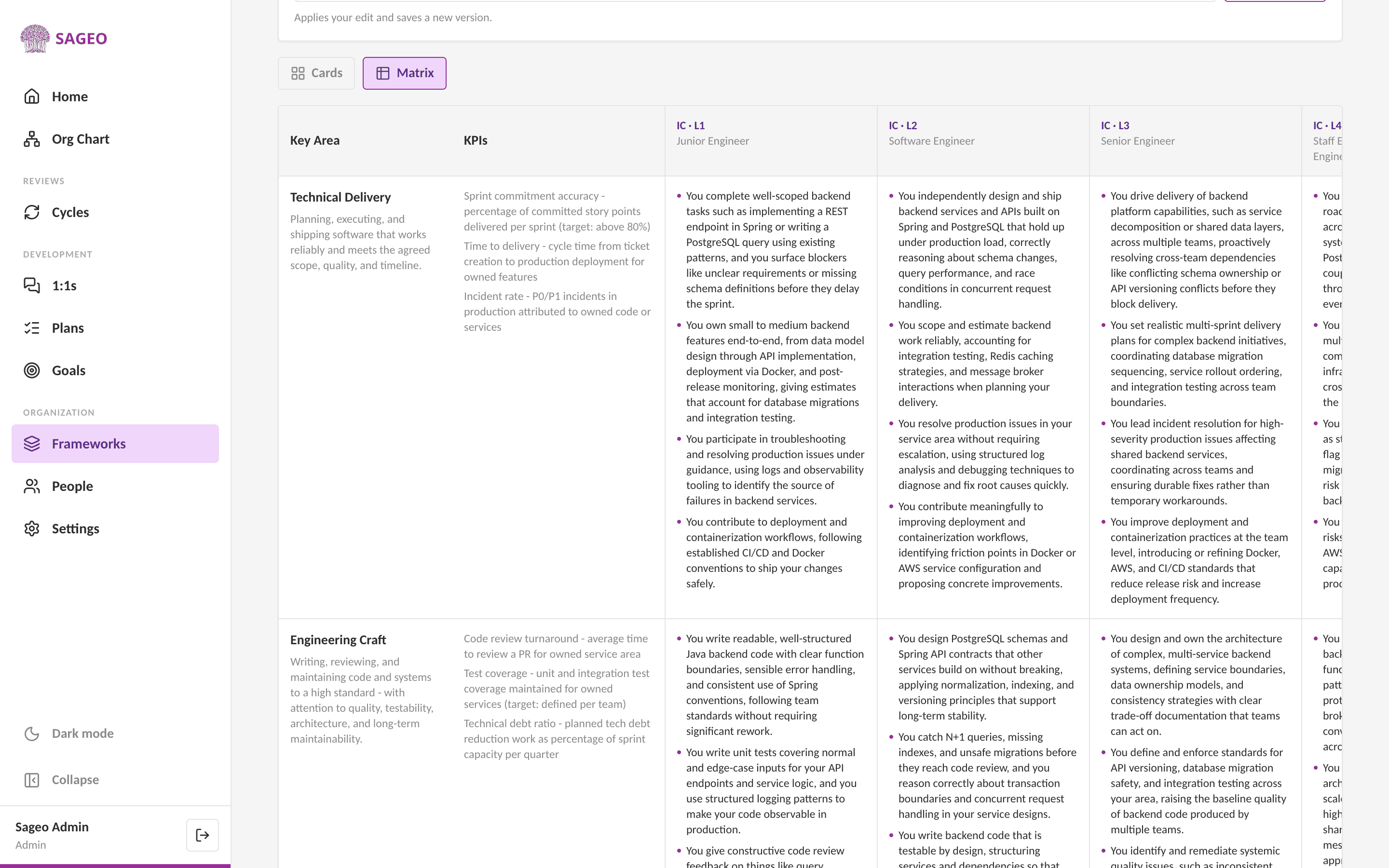
Sageo is a culture-first performance platform for companies of 10 to 1,000 people, built on the principle "The AI drafts. Your people decide." It starts where Lattice assumes you have already finished: it turns your company values into written, level-by-level competency frameworks, then runs reviews, calibration, 1:1s, and development plans on top of them.
Why choose it over Lattice. Lattice expects you to bring your own job architecture; Sageo generates it from your values in about an hour. Sageo includes every module for €6 per seat, roughly a third of a comparable Lattice setup with Grow and Compensation added, and there is no $4,000 floor. It is designed around the EU AI Act and pay transparency from day one, with names and identifiers stripped before any AI call.
- Category
- Performance specialist, framework-first
- Best fit
- 10 to 1,000 employees, especially without a written competency framework
- Pricing
- €6 per seat per month, every module, annual, 10-seat minimum. No floor. Free to start building.
- vs Lattice
- Builds the framework for you, one flat price, no annual minimum, EU-first privacy
Key features
AI competency framework generator
converts values and levels into IC and manager expectations, level by level.
Calibrated 360 reviews
self, manager, peer, and upward, with controlled peer nomination and an immutable audit log for every score change.
360 reports
managers and skip-levels get a live report across their whole line; every employee sees their blended result once calibration closes.
AI development plans
turn review gaps into multi-quarter plans linked to goals.
Monthly 1:1s, feedback and recognition tagged to values, and a live org chart
Private-by-design AI
names, emails, and identifiers are stripped before any LLM call and re-identified only inside your instance.
What users say
Praised
- Speed from values to a working framework.
- Flat, all-inclusive pricing with no floor or add-ons.
Watch out for
- No engagement surveys or compensation planning.
- Young product without a large review footprint yet.

See how Sageo actually works
An interactive walkthrough of frameworks, 360 reviews, calibration, and monthly 1:1s.
Explore the Walkthrough Leapsome
Leapsome, headquartered in Berlin, is an all-in-one "people enablement" platform that unifies a core HRIS with performance, engagement, learning, and compensation on a single Talent Graph. It is the closest European all-in-one to Lattice, and one of the highest-rated tools in the category at G2 4.8.
Why choose it over Lattice. Leapsome keeps a unified core HRIS, exactly the piece Lattice is discontinuing, and adds a native LMS that Lattice has never had. It is built for strict GDPR and works-council environments, with EU hosting in Germany. For European buyers who want one vendor across HR and performance, it consolidates more of the stack than Lattice's talent-only layer.
- Category
- All-in-one HCM, performance, and learning
- Best fit
- 50 to 2,000 employees, Europe-first
- Pricing
- Quote-based, roughly $7 to $20 per user; $199 per month minimum platform fee
- vs Lattice
- Keeps its HRIS, adds native LMS, GDPR and works-council tooling
Key features
Core HRIS
employee database, onboarding and offboarding, absence and time tracking, payroll prep (including German DATEV).
360 reviews with calibration grids, 9-box, competency frameworks, and probation reviews
OKRs and cascading goal trees with Jira sync; engagement pulse surveys with AI sentiment
Native LMS with developmental paths and career frameworks
Compensation tied to the Talent Graph; broad integrations (Workday, Personio, BambooHR, HiBob, Deel, Slack, Teams)
What users say
Praised
- Ease of use, cited over 1,300 times on G2; 9.5 out of 10 quality of support.
- Deep Slack and Teams embedding and strong automation, up to 40 percent admin time saved.
Watch out for
- Navigation friction retrieving historical record data.
- Basic course-authoring in the LMS, and restrictive export of raw review datasets.
 15Five
15Five is a continuous performance and manager-enablement platform built on positive-psychology weekly check-ins that feed 1:1 agendas and review cycles. It is strongest where the problem is manager habits and cadence rather than the framework.
Why choose it over Lattice. 15Five leans harder into weekly check-in rhythm and AI manager coaching than Lattice does, and its entry point is lower: engagement starts at $4 per seat. Its own comparison notes Lattice at $11 to $25 per seat with the $4,000 floor, against 15Five's $4 to $16 range.
- Category
- Manager enablement and continuous performance
- Best fit
- 51 to 1,000 employees, manager-capability focus
- Pricing
- Engage $4, Perform $11, Total Platform $16 per seat; annual contracts
- vs Lattice
- Weekly check-in cadence and AI manager coaching, lower entry price
Key features
Weekly check-ins (15 minutes for employees, 5 for managers) feeding 1:1 agendas
360 reviews, OKRs with parent-child weighting, and a Talent Matrix 9-box
Engage module
validated pulse surveys, eNPS, heatmaps, and an HR Outcomes Dashboard.
AMAYA AI review drafting and Kona AI coaching in Slack and Teams
High Fives peer recognition and compensation with Mercer benchmarking add-on
What users say
Praised
- Habit-forming weekly check-in rhythm and strong 1:1 tools.
- Board-ready HR Outcomes Dashboard and AMAYA review writing.
Watch out for
- Survey fatigue when questions stay static, and a rigid OKR module.
- Cost and mandatory annual contracts make it heavy for teams under 50.
 Culture Amp
Culture Amp is an enterprise employee-experience platform grounded in industrial-organizational psychology, with the largest benchmark dataset in the category (7,500-plus organisations, around 25 million employees). Engagement listening is its centre of gravity; performance and development sit alongside it.
Why choose it over Lattice. If workforce sentiment research and board-level people analytics are the reason you are shopping, Culture Amp goes far deeper than Lattice on survey science and external benchmarking. Note the trade: Lattice has the edge on native OKRs, 1:1 workflows, and integrated compensation, and Culture Amp carries a roughly $4,500 annual floor of its own.
- Category
- Engagement and people science
- Best fit
- 200 to 5,000+ employees prioritising analytics
- Pricing
- Quote-based, roughly $9 to $14 per employee; about $4,500 annual minimum
- vs Lattice
- Far deeper survey science and benchmarks; weaker on OKRs and comp
Key features
Engage
eNPS, pulse and lifecycle surveys, DEI heatmaps, and predictive flight-risk.
Perform
360s, in-product calibration, SMART goals, 1:1 agendas, and Shoutouts recognition.
Develop
competency frameworks, career pathing, and Skills Coach micro-learning in Slack and Teams.
Performance Culture Quadrant diagnostic and generative-AI comment summarisation
What users say
Praised
- People-science methodology and benchmark credibility; high survey completion.
- Skills Coach and AI comment summaries; roughly 2-month implementation.
Watch out for
- Poor ROI under 50 employees because of the floor.
- No native SCIM on standard packages, and limited reporting customisation.
 PerformYard
PerformYard is a flexible, highly customisable performance platform that adapts to any review methodology rather than prescribing one, and includes setup plus a dedicated success manager for every client, regardless of account size.
Why choose it over Lattice. Where Lattice has higher baseline pricing, the $4,000 minimum, and separate implementation fees, PerformYard offers transparent pricing, included setup, no floor of that kind, and more review-cycle and form flexibility. It is the strongest cost-conscious, flexibility-first alternative for SMB and mid-market teams.
- Category
- Flexible performance management
- Best fit
- 30 to 500+ employees moving off spreadsheets
- Pricing
- $5 to $15 per user, setup included; industry minimum around $5,000
- vs Lattice
- Transparent pricing, included implementation, more cycle flexibility
Key features
Any review methodology
annual, quarterly, continuous, 360, upward, project, 30-60-90, and PIPs, with custom forms and sign-off workflows.
Goal and OKR management cascading corporate to individual, plus 1:1 meetings
Continuous feedback, recognition, and 7-factor engagement surveys
Talent Development suite
compensation, competency and gap analysis, succession and 9-box.
AI Review Assist and quality coaches that flag recency, halo-horns, and vagueness
What users say
Praised
- Form and workflow flexibility; a clean spreadsheet replacement.
- Dedicated success manager and unlimited onboarding with no extra fees.
Watch out for
- Some config menus feel dated, and native reporting is basic.
- No dedicated native mobile app, and no self-serve free trial.
 Betterworks
Betterworks is an enterprise performance-enablement platform centred on OKR alignment for large, matrixed organisations, sitting as an execution layer on top of an HCM system.
Why choose it over Lattice. For complex enterprises that need multi-level cascading OKRs, deep ERP integration, and advanced governance, Betterworks scales further than Lattice, which is faster to deploy in the mid-market but less suited to multi-layered matrix structures. Its Anytime Calibration adds live DEI and bias warnings during calibration.
- Category
- Enterprise OKR and performance
- Best fit
- 500 to 1,000+ employees, matrixed and distributed
- Pricing
- Performance $8, plus Talent Intelligence $9 per user; about $4,000 floor
- vs Lattice
- Deeper cascading OKRs, live DEI calibration, enterprise security
Key features
Goals and OKRs
cascading, SMART, and hybrid, with AI-assisted goal writing and cross-team milestone visibility.
Conversations
1:1s with meeting-transcript parsing, auto-summaries, and rollover action items.
Anytime Calibration
9-box and bell-curve with real-time DEI and bias warnings.
Unified Talent Intelligence
skills inferred from work, IDPs, succession, and internal mobility.
Bidirectional Workday sync, plus BambooHR and SAP SuccessFactors
What users say
Praised
- Strategic objective transparency and flow-of-work access in Teams and Slack.
- AI feedback rephrasing and 1:1 summaries; roughly 2-month implementation.
Watch out for
- Native reporting lacks deep customisation, and review fatigue from frequent self-evaluations.
- Editing active review templates mid-cycle often needs vendor support.
 Engagedly
Engagedly is an AI-powered unified talent platform that combines performance, a learning experience platform, engagement, gamified recognition, and frontline enablement, driven by its Marissa AI assistant.
Why choose it over Lattice. Engagedly bundles things Lattice does not: a native LXP, native mentorship software, gamified recognition with points and badges, and deskless and frontline management, all at a mid-market-accessible price. It suits hybrid and frontline workforces in retail, healthcare, and logistics.
- Category
- Talent suite with LXP and gamification
- Best fit
- 50 to 5,000+ employees, including frontline
- Pricing
- Modules $2 to $5 per user; full suite about $9 per user on a ~$5,000 base
- vs Lattice
- Native LXP, mentorship, gamified recognition, frontline tools
Key features
Manage Performance
Goals 2.0 OKRs, 360, calibration, Talent Cards, IDPs, and check-ins.
Learn and Grow LXP
custom courses, compliance assignment, skill-gap mapping, and career paths.
Engage and Listen
team pulse, sentiment heatmaps, and a social feed.
Recognize and Reward
gamified praise wall, badges, points, and a rewards marketplace.
EngagedlyFX for frontline
shift check-ins, safety alerts, and micro-learning.
What users say
Praised
- A unified suite that eliminates point tools; up to 86 percent admin-time reduction.
- Marissa AI feedback drafting and strong support.
Watch out for
- A steep first-time admin learning curve with heavy configuration.
- Lightweight survey logic, and mobile apps that lack full feature parity.
 Workleap (Officevibe)
Workleap, formerly Officevibe, is a lightweight continuous-listening, recognition, and manager-enablement tool inside the broader Workleap employee-experience ecosystem. It measures 10 engagement drivers and is built for quick, low-admin deployment.
Why choose it over Lattice. Where Lattice unifies OKRs and appraisals at $10 to $15 per seat, Workleap is the accessible, rapid-deployment option at $5 to $6.25, focused on lightweight team engagement and light performance rather than full talent management. It is the right call when Lattice is simply more platform than you need.
- Category
- Engagement and pulse surveys
- Best fit
- 20 to 1,000 employees wanting low-admin listening
- Pricing
- Officevibe $5 to $6.25; bundle with Performance about $9 per user; Standard platform $4,999 per year
- vs Lattice
- Simpler, faster to deploy, and lower cost for engagement-first teams
Key features
Automated pulse surveys drawn from a 122-question bank, with 80 percent-plus participation
Two-way anonymous feedback chat with a mandatory 3-respondent anonymity threshold
Good Vibes peer recognition cards and shared 1:1 agendas with action tracking
Workleap AI for comment summarisation and manager coaching; adjacent org-chart, LMS, and onboarding modules
What users say
Praised
- Intuitive, low-friction short surveys in Slack and Teams.
- Two-way anonymous chat that unlocks candid feedback.
Watch out for
- Support latency of up to three business days.
- The anonymity threshold suppresses data in small teams, and the free tier is retired.
 HiBob (Bob)
HiBob's "Bob" is a modern all-in-one HCM: a complete system of record spanning core HR, global payroll, talent, and culture, built for mid-market, scaling, and multinational companies.
Why choose it over Lattice. This is the direct answer to Lattice's HRIS sunset. HiBob is a native system of record and does not require a third-party HRIS. Buyers who want one platform for payroll, records, and performance choose HiBob, whereas Lattice now sits on top of an HRIS you supply. HiBob's own performance depth is lighter than Lattice's specialist tooling, which is the trade.
- Category
- All-in-one HCM and HRIS
- Best fit
- 100 to 1,500 employees, high-growth and multinational
- Pricing
- Custom quote; roughly $6 to $15 core, $16 to $25 fully loaded per employee
- vs Lattice
- Native HRIS and payroll in one platform, which Lattice no longer offers
Key features
Bob Core
system of record, dynamic org charts, a no-code workflow engine, time and attendance, and time-off.
Talent
continuous and annual performance, 360s, 1:1s, compensation with pay-equity audits, and a native LMS.
Global Payroll Hub plus native localised payroll in some markets, and benefits administration
Workforce planning with headcount scenarios, and Bob AI via MCP for self-service and appraisal summaries
What users say
Praised
- Consumer-grade UI with low onboarding friction; 70 percent five-star on G2.
- Automated workflow triggers and strong integrations; consolidates point tools.
Watch out for
- Hard to build complex custom reports and clean exports.
- The API lacks some endpoints, and a few localised compliance gaps need workarounds.
 BambooHR
BambooHR is a purpose-built, easy-to-use core HRIS for small and mid-sized businesses: a unified system of record across the employment lifecycle, with performance as a lightweight add-on. It serves 34,000-plus customers, mostly in the US.
Why choose it over Lattice. Like HiBob, BambooHR answers the "we need an HRIS again" problem, tuned for US SMBs. It gives you core records, native US payroll, and basic performance in one platform, the opposite of Lattice's talent-only overlay. Its performance module is explicitly basic next to Lattice, so it is the pick when the system of record matters more than review depth.
- Category
- SMB core HRIS
- Best fit
- 25 to 500 US-based employees
- Pricing
- Core about $10, Pro about $17, Elite about $25 per employee; 5 to 10% implementation fee
- vs Lattice
- Integrated HRIS with native US payroll, plus basic performance
Key features
Core employee database and self-service portal, with document management and e-signatures
ATS and offer management, automated onboarding and offboarding checklists
PTO and time tracking with real-time accruals, plus native US payroll and benefits administration
Lightweight performance (check-ins, goals, self and manager assessments) and eNPS with sentiment
People Analytics with 49 standard reports and Bamboo AI natural-language querying
What users say
Praised
- Clean, intuitive UI with rapid adoption; 6,700-plus G2 reviews.
- Strong self-service portal and non-technical reporting.
Watch out for
- Performance and ATS modules lack the depth of dedicated tools like Lattice.
- Native payroll is US-only, and add-on fees stack up.
 Qualtrics EmployeeXM
Qualtrics EmployeeXM is an enterprise experience-management platform for continuous, multi-channel employee listening, with advanced statistical analytics, predictive attrition modelling, and the ability to correlate employee experience with customer experience. It is the largest, most complex, and most expensive tool in this set.
Why choose it over Lattice. Only when enterprise-scale data science is the actual requirement. Qualtrics wins where you need deep statistical power and EX-to-CX correlation. For most mid-market buyers, unified performance-and-engagement suites like Lattice embed pulse feedback directly into reviews and OKRs, consolidate the stack, and avoid Qualtrics's premium fees.
- Category
- Enterprise experience management
- Best fit
- Large global enterprises with dedicated HR analytics teams
- Pricing
- Non-public, enterprise-quoted, metered by interaction units
- vs Lattice
- Far deeper analytics; overkill and pricier for mid-market performance
Key features
Continuous multi-channel engagement and pulse surveys, and full employee-lifecycle management
360 development feedback with automated growth reports
Connected Experiences linking employee experience to customer and operational KPIs
XM AI for sentiment, emotion, and theme analysis, plus predictive flight-risk and a Flight Risk Simulator
What users say
Praised
- Best-in-class statistical power and robust global benchmarks.
- AI text summarisation that saves significant analyst time.
Watch out for
- Cost is the dominant criticism, a barrier for mid-market and small orgs.
- A steep learning curve and integration friction with smaller HRIS systems.
6. When should you just stay on Lattice?
Switching tools is expensive in time and change management, so it is worth being honest about when Lattice remains the right answer. Stay if most of these describe you.
- You are 100 to 5,000 employees, so the $4,000 floor is a rounding error rather than a barrier.
- You already own a mature competency framework and job architecture, so you do not need a tool to build one.
- You already run a dedicated HRIS you are happy with, and only want a talent layer on top of it.
- You want compensation planning, engagement, and performance from one established vendor with deep integrations, and the add-on pricing is acceptable at your scale.
- You value a large, proven review footprint and mature support over a lower price.
The short version
Stay on Lattice if you are a larger mid-market or enterprise team with a framework and an HRIS already in place. Look at Sageo if you want that performance depth without the floor, the add-on stacking, or a separate HRIS to maintain. Look at HiBob or BambooHR if you now need the HRIS itself, and at Leapsome for a full European suite with learning built in.
7. How this comparison was researched
Every Lattice and competitor figure in this comparison comes from vendor pricing pages, public procurement records, and review sites including G2 and Capterra, as of September 2026. Ratings are current vendor averages at the time of writing and change over time. Every Sageo claim comes from sageo.ai. Prices are shown per seat per month unless noted; several vendors quote only on request, in which case we use buyer-reported ranges. Sageo is priced in euros. Where a vendor's own materials cite a competitor's price, we defer to that competitor's official pricing.
Frequently asked questions
What is the best alternative to Lattice?
It depends on why you are leaving. For teams that want Lattice's performance depth without its $4,000 annual floor or add-on pricing, and that still need a competency framework built, Sageo fits best at EUR 6 per seat with every module included. If you now need the HRIS Lattice is sunsetting, HiBob or BambooHR give you records and payroll in one platform. Leapsome is the closest European all-in-one.
Why do companies leave Lattice?
The most common reasons are its strict $4,000 annual minimum contract (which makes it expensive for teams under about 30 people), add-on pricing that stacks Grow at +$4 and Compensation at +$6 on top of the base, complaints that cascading OKRs feel rigid, limited reporting customisation, and the fact that Lattice is sunsetting its native HRIS and payroll by mid-2026, forcing customers to run a separate system of record.
Is Lattice good for small teams?
Lattice is built for companies of roughly 100 to 5,000 employees. Its $4,000 annual minimum means a 20-person team pays an effective rate near $16.66 per seat rather than the $13 list price, so teams under about 30 people often find it cost-prohibitive. Alternatives with no floor, such as Sageo or PerformYard, are usually a better fit at that size.
Does Lattice have an HRIS?
Not for much longer. Lattice is sunsetting its native HRIS and payroll modules by mid-2026 and repositioning as a talent layer that sits on top of a separate system of record like Workday, BambooHR, or Rippling. If you want performance and an HRIS in one tool, look at HiBob, BambooHR, or Leapsome instead.
How much does Lattice cost compared with the alternatives?
Lattice runs $8 to $13 per seat per month with Grow (+$4) and Compensation (+$6) as add-ons, plus a $4,000 annual floor. By comparison, 15Five starts at $4, Workleap at about $5, PerformYard at $5 with setup included, and Sageo is a flat EUR 6 with every module and no floor. Culture Amp and Betterworks carry floors of their own around $4,000 to $4,500.
Product names and logos are trademarks of their respective owners, shown here for identification only and not as endorsements.
All comparisons