Comparison · September 2026
The Best Betterworks Alternatives for 2026
Eleven honest alternatives to Betterworks, compared on price, features, and fit: Sageo, Lattice, Profit.co, Mooncamp, 15Five, Leapsome, PerformYard, Culture Amp, Workday, SAP SuccessFactors, and Teamflect.
The verdict
- Best alternative that ties goals to a real framework
- Sageo, generates the competency framework from your values and runs reviews, calibration, goals and development for EUR 6 per seat, with no floor and no implementation project.
- Best dedicated OKR alternative at lower cost
- Profit.co or Mooncamp, deep cascading OKRs without the enterprise heaviness; Profit.co adds project portfolio management, Mooncamp leads on adoption UX.
- Best broad performance suite
- Lattice, mature performance, engagement and compensation, if you already own your framework and can clear its $4,000 floor.
Bottom line. Choose Sageo if you want performance and development grounded in a framework, at one flat price with no floor or implementation project. If deep cascading OKRs are the core need, Profit.co or Mooncamp at lower cost; for a broad suite, Lattice; and if you need the enterprise HCM system of record, Workday or SAP SuccessFactors.

Betterworks is a serious enterprise OKR and performance platform, built for complex, matrixed organisations, with deep cascading goals, live calibration, and bidirectional Workday and SAP sync. It is good at what it does. So teams rarely leave because it is weak. They leave because it is enterprise-heavy: a roughly $4,000 annual floor, one-time implementation and change-management fees on top of the per-seat price, reporting you often have to export to a spreadsheet, and review templates you cannot easily edit mid-cycle without a support ticket.
A note on who wrote this
Sageo publishes this comparison, and Sageo is one of the eleven products in it. One honest point up front: Betterworks is OKR-first at enterprise scale, and Sageo is framework-and-performance-first, so if deep cascading OKRs are your whole reason for buying, the dedicated OKR tools below may fit better, and we say so. Our rules: every Betterworks and competitor figure comes from vendor pricing pages, G2, Capterra, and public procurement data, as of September 2026; every Sageo claim comes from sageo.ai; and where another product is the better fit, we say so plainly. Section 6 is about when you should just stay on Betterworks.
1. Which Betterworks alternative should you choose?
The right alternative depends on why you are leaving Betterworks: the enterprise cost and implementation weight, a need for deeper or lighter OKRs, or a need for the HCM system of record underneath. Match the reason to the shortlist below.
Quick picks
| If you are leaving Betterworks because... | Look at | Why |
|---|---|---|
| The floor, implementation and change-management weight are too much, and you still lack a real competency framework | Sageo | Generates a level-by-level framework from your values, then runs 360s, calibration, 1:1s, goals and development plans. Every module for €6 per seat, no floor, no implementation project. |
| You want deep cascading OKRs without the enterprise heaviness | Profit.co, Mooncamp | Dedicated OKR platforms at lower total cost. Profit.co adds project portfolio management; Mooncamp leads on adoption-friendly UX. |
| You want a broad, mature performance suite with compensation | Lattice | Deep performance, goals, engagement and comp, if you already own your framework and can clear its $4,000 floor. |
| You want performance plus engagement at transparent prices | 15Five | Engagement from $4, weekly check-ins, reviews and AI coaching, with pricing you can see up front. |
| You want maximum review-cycle flexibility with setup included | PerformYard | Adapts to any review methodology, includes implementation and a success manager, no floor of Betterworks' kind. |
| You want one European suite with performance, HRIS and learning | Leapsome | All-in-one HCM with a native LMS, GDPR and works-council tooling. |
| You actually need the enterprise HCM system of record, not a layer on top | Workday, SAP SuccessFactors | Full global HCM suites with native performance. The heavy but complete route, if you run at that scale. |
| You live entirely inside Microsoft Teams and want it cheap | Teamflect | Teams-native performance and OKRs with a free tier up to 10 users; Microsoft 365 only. |
2. Why do teams look for a Betterworks alternative?
Five reasons come up again and again in reviews and buyer conversations. None mean Betterworks is a poor product. They mean it is built and priced for large, matrixed enterprises, and if that is not you, the fit gets heavy or expensive.
- Enterprise-heavy cost
- The roughly $4,000 annual minimum spend makes Betterworks unviable for small teams, and the real cost of ownership adds one-time implementation and professional-services fees on top of the $8 to $9 per-seat list rate. It is overkill for lighter mid-market needs.
- Reporting you export
- A common criticism is that native reports lack deep customisation, so administrators often export raw CSV data into external spreadsheets to do complex analysis.
- Workflow rigidity
- Editing an active review template or adjusting a process timeline mid-cycle can be cumbersome, and sometimes needs a vendor support ticket rather than a self-service change.
- Admin complexity
- Administrative settings and permissions menus can be hard to navigate, which means dedicated onboarding time for your HR operations team.
- It is a programme, not an install
- Betterworks itself frames adoption as an ongoing organisational-development programme. Long-term success depends heavily on change management and manager training, and an aggressive check-in cadence can create review fatigue.
The pattern. Betterworks fits complex mid-market companies of 500-plus and global enterprises of 1,000-plus with matrixed structures, deep OKR needs, and an HCM already in place. If you are smaller, want simpler OKRs, or do not have the appetite for an implementation project, the alternatives below tend to fit better.
3. How do you choose between them?
Three questions cut the field faster than a feature checklist.
Is your core need OKRs, or performance?
Betterworks leads with OKR alignment. If deep cascading OKRs at scale are the whole point, a dedicated OKR tool like Profit.co or Mooncamp will be sharper and cheaper. If what you really want is structured reviews, calibration, and development grounded in a competency framework, that is a different category, where Sageo, Lattice, or Leapsome fit better.
Do you need the HCM system of record?
Betterworks is a layer that sits on top of an HCM like Workday or SAP. If you actually need the system of record itself, employee data, payroll, global compliance, you are shopping for an HCM suite (Workday, SAP SuccessFactors), not a performance layer. If your HCM is settled, a focused specialist will be lighter.
What will it cost at your headcount, all in?
Watch for four things list prices hide: the annual floor, implementation and change-management fees, seat minimums, and support gated by tier. Betterworks, the enterprise HCMs, and several OKR tools all carry meaningful minimums. Sageo and PerformYard are the transparent, low-friction ends: Sageo is one flat €6 per seat with no floor and no implementation project, and PerformYard includes setup.
4. What do the Betterworks alternatives cost?
Entry pricing and minimums, from vendor pricing pages and buyer-reported data as of September 2026. Per seat per month unless noted. "Floor" is the minimum you pay regardless of headcount.
| Product | Category | Entry price | Minimum / floor | G2 |
|---|---|---|---|---|
| Betterworks | Enterprise OKR + performance | $8 to $9 | ~$4,000 / year + implementation | 4.4 to 4.7 |
| Sageo | Performance, framework-first | €6, all modules | None (10-seat min) | New |
| Lattice | Performance suite (no HRIS) | $8 to $13 | $4,000 / year | 4.6 |
| Profit.co | OKR + strategy + PPM | $7 to $9 ($0 trial) | ~$10,000 / year enterprise | 4.7 |
| Mooncamp | Dedicated OKR / strategy | €7 to €10 | 100-user Enterprise min | 4.8 |
| 15Five | Engagement + performance | $4 to $16 | Annual contract | 4.6 |
| Leapsome | All-in-one HCM + LMS | ~$7 to $20 | $199 / month platform fee | 4.8 |
| PerformYard | Flexible performance | $5 to $15, setup included | ~$5,000 industry min | 4.7 |
| Culture Amp | Engagement / people science | $9 to $14 | ~$4,500 / year | 4.5 |
| Workday HCM | Enterprise HCM suite | ~$7.50 to $11 (PEPY billed) | 1,000+ emp; 2.5x setup | 4.2 |
| SAP SuccessFactors | Global HCM (HXM) suite | $6.30 core; $28 to $38 full suite | 500 to 1,000 seats | 4.1 |
| Teamflect | Microsoft Teams-native | $7 (free to 10 users) | None | 4.5 |
5. Each Betterworks alternative in depth
Eleven products, each in the same format: what it is, why you would pick it over Betterworks, its core features, and what users praise and warn about. Sageo first, since we make it, then the rest in rough order of how often they come up as Betterworks replacements.
Sageo
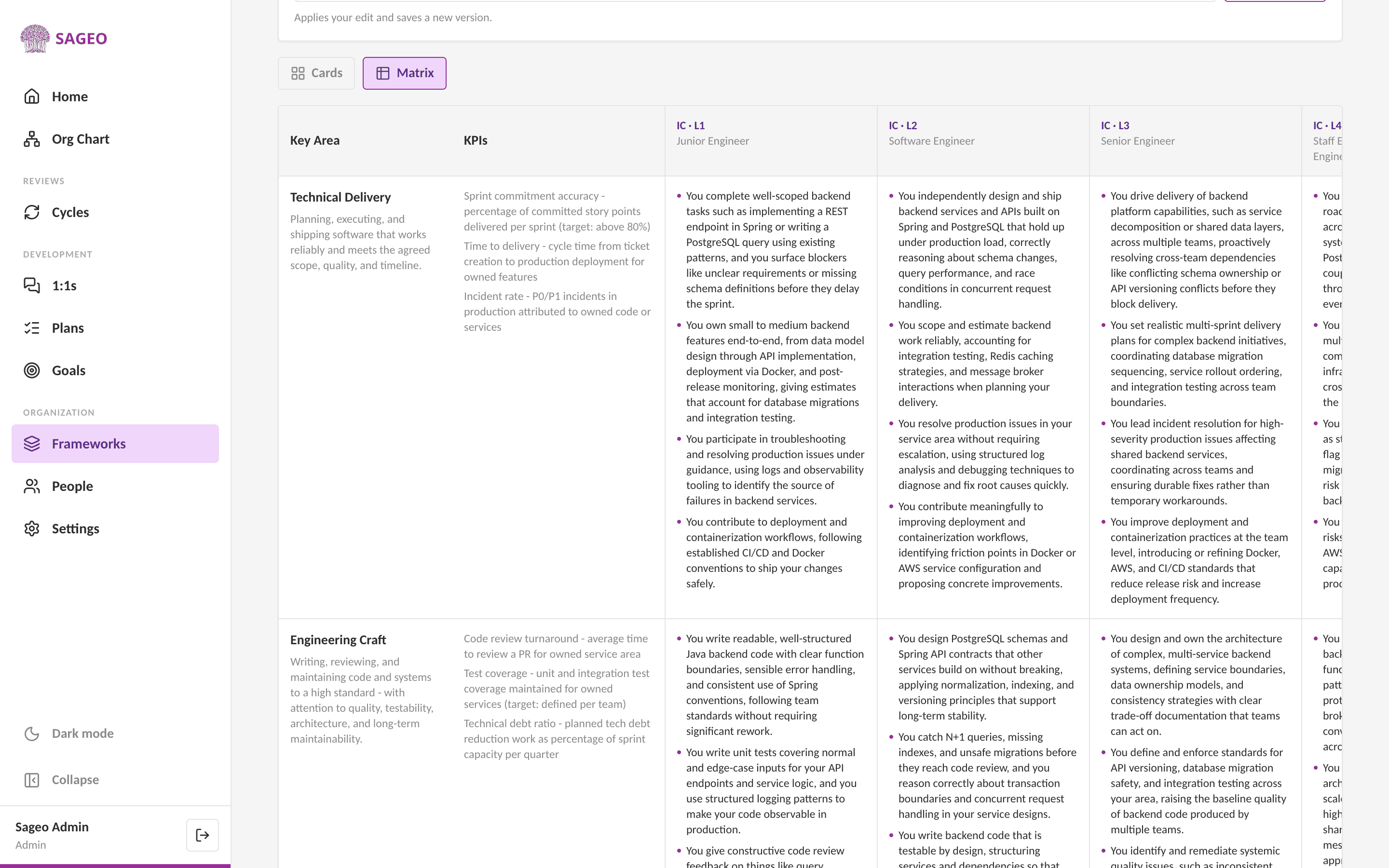
Sageo is a culture-first performance platform for companies of 10 to 1,000 people, built on the principle "The AI drafts. Your people decide." Where Betterworks starts with cascading OKRs, Sageo starts with structure: it turns your company values into written, level-by-level competency frameworks, then runs reviews, calibration, goals, 1:1s, and development plans against them.
Why choose it over Betterworks. Be clear on fit: Betterworks is OKR-first at enterprise scale, so if deep cascading OKRs are the whole job, a dedicated OKR tool below fits better. But if what you want is structured, calibrated performance and development, with goals tied to a framework, Sageo delivers it without the $4,000 floor, without an implementation and change-management project, and without exporting to spreadsheets to report. Every module is €6 per seat, and setup takes about an hour, not two months.
- Category
- Performance specialist, framework-first
- Best fit
- 10 to 1,000 employees, especially without a written competency framework
- Pricing
- €6 per seat per month, every module, annual, 10-seat minimum. No floor, no implementation fee. Free to start building.
- vs Betterworks
- Framework and calibrated performance without the floor, implementation, or change-management programme
Key features
AI competency framework generator
converts values and levels into IC and manager expectations, level by level.
Calibrated 360 reviews
self, manager, peer, and upward, with controlled peer nomination and an immutable audit log for every score change.
360 reports
managers and skip-levels get a live report across their whole line; every employee sees their blended result once calibration closes.
AI development plans and goals linked to the same framework used for reviews
Monthly 1:1s, feedback and recognition tagged to values, and a live org chart
Private-by-design AI
names, emails, and identifiers are stripped before any LLM call and re-identified only inside your instance.
What users say
Praised
- Speed from values to a working framework, in about an hour.
- Flat, all-inclusive pricing with no floor or implementation fee.
Watch out for
- Goals are tied to the framework, not a standalone enterprise OKR engine.
- Young product without a large review footprint yet.

See how Sageo actually works
An interactive walkthrough of frameworks, 360 reviews, calibration, and monthly 1:1s.
Explore the Walkthrough Lattice
Lattice is the best-known performance platform in the North American mid-market, used by more than 5,000 organisations. It combines reviews, goals, engagement, career development, and compensation, with an agentic AI assistant across modules.
Why choose it over Betterworks. Lattice is a broader, more balanced performance suite than Betterworks' OKR-centric platform, with stronger engagement and a mature compensation module, and it deploys faster in the mid-market. Betterworks scales further into large, matrixed enterprises; Lattice is the better fit if you want breadth without an enterprise implementation, though it carries a $4,000 floor and add-ons.
- Category
- Performance suite (no native HRIS)
- Best fit
- 100 to 5,000 employees, mid-market-leaning
- Pricing
- $8 to $13 per seat; Grow +$4, Compensation +$6; $4,000 annual floor
- vs Betterworks
- Broader, more balanced suite with faster mid-market deployment
Key features
Performance
AI review drafts, 360s, PIPs, 9-box talent reviews, succession, and calibration.
Goals and OKRs
cascading goal trees with Salesforce and Jira sync.
Engagement
pulse surveys, eNPS, and AI driver analysis.
Grow and Compensation
career tracks, IDPs, pay bands, and merit cycles as add-ons.
Deep integrations with Workday, BambooHR, Rippling, and an AI manager agent
What users say
Praised
- Modern, intuitive UI; 4.6 on G2 across 4,000-plus reviews.
- Centralised feedback and strong onboarding and support.
Watch out for
- The $4,000 floor and add-on stacking get expensive.
- No native HRIS, and reporting that often needs CSV exports.
 Profit.co
Profit.co is a strategy-execution and performance platform that unifies OKRs, Balanced Scorecard, Hoshin Kanri, project portfolio management, and 360 reviews. It straddles the line between a dedicated OKR tool and a performance suite, and it is Betterworks' most direct OKR rival.
Why choose it over Betterworks. Profit.co matches Betterworks on cascading OKRs and calibration but adds a broader modular footprint, including project portfolio management with earned-value tracking, often at a lower total cost of ownership. Its enterprise minimum of around $10,000 sits below Betterworks' enterprise heaviness, and its metric flexibility (7 key-result types, 300-plus KPI templates) is a genuine strength. It shares Betterworks' learning curve.
- Category
- OKR, strategy execution, and PPM
- Best fit
- 51 to 1,000+ employees needing flexible metrics and governance
- Pricing
- $7 to $9 per user (30-day free trial); enterprise minimum about $10,000 per year
- vs Betterworks
- Comparable OKRs plus PPM at lower total cost of ownership
Key features
OKR engine cascading across four levels, with 7 key-result types and 300-plus KPI templates
Native Balanced Scorecard and Hoshin Kanri X-Matrix, with visual alignment maps
Performance
configurable 360s, 9-box matrix, bell-curve calibration, and IDPs.
Project portfolio management with earned-value dashboards and phase-gate governance
Athena AI agents and a hosted MCP server for conversational OKR management in Claude and ChatGPT
What users say
Praised
- Metric flexibility and organisational visibility; 4.7 on G2 across 495-plus reviews.
- Strong customer support and onboarding; platform consolidation.
Watch out for
- A steep initial learning curve and conceptual friction between KRs, initiatives, and tasks.
- No native compensation planning; needs an HRIS integration for merit.
 Mooncamp
Mooncamp is a dedicated, enterprise-grade OKR and strategy-execution platform with a minimalist, Notion-inspired canvas UI built to drive high organisational adoption. It is European, GDPR-compliant, and ISO 27001-certified.
Why choose it over Betterworks. Mooncamp is the lightweight, adoption-first OKR alternative for teams that find Betterworks' full talent-intelligence and calibration stack to be overkill. It leads on customisable goal engines and multi-alignment (one key result can link to several parent objectives), with a clean UI that lowers the learning curve, all at a lower total cost than heavier incumbents.
- Category
- Dedicated OKR / strategy execution
- Best fit
- Scale-ups and enterprises, 50 to 500+, Europe-strong
- Pricing
- Essential €7, Professional €10 per user (min 5 users); Enterprise custom, 100-user minimum
- vs Betterworks
- Adoption-friendly UX and flexible goals without enterprise heaviness
Key features
Fully customisable goal engine
unlimited goal types, hierarchies, terminology, and required-field rules.
Multi-alignment and mathematical goal weighting across business units
A "Plans" staging sandbox for modelling future-cycle goal structures before deployment
Automated check-in cadences native to Microsoft Teams and Slack
Interactive Goal Tree strategy map, a Health Dashboard, and SCIM and SAML governance
What users say
Praised
- The highest satisfaction of the OKR tools reviewed, 4.8 on G2 across 290-plus reviews.
- Clean, Notion-style UI drives smooth non-technical adoption.
Watch out for
- Goal Tree and Health Dashboard are gated to higher tiers.
- Weak native task management, and a 100-user Enterprise minimum.
 15Five
15Five is a continuous performance and manager-enablement platform built on weekly check-ins, with OKRs and an engagement module alongside, at published, transparent prices.
Why choose it over Betterworks. 15Five is the lighter, manager-focused alternative for teams that find Betterworks over-configured. It runs OKRs and reviews with a weekly check-in rhythm, publishes its pricing ($4 Engage, $11 Perform, $16 Total), and deploys in one to two weeks rather than two months. It is less suited to deep enterprise OKR cascades, but far quicker to stand up.
- Category
- Engagement and continuous performance
- Best fit
- 51 to 1,000 employees, manager-capability focus
- Pricing
- Engage $4, Perform $11, Total Platform $16 per seat; annual
- vs Betterworks
- Lighter, transparent pricing and fast deployment; weaker on deep OKRs
Key features
Weekly check-ins feeding 1:1 agendas, plus 360 reviews and OKRs
Engage module
validated pulse surveys, eNPS, heatmaps, and an HR Outcomes Dashboard.
AMAYA AI review drafting and Kona AI coaching in Slack and Teams
High Fives peer recognition and compensation with Mercer benchmarking add-on
What users say
Praised
- Habit-forming weekly cadence and board-ready reporting.
- Transparent, public pricing and fast deployment.
Watch out for
- The OKR module is rigid next to a dedicated OKR tool.
- Add-ons and annual contracts make it heavy for teams under 50.
 Leapsome
Leapsome, headquartered in Berlin, is an all-in-one people-enablement platform that unifies a core HRIS with performance, engagement, learning, and compensation on a single Talent Graph. At G2 4.8 it is one of the highest-rated tools in the category.
Why choose it over Betterworks. If you want more than OKRs and performance, HRIS, learning, engagement, and compensation in one European suite, Leapsome consolidates far more of the stack than Betterworks' enablement layer. It is broader and better-liked on UX, though it is less specialised on deep enterprise OKR cascades and carries a $199 per month platform fee.
- Category
- All-in-one HCM, performance, and learning
- Best fit
- 50 to 2,000 employees, Europe-first
- Pricing
- Quote-based, roughly $7 to $20 per user; $199 per month minimum platform fee
- vs Betterworks
- Broader all-in-one suite with HRIS and LMS; less specialised OKRs
Key features
Core HRIS, plus 360 reviews with calibration grids, 9-box, and competency frameworks
OKRs and cascading goal trees; engagement pulse surveys with AI sentiment
Native LMS with developmental paths and career frameworks
Compensation tied to the Talent Graph; broad integrations (Workday, Personio, HiBob, Slack)
What users say
Praised
- Ease of use, cited over 1,300 times on G2; 9.5 out of 10 quality of support.
- Deep Slack and Teams embedding and strong automation.
Watch out for
- Navigation friction retrieving historical record data.
- A $199 platform-fee floor and opaque, module-by-module pricing.
 PerformYard
PerformYard is a flexible, highly customisable performance platform that adapts to any review methodology rather than prescribing one, and includes setup plus a dedicated success manager for every client.
Why choose it over Betterworks. Where Betterworks locks review workflows behind support tickets, PerformYard is built for self-service flexibility: any review methodology, custom forms, and mid-cycle changes you can make yourself, with setup and support included at every size and no enterprise floor. It is lighter on deep OKR cascades, but far simpler to run for review-led performance.
- Category
- Flexible performance management
- Best fit
- 30 to 500+ employees moving off spreadsheets
- Pricing
- $5 to $15 per user, setup included; industry minimum around $5,000
- vs Betterworks
- Self-service review flexibility and included setup, no enterprise floor
Key features
Any review methodology
annual, quarterly, continuous, 360, upward, project, and PIPs, with custom forms.
Goal and OKR management cascading corporate to individual, plus 1:1 meetings
Continuous feedback, recognition, and 7-factor engagement surveys
Talent Development suite
compensation, competency and gap analysis, succession and 9-box.
AI Review Assist and quality coaches that flag recency, halo-horns, and vagueness
What users say
Praised
- Form and workflow flexibility; a clean spreadsheet replacement.
- Dedicated success manager and unlimited onboarding with no extra fees.
Watch out for
- Some config menus feel dated, and native reporting is basic.
- No dedicated native mobile app, and no self-serve free trial.
 Culture Amp
Culture Amp is an enterprise employee-experience platform grounded in industrial-organizational psychology, with the largest benchmark dataset in the category. Engagement listening is its centre of gravity, with performance and development alongside.
Why choose it over Betterworks. If the value you want from Betterworks is really engagement and people analytics rather than OKR execution, Culture Amp goes far deeper on validated survey science and benchmarks. It is engagement-first rather than goal-first, so it is a poor swap if OKRs are your core need, and it carries a roughly $4,500 annual floor.
- Category
- Engagement and people science
- Best fit
- 200 to 5,000+ employees prioritising analytics
- Pricing
- Quote-based, roughly $9 to $14 per employee; about $4,500 annual minimum
- vs Betterworks
- Deeper engagement science and benchmarks; not an OKR tool
Key features
Engage
eNPS, pulse and lifecycle surveys, DEI heatmaps, and predictive flight-risk.
Perform
360s, in-product calibration, SMART goals, and Shoutouts recognition.
Develop
competency frameworks, career pathing, and Skills Coach micro-learning.
Performance Culture Quadrant diagnostic and generative-AI comment summarisation
What users say
Praised
- People-science methodology and benchmark credibility.
- Skills Coach and AI comment summaries.
Watch out for
- Poor ROI under 50 employees because of the floor.
- Not a goal-execution tool; limited reporting customisation.
 Workday HCM
Workday HCM is an enterprise, cloud-native Human Capital Management platform that unifies HR, talent, payroll, workforce planning, and analytics on a single data model. It is a Gartner Magic Quadrant Leader for cloud HCM suites, and performance is one module within it.
Why choose it over Betterworks. Betterworks is a layer that sits on top of Workday. If you would rather have performance native inside your system of record, with no external sync, Workday's own performance module is the single-suite route. The trade is well documented: higher UI friction, more process rigidity, and a 2.5x to 3x first-year implementation multiplier. It only makes sense if you already run Workday at enterprise scale.
- Category
- Enterprise HCM suite (system of record)
- Best fit
- 1,000+ employee global enterprises with dedicated HRIS teams
- Pricing
- Negotiated; roughly $90 to $130 per employee per year, plus 2.5x to 3x first-year implementation
- vs Betterworks
- Native performance in the system of record; heavier, rigid, costly
Key features
Core HR system of record on a single object-oriented data model, with global org hierarchies
Talent management
Skills Cloud ontology, career pathing, goals, reviews, and succession.
Continuous payroll engine (US and Canada native, 60-plus countries via partners) and advanced compensation
5,000-plus prebuilt reports, 175 dashboards, and drag-and-drop reporting for non-technical users
Workday Illuminate agentic AI, plus Peakon Employee Voice pulse surveys
What users say
Praised
- A single data architecture with strong data integrity and no middleware.
- Deep global compliance and native drag-and-drop reporting.
Watch out for
- Interface complexity overwhelms casual users and line managers.
- Cost and implementation multipliers, and structural rigidity after setup.
 SAP SuccessFactors
SAP SuccessFactors is a cloud Human Experience Management suite for global corporations and growing mid-market, built on Employee Central and deeply integrated with the SAP ecosystem, with the Joule AI assistant. Performance is one module within an end-to-end platform.
Why choose it over Betterworks. Like Workday, SuccessFactors is the maximal, globally-compliant HCM route, where Betterworks is a lighter layer on top. Choose it if you need deeply localised payroll and compliance across many countries and ideally already run SAP. The trade is a long implementation (average time-to-value around 21 months) and a steep configuration learning curve.
- Category
- Global HCM (HXM) suite
- Best fit
- Large multinationals across many regulatory environments, often on SAP
- Pricing
- Employee Central from $6.30 per employee; full suite $28 to $38; 500 to 1,000 seat minimums
- vs Betterworks
- Maximal global compliance and native performance; long, complex setup
Key features
Employee Central core HR plus multi-country payroll across 90 to 100-plus countries
Performance and Goals
continuous management, goal alignment, 360 reviews, and check-ins.
Compensation, Learning (LMS and LXP), and Succession with 9-box and talent pools
Opportunity Marketplace for skill-based internal mobility, and People Analytics
Joule AI across the suite, with human-in-the-loop enforced for high-stakes decisions
What users say
Praised
- Full-lifecycle data centralisation and deep talent and learning modules.
- Native SAP S/4HANA integration and global compliance.
Watch out for
- UI complexity, scattered admin menus, and a steep configuration curve.
- Heavy upfront implementation and a roughly 21-month time-to-value.
 Teamflect
Teamflect is a performance-management and engagement tool engineered to run natively inside Microsoft Teams and Outlook. It is an independent Microsoft Partner (not a Workday product, despite the occasional search confusion), and it packs nine modules into the Teams interface.
Why choose it over Betterworks. For a Microsoft-centric organisation that finds Betterworks over-configured and over-priced, Teamflect is the cheaper, lighter option: reviews, OKRs, 360s, and 1:1s inside Teams and Outlook, with a genuinely free tier up to 10 users. The catch is complete Microsoft lock-in, it cannot run standalone or with Slack or Google Workspace, and its OKR metrics are simpler than a dedicated tool.
- Category
- Microsoft Teams-native performance
- Best fit
- Mid-market organisations standardised on Microsoft 365
- Pricing
- Free up to 10 users; Essential $7, Professional $11 per user (annual)
- vs Betterworks
- Much cheaper and lighter inside Teams; Microsoft-only, simpler OKRs
Key features
Nine modules embedded in Teams and Outlook with Microsoft SSO and no separate portal
Configurable reviews and competency libraries mapped to job titles, plus 9-box grids
Hierarchical cascading OKRs with automated Teams check-in prompts
360 and continuous feedback, a 1:1 meeting sidebar, and recognition with badges and points
An AI HR agent trained on internal policy and performance data, plus HRIS sync via middleware
What users say
Praised
- Native Teams and Outlook workflow drives high adoption; 4.7 on Capterra.
- Microsoft SSO removes password friction; strong 1:1 meeting tools.
Watch out for
- Complete Microsoft ecosystem lock-in; no Slack or Google support.
- Limited OKR metric options and delayed Power BI data refresh.
6. When should you just stay on Betterworks?
Switching tools is expensive in time and change management, so it is worth being honest about when Betterworks remains the right answer. Stay if most of these describe you.
- You are a complex, matrixed enterprise of 500 to 1,000-plus employees where deep cascading OKR alignment is the primary need.
- You run Workday or SAP and value Betterworks' bidirectional sync feeding ratings, calibration, and skills back for compensation and succession.
- You want enterprise governance features like Anytime Calibration with live DEI and bias warnings.
- You have the HR operations capacity to run adoption as an ongoing change-management programme.
- The $4,000 floor and implementation cost are immaterial at your scale, and you already own a competency framework.
The short version
Stay on Betterworks if enterprise OKR alignment at scale is the point and you have the HCM and change-management capacity behind it. Look at Sageo if you want performance and development grounded in a framework, at one flat price with no floor or implementation project. If pure OKRs are the need, Profit.co or Mooncamp at lower cost; for a broad suite, Lattice; and if you need the HCM system of record itself, Workday or SAP SuccessFactors.
7. How this comparison was researched
Every Betterworks and competitor figure in this comparison comes from vendor pricing pages, public procurement records, and review sites including G2 and Capterra, as of September 2026. Ratings are current vendor averages at the time of writing and change over time. Every Sageo claim comes from sageo.ai. Prices are shown per seat per month unless noted; several vendors, including Betterworks, Workday, and SAP SuccessFactors, quote only on request, in which case we use buyer-reported ranges. Sageo is priced in euros. Where a vendor's own materials cite a competitor's price, we defer to that competitor's official pricing.
Frequently asked questions
What is the best alternative to Betterworks?
It depends on your core need. If deep cascading OKRs at scale are the point, dedicated OKR tools like Profit.co or Mooncamp are sharper and cheaper. If what you want is structured performance and development grounded in a competency framework, without an implementation project, Sageo fits best at a flat EUR 6 per seat. Lattice is the broad performance suite, and Workday or SAP SuccessFactors if you need the HCM system of record itself.
Why do companies leave Betterworks?
Betterworks is built for large, matrixed enterprises, so the common reasons are enterprise heaviness: a roughly $4,000 annual minimum plus one-time implementation and change-management fees on top of the $8 to $9 per-seat rate, native reporting that often needs CSV export, review templates that are hard to edit mid-cycle without a support ticket, admin menus that are hard to navigate, and adoption that depends on a sustained change-management programme.
Is Betterworks only for large enterprises?
Effectively, yes. Betterworks targets complex mid-market companies of 500-plus and global enterprises of 1,000-plus, and its roughly $4,000 annual floor plus implementation cost make it unviable for small teams. Smaller or lighter-touch teams tend to fit better on flat-priced or no-implementation alternatives such as Sageo, or dedicated OKR tools like Mooncamp and Profit.co.
Betterworks vs a dedicated OKR tool: which should I choose?
Betterworks bundles enterprise OKRs with talent intelligence, calibration, and HCM sync, which is powerful but heavy and expensive. If you only need the OKRs, a dedicated tool like Profit.co (which adds project portfolio management) or Mooncamp (which leads on adoption-friendly UX) delivers comparable goal alignment at a lower total cost of ownership. Choose Betterworks for the full enterprise talent stack, a dedicated OKR tool for focused goal execution.
How much does Betterworks cost?
Betterworks lists at $8 per user per month for its Performance tier and $9 for Performance plus Talent Intelligence, with Enterprise custom-quoted. There is a roughly $4,000 annual minimum spend, plus one-time implementation and professional-services fees, and large accounts negotiate about 17 percent off list. By comparison, Sageo is a flat EUR 6 per seat with every module, no floor, and no implementation fee.
Product names and logos are trademarks of their respective owners, shown here for identification only and not as endorsements.
All comparisons