Performance Metrics
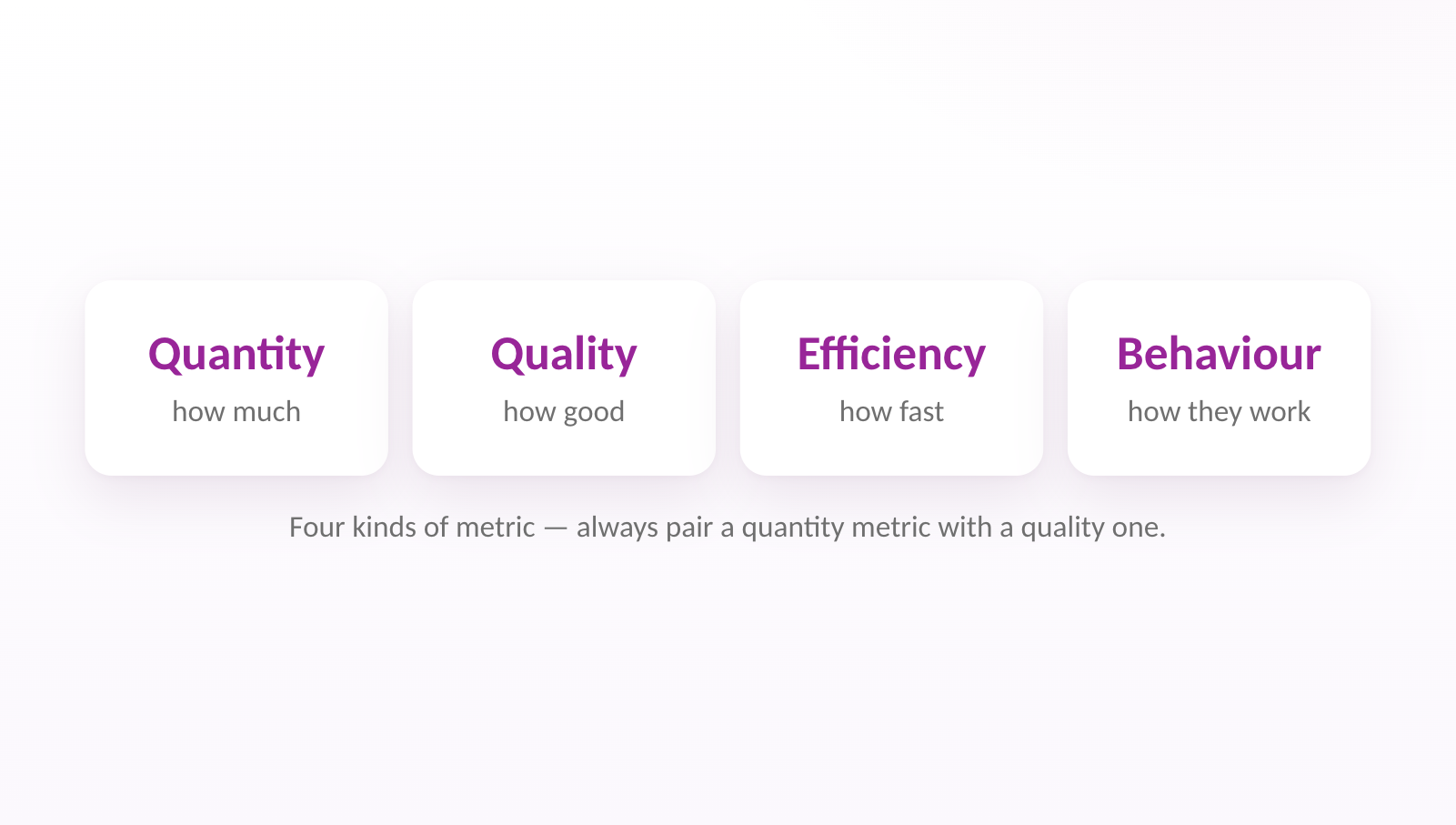
Performance metrics are the measures used to judge how well an employee, team, or organisation is doing against its goals. In people management, they usually cover four things: the quantity of work, its quality, its efficiency, and behaviours like collaboration. Good metrics are tied to goals, agreed upfront, and paired with context.
Also known as: performance measures, employee performance metrics, performance indicators
Reviewed
Key takeaways
- Performance metrics quantify how well someone or a team is doing.
- There are four kinds: quantity, quality, efficiency, and behaviour.
- Always pair a quantity metric with a quality one, or you optimise the wrong thing.
- Fewer, well-chosen metrics beat a long dashboard nobody acts on.
At a glance
- Four kinds
- Quantity, quality, efficiency, behaviour
- Rule
- Pair volume with a quality measure
- How many
- A handful per role, not dozens
- Related
- KPIs, OKRs, performance goals
Why do performance metrics matter?
Without metrics, reviews run on impressions, and impressions favour whoever is most visible. With the wrong metrics, people optimise for the number and lose sight of the outcome.
What are the types of performance metrics?
| Type | What it measures | Example |
|---|---|---|
| Quantity | Volume of output | Tickets resolved per week |
| Quality | Standard of output | Customer satisfaction score, defect rate |
| Efficiency | Output per unit of time or cost | Average handle time, cost per hire |
| Goal attainment | Progress on agreed goals | % of key results achieved |
| Behavioural | How the work gets done | 360 feedback ratings on collaboration |
Common mistakes
Measuring only what is easy to count. Using a single metric. Comparing roles that are not comparable. And changing metrics mid-cycle without telling people.
Worked example
A support team is measured only on tickets closed. Agents start closing tickets fast and reopening rates climb. Adding first-contact resolution and CSAT next to volume gives a balanced picture, and reopen rates fall.
Frequently asked questions
- Performance metrics vs KPIs?
- A KPI is a performance metric chosen as one of the few that matter most. All KPIs are metrics, not all metrics are KPIs.
- How many metrics per role?
- Three to five is usually enough. Mix at least one quality measure with any quantity measure.
- What are the four types of performance metrics?
- Quantity (how much), quality (how good), efficiency (how fast or cheap), and behaviour (how the work is done).
- What are examples of performance metrics?
- Deals closed (quantity), win rate (quality), cycle time (efficiency), and peer-rated collaboration (behaviour).
- What is the difference between a metric and a KPI?
- A KPI is a metric you have chosen as a key indicator of success. All KPIs are metrics; not every metric is a KPI.
- How do you avoid gaming performance metrics?
- Pair every volume metric with a quality metric, review them in context, and never tie a single number to high stakes without a counterbalance.
See it in practice
Compare performance management software
Related reading
Related terms