OKR (Objectives and Key Results)
OKR stands for objectives and key results. It is a goal-setting framework where an objective describes what you want to achieve in plain, ambitious language, and 3 to 5 key results describe how you will measure it. OKRs are usually set quarterly, shared openly across the company, and scored at the end of the cycle.
Also known as: okrs, objectives and key results, what are okrs, okr examples
Reviewed
Key takeaways
- An OKR pairs one qualitative Objective with about three measurable Key Results.
- Objectives say where you are going; key results prove you got there.
- Set them quarterly, keep them few, and score honestly (0.0 to 1.0).
- OKRs are for change and focus, not a list of everything you do.
At a glance
- Format
- 1 Objective + ~3 measurable Key Results
- Cadence
- Usually quarterly
- Scoring
- 0.0–1.0; ~0.7 is often a healthy stretch
- Related
- KPIs, SMART goals, performance goals
Why do OKRs matter?
OKRs turn strategy into something every team can see and act on. Because they are public, teams can spot overlap, dependencies, and gaps early. Intel popularised the method under Andy Grove, and John Doerr later introduced it to Google, which is why it spread through tech.
How do OKRs work?
- Objective: qualitative and directional. "Make onboarding something new hires rave about."
- Key results: numeric and time-bound. Each one is either hit or missed.
- Scoring: many teams score each key result from 0 to 1.0. On stretch OKRs, landing around 0.6 to 0.7 is often treated as a good result.
Worked example
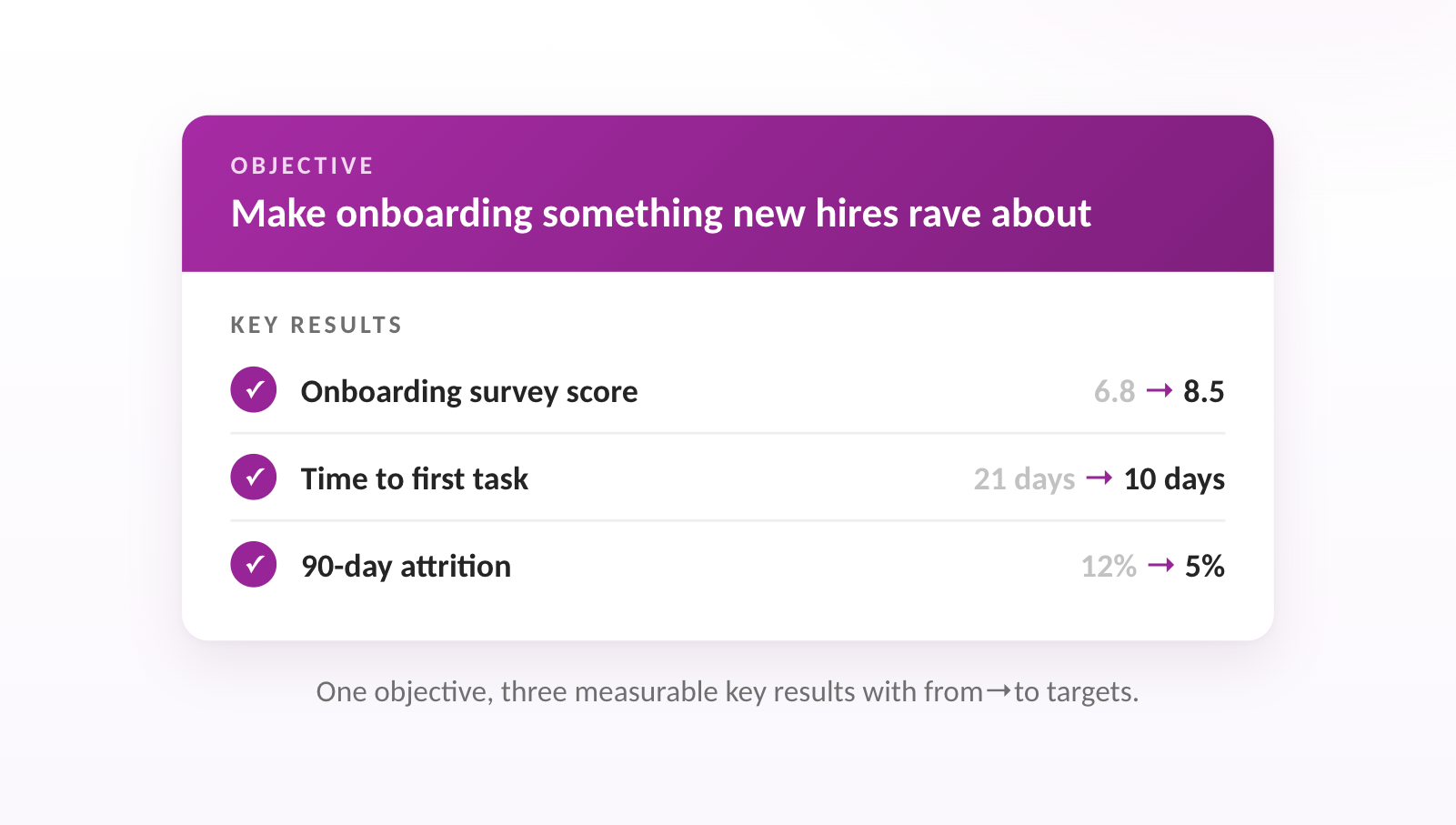
Objective: Make onboarding something new hires rave about.
KR1: Raise 30-day new hire survey score from 6.8 to 8.5.
KR2: Cut time to first shipped task from 21 days to 10.
KR3: Reduce 90-day attrition from 12% to 5%.
Frequently asked questions
- What is the difference between OKRs and KPIs?
- KPIs track the ongoing health of the business. OKRs drive a specific change in a set period. A KPI that slips can become the focus of an OKR.
- How many OKRs should a team have?
- Usually 1 to 3 objectives per quarter, each with 3 to 5 key results. More than that and focus disappears.
- What is an example of an OKR?
- Objective: make onboarding something new hires rave about. Key results: raise the onboarding score from 6.8 to 8.5, cut time-to-first-task from 21 to 10 days, reduce 90-day attrition from 12% to 5%.
- Who invented OKRs?
- The approach grew out of Andy Grove's management at Intel and was popularised at Google by John Doerr, who wrote about it in Measure What Matters.
- Should OKRs be tied to pay?
- Most practitioners keep OKRs separate from compensation, so teams set ambitious targets without sandbagging to protect a bonus.
- What is a good OKR score?
- On a 0.0 to 1.0 scale, around 0.7 often signals a healthy stretch. Consistently hitting 1.0 can mean the targets were too easy.
Sources
- John Doerr, Measure What Matters (2018)
- Andy Grove, High Output Management (1983)
See it in practice
Compare OKR and goal-setting software
Related reading
Related terms