KPI (Key Performance Indicator)
KPI stands for key performance indicator. It is a measurable value that shows how well a person, team, or company is performing against its most important ongoing objectives. "Key" is the important word: out of everything you could measure, KPIs are the handful that tell you whether the business is healthy.
Also known as: key performance indicator, kpis, performance indicator
Reviewed
Key takeaways
- A KPI is a metric chosen as a key indicator of ongoing success.
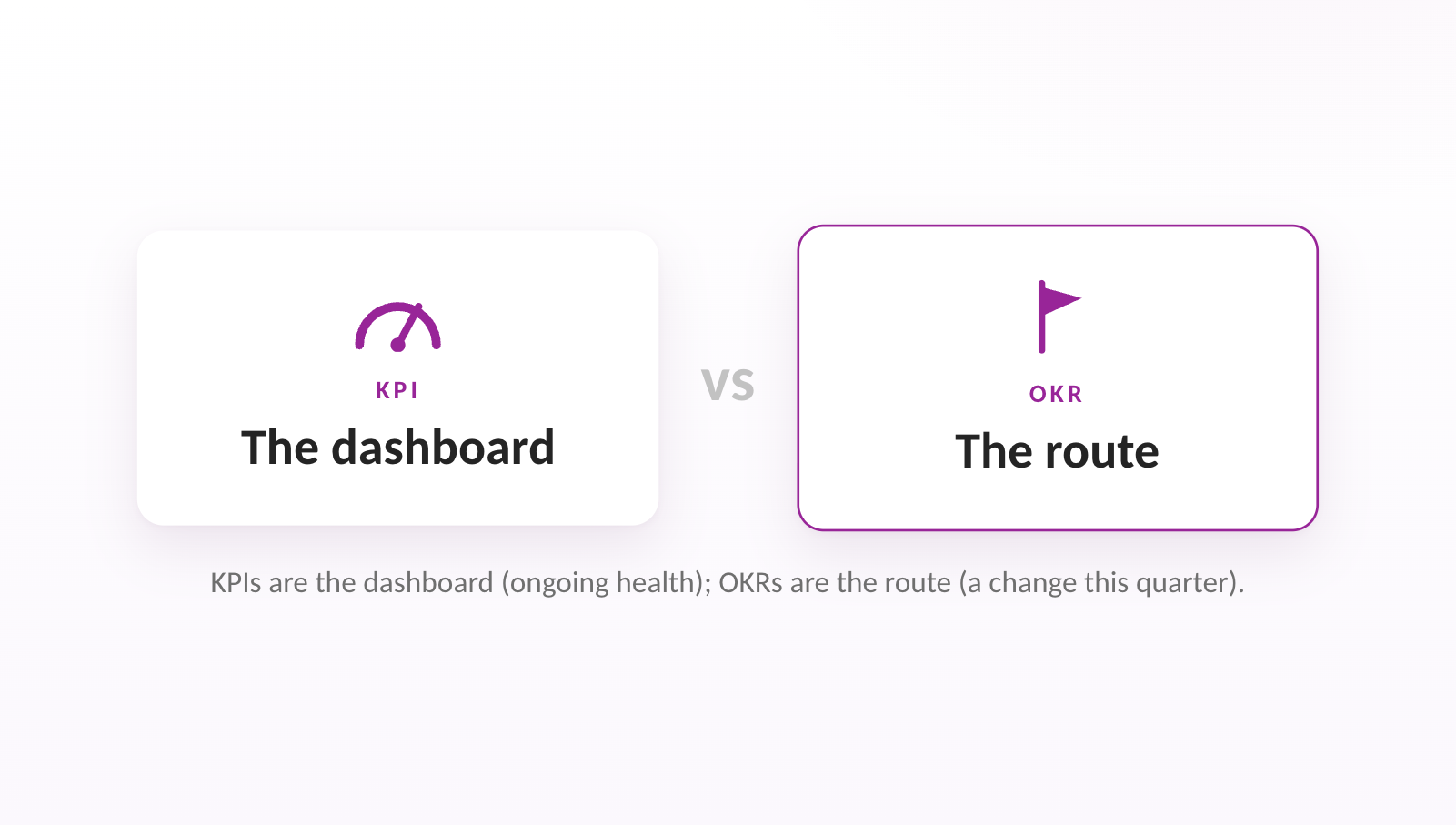
- KPIs are the dashboard (health you watch); OKRs are the route (change you drive).
- Good KPIs are specific, measurable, owned, and reviewed on a regular cadence.
- Track a handful that matter, not every number you can collect.
At a glance
- What it is
- A metric chosen as a key success signal
- KPI vs OKR
- Dashboard (health) vs route (change)
- Cadence
- Reviewed weekly, monthly, or quarterly
- Related
- OKRs, performance metrics
Why do KPIs matter?
KPIs keep teams focused on a few numbers that matter instead of dozens that do not. When a KPI moves the wrong way, it tells you where to look before the problem shows up in revenue.
Examples by team
| Team | KPI |
|---|---|
| Sales | Monthly new revenue, win rate |
| Customer success | Net revenue retention, churn rate |
| Support | First response time, CSAT |
| HR | Attrition rate, time to hire, eNPS |
| Engineering | Deployment frequency, change failure rate |
KPI vs OKR
KPIs measure ongoing health, like a car's dashboard. OKRs are for driving a specific change in a set period, like a route to a new destination. When a KPI slips, it often becomes the target of an OKR.
Worked example
An HR team tracks three KPIs: attrition rate, time to hire, and eNPS. Attrition jumps from 9% to 14% over two quarters. The team sets an OKR for Q3: "Make our first 90 days the best part of joining", with key results tied to onboarding and 90-day retention.
Frequently asked questions
- How many KPIs should a team have?
- Usually three to five. More than that and none of them are really "key".
- What makes a good KPI?
- It is measurable, tied to a clear objective, owned by someone, and reviewed on a regular rhythm.
- What is the difference between a KPI and an OKR?
- A KPI tracks the ongoing health of something; an OKR drives a specific change over a set period. KPIs are the dashboard, OKRs are the route.
- What is an example of a KPI?
- Monthly recurring revenue, customer churn rate, average resolution time, or 90-day new-hire retention.
- What is a leading vs lagging KPI?
- A lagging KPI measures a result (revenue); a leading KPI measures an early driver of it (qualified pipeline). Good dashboards use both.
- How do you choose the right KPIs?
- Pick a few that map directly to the outcome you care about, can be measured reliably, and have a clear owner. Drop vanity metrics.
See it in practice
Compare OKR and goal-setting software
Related reading
Related terms