9-Box Grid
The 9-box grid is a talent review tool that plots employees on two axes: current performance and future potential, each rated low, medium, or high. That creates a 3x3 grid of nine boxes. Leaders use it to decide who to develop, promote, retain, or support, and to build succession plans. It is adapted from the GE-McKinsey matrix used in business strategy.
Also known as: nine box grid, 9 box talent grid, 9 box matrix, talent review grid
Reviewed
Key takeaways
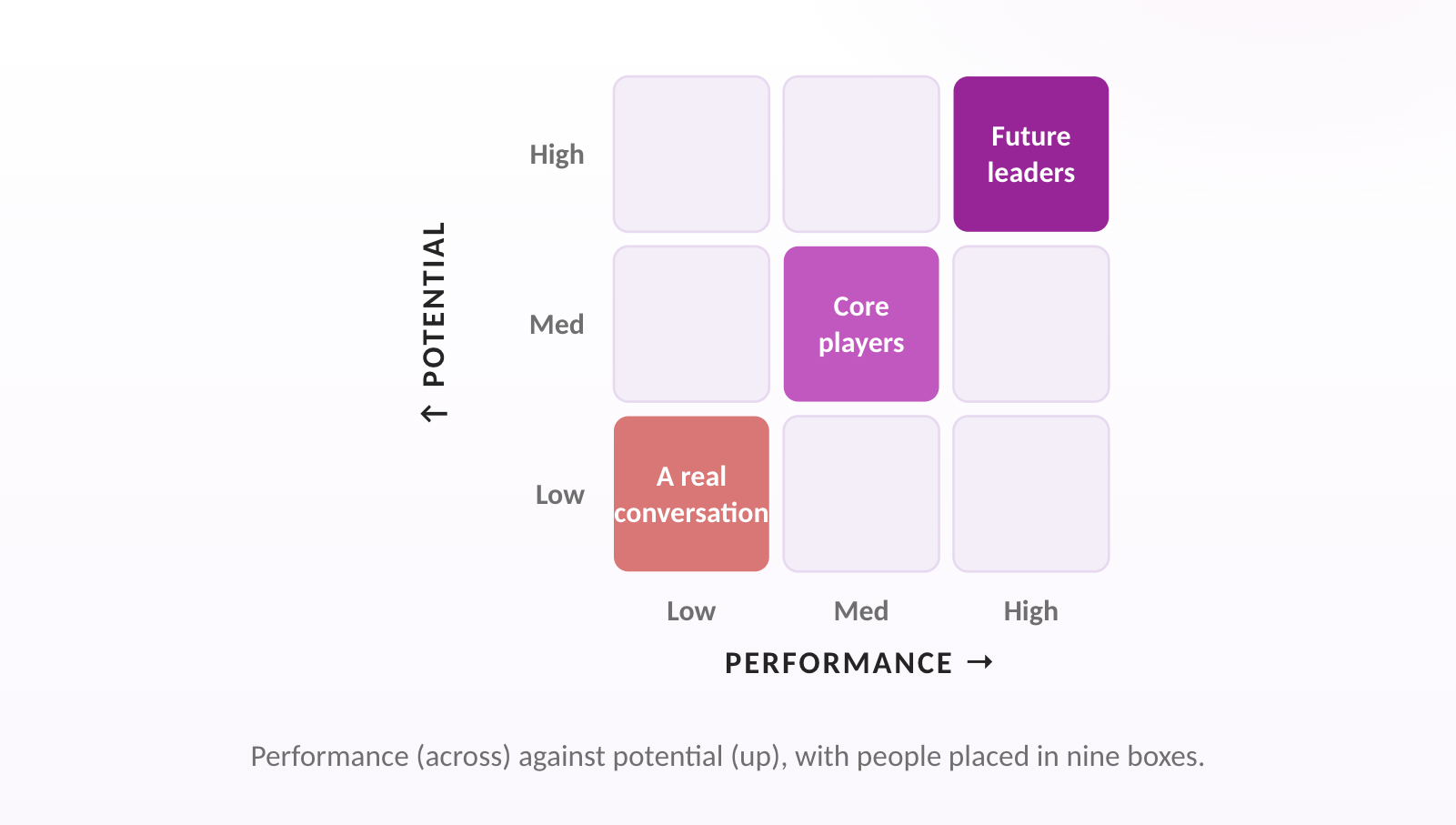
- The 9-box grid plots people on performance (across) and potential (up).
- It creates nine boxes used to plan development, promotions, and succession.
- It is a conversation tool for calibration, not a permanent label.
- Potential is the hard axis; define it clearly before you place anyone.
At a glance
- Axes
- Performance (across) × potential (up)
- Output
- Nine talent segments
- Used for
- Development, succession, calibration
- Origin
- Adapted from the GE-McKinsey matrix
Free template
9-box grid template
Place each person by performance (across) and potential (up). Use it to plan development and spot successors, not to label people permanently.
Why does the 9-box grid matter?
Performance ratings only look backward. The 9-box adds a forward-looking question: who can grow into bigger roles? It also forces leaders to talk about people side by side, which surfaces bias and gaps in succession.
The boxes (performance across, potential up)
| Low performance | Medium performance | High performance | |
|---|---|---|---|
| High potential | Rough diamond | Growth employee | Future leader / star |
| Medium potential | Inconsistent player | Core player | High performer |
| Low potential | Risk | Effective contributor | Trusted professional |
Labels vary by company. The positions are what matter.
How do you use the 9-box grid fairly?
Define "potential" in writing before the session (for example: learning agility, aspiration, and capacity for broader scope). Use evidence, not gut feel. Calibrate across managers. And keep the placement private: it is a planning tool, not a label.
Worked example
In a calibration session, a manager places an engineer in "high performance, low potential". Peers point out she led two cross-team projects last year. With that evidence, the group moves her to "high potential" and puts her on the tech lead succession list.
Frequently asked questions
- Should employees see their 9-box placement?
- Most companies keep it internal and share the development actions instead.
- How is potential measured?
- There is no single test. Define criteria upfront and rate against them with examples.
- What do the nine boxes mean?
- Each box combines a performance level and a potential level, from “underperformer” (low/low) to “star” (high/high), guiding different development and retention actions.
- How do you use a 9-box grid fairly?
- Define performance and potential in advance, calibrate placements across managers with evidence, and treat the grid as a development plan, not a verdict.
- What is the difference between performance and potential?
- Performance is results in the current role; potential is the likelihood of succeeding in a bigger or different role. They do not always move together.
- Where did the 9-box grid come from?
- It is adapted from the GE-McKinsey matrix used in business-portfolio strategy, repurposed for talent review.
Sources
- Adapted from the GE-McKinsey nine-box matrix
See it in practice
Compare performance management software
Related reading
Related terms