Bell Curve (in Performance Appraisal)
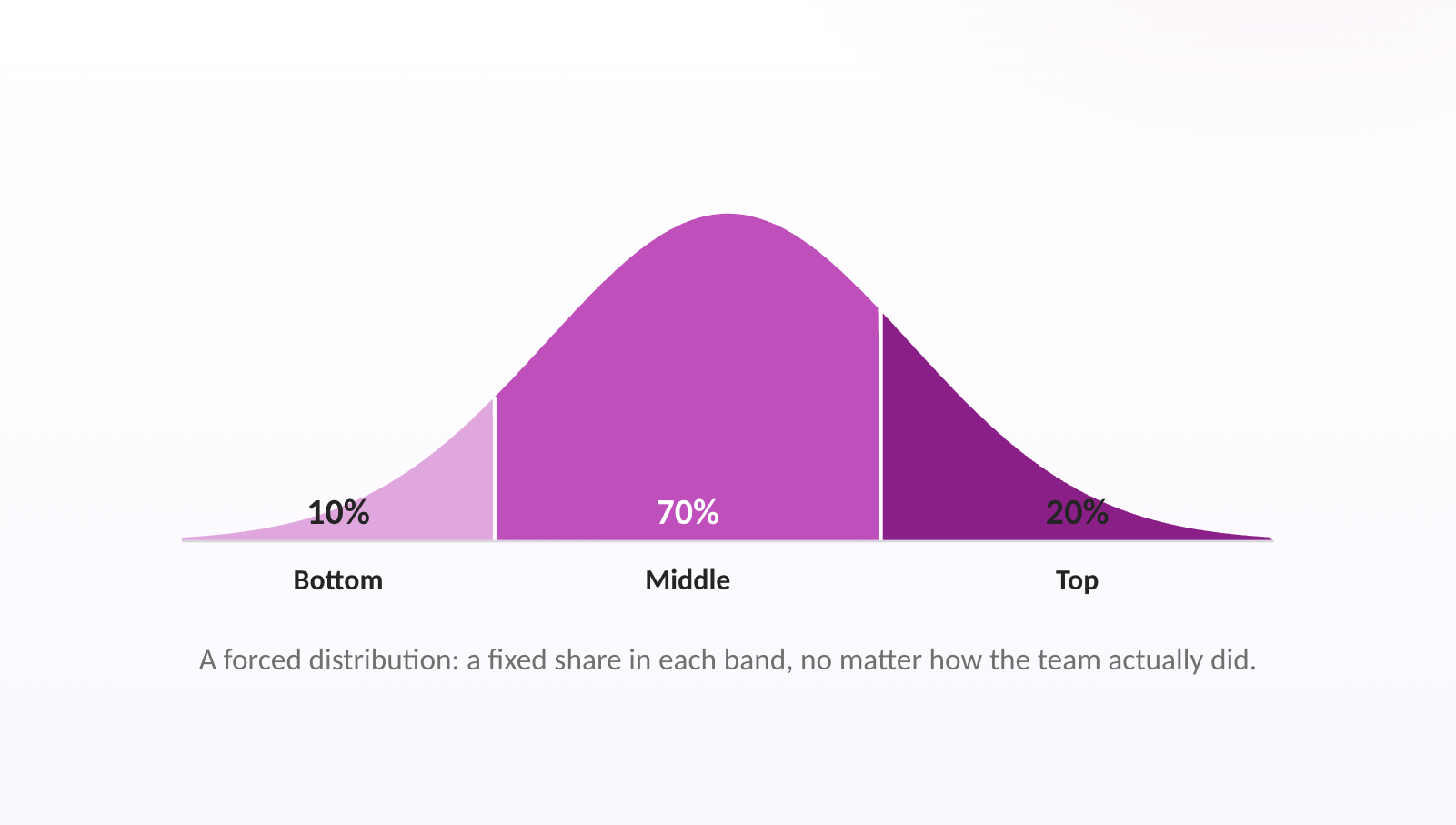
The bell curve, also called forced distribution or stack ranking, is a performance appraisal method that sorts employees into fixed rating buckets. A small share are rated top performers, most land in the middle, and a small share are rated low. A common split is 20% high, 70% average, and 10% low, regardless of how the team actually performed.
Also known as: forced distribution, forced ranking, stack ranking, bell curve appraisal
Reviewed
Key takeaways
- The bell curve forces performance ratings into a fixed distribution (for example 10/70/20).
- It assumes most people are average and only a few are top or bottom, regardless of actual results.
- It can create fairness and morale problems by capping how many can be rated highly.
- Most large tech firms have moved away from it toward continuous, calibrated reviews.
At a glance
- Typical split
- ~10% low / 70% middle / 20% top (varies)
- Also called
- Forced distribution, stack ranking
- Popularised by
- GE under Jack Welch (“rank and yank”)
- Modern alternative
- Continuous feedback + calibration
Why does the bell curve matter?
The bell curve was built to stop rating inflation, where every manager rates every person "exceeds expectations". It does that. It also forces managers to label someone as low even in a team of strong performers, which can damage trust and collaboration. Many large companies have moved away from it, but plenty still use it, especially for bonus and increment budgets.
How does the bell curve work?
- Managers rate everyone as usual.
- HR or a calibration panel maps the ratings onto the fixed curve.
- Ratings get adjusted up or down until each bucket matches its quota.
- Pay and promotion budgets follow the final buckets.
Worked example
A department of 50 people on a 20-70-10 curve must place 10 people in the top bucket, 35 in the middle, and 5 in the bottom. If 15 people genuinely exceeded their goals, 5 of them get moved down to "meets expectations" to fit the quota.
Frequently asked questions
- Why is it called a bell curve?
- Plot the ratings and you get a bell shape: a tall middle and thin tails, like a normal distribution.
- What replaces the bell curve?
- Common alternatives are absolute ratings against goals, calibration without fixed quotas, and continuous feedback with fewer formal ratings.
- What is forced distribution?
- A system that requires managers to slot a set percentage of their team into each rating band, whether or not the team's actual performance fits that shape.
- What are the disadvantages of the bell curve?
- It can force artificial ratings, pit colleagues against each other, punish strong teams where everyone performs, and damage trust and collaboration.
- Why did companies like GE and Microsoft drop it?
- They found forced ranking hurt teamwork and engagement and rarely improved performance, so they shifted to more frequent feedback and calibrated, evidence-based reviews.
- Is the bell curve ever appropriate?
- Occasionally as a calibration sanity-check across very large populations, but as a hard rule applied to small teams it usually does more harm than good.
Sources
- Jack Welch, GE vitality curve (“rank and yank”)
See it in practice
Compare performance management software
Related reading
Related terms