Talent Review
A talent review is a structured meeting in which leaders discuss employees' performance, potential, and readiness for bigger roles. It is used to plan development, identify successors for key positions, spot retention risks, and make sure promotion decisions are consistent across teams. Many companies use the 9-box grid as the framework for the discussion.
Also known as: talent review process, calibration meeting, talent calibration, succession planning
Reviewed
Key takeaways
- A talent review is a meeting where leaders assess people's performance, potential, and readiness.
- It plans development, identifies successors, spots retention risks, and calibrates across teams.
- Many use the 9-box grid as the framework for the discussion.
- Performance reviews look back at one person; talent reviews look ahead across the team.
At a glance
- What it is
- Leaders calibrate performance & potential
- Output
- Development plans, successors, retention risks
- Framework
- Often the 9-box grid
- Cadence
- Once or twice a year
Why do talent reviews matter?
Without talent reviews, high-potential people in quiet teams get overlooked, succession gaps stay hidden, and each manager uses a different standard. A good review turns individual opinions into a shared, calibrated view.
The process
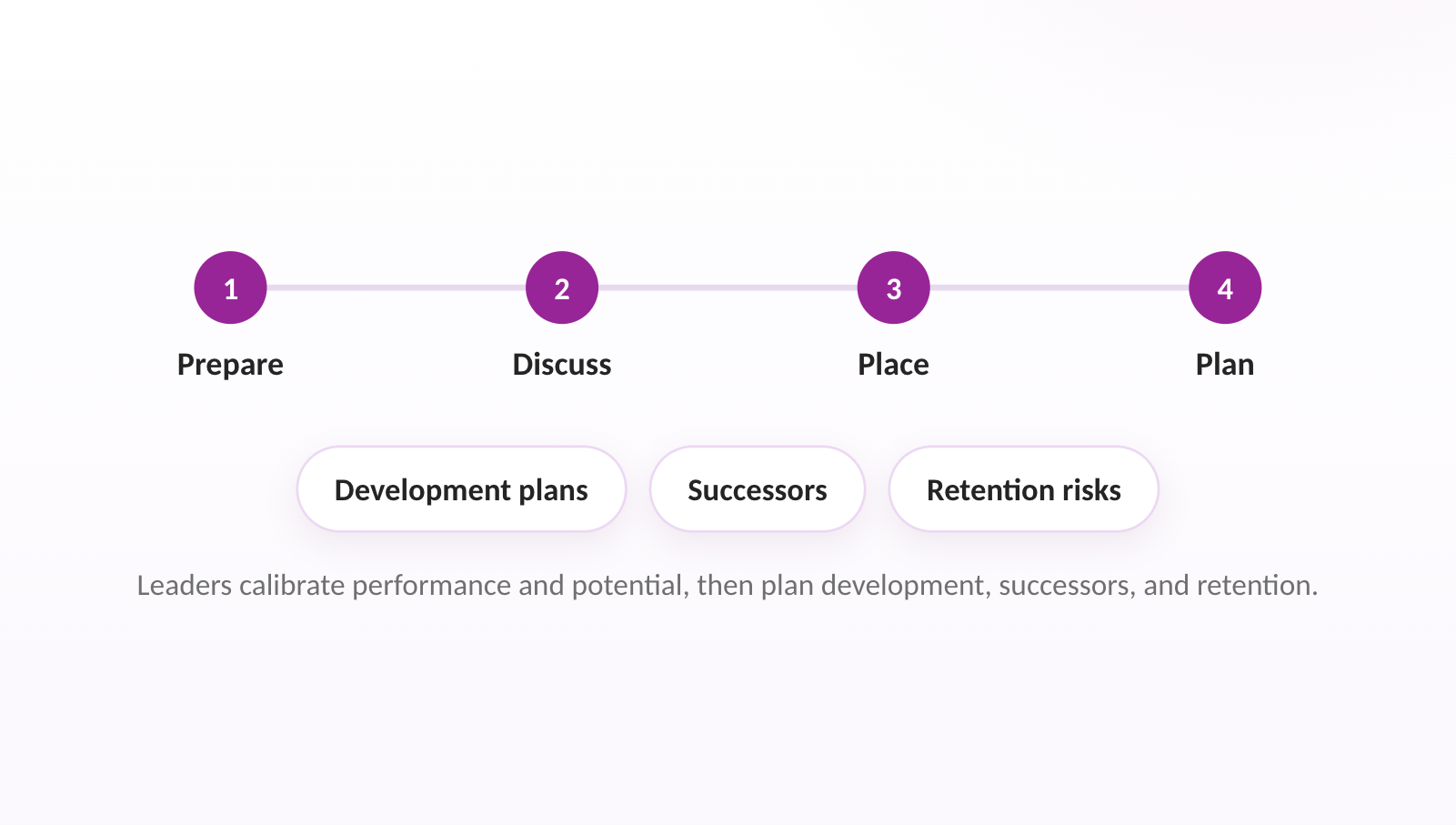
- Prepare: managers submit ratings for performance and potential, with evidence.
- Discuss: leaders review each person, challenge ratings, and calibrate across teams.
- Place: people are mapped on the 9-box grid or a similar framework.
- Plan: agree development actions, successors, and retention risks.
- Follow through: managers share development plans and track them.
Sample agenda (90 minutes)
10 min: purpose and definitions of "potential". 60 min: team-by-team discussion. 15 min: succession gaps for critical roles. 5 min: owners and next steps.
Worked example
In a quarterly talent review, two directors realise they have no ready successor for the head of customer success. They identify a senior CSM rated high performance and high potential, give her a cross-functional project and a mentor, and set a 12-month readiness goal.
Frequently asked questions
- Talent review vs performance review?
- A performance review is between a manager and one employee, looking back. A talent review is between leaders, looking at the whole team and ahead.
- How often should talent reviews happen?
- Once or twice a year for most companies, and before major restructures or promotion cycles.
- What is the talent review process?
- Managers submit ratings with evidence, leaders discuss and calibrate across teams, people are placed (often on a 9-box grid), and development and succession actions are agreed and tracked.
- What is the difference between a talent review and a performance review?
- A performance review is between a manager and one employee, looking back. A talent review is between leaders, looking at the whole team and ahead.
- Who should attend a talent review?
- The leaders of the teams in scope, usually facilitated by HR, so ratings can be challenged and calibrated to a shared standard.
- How do you prepare for a talent review?
- Managers bring performance and potential ratings with evidence, note flight risks and successors, and agree how “potential” is defined before placing anyone.
See it in practice
Compare performance review software
Related reading
Related terms