Span of Control
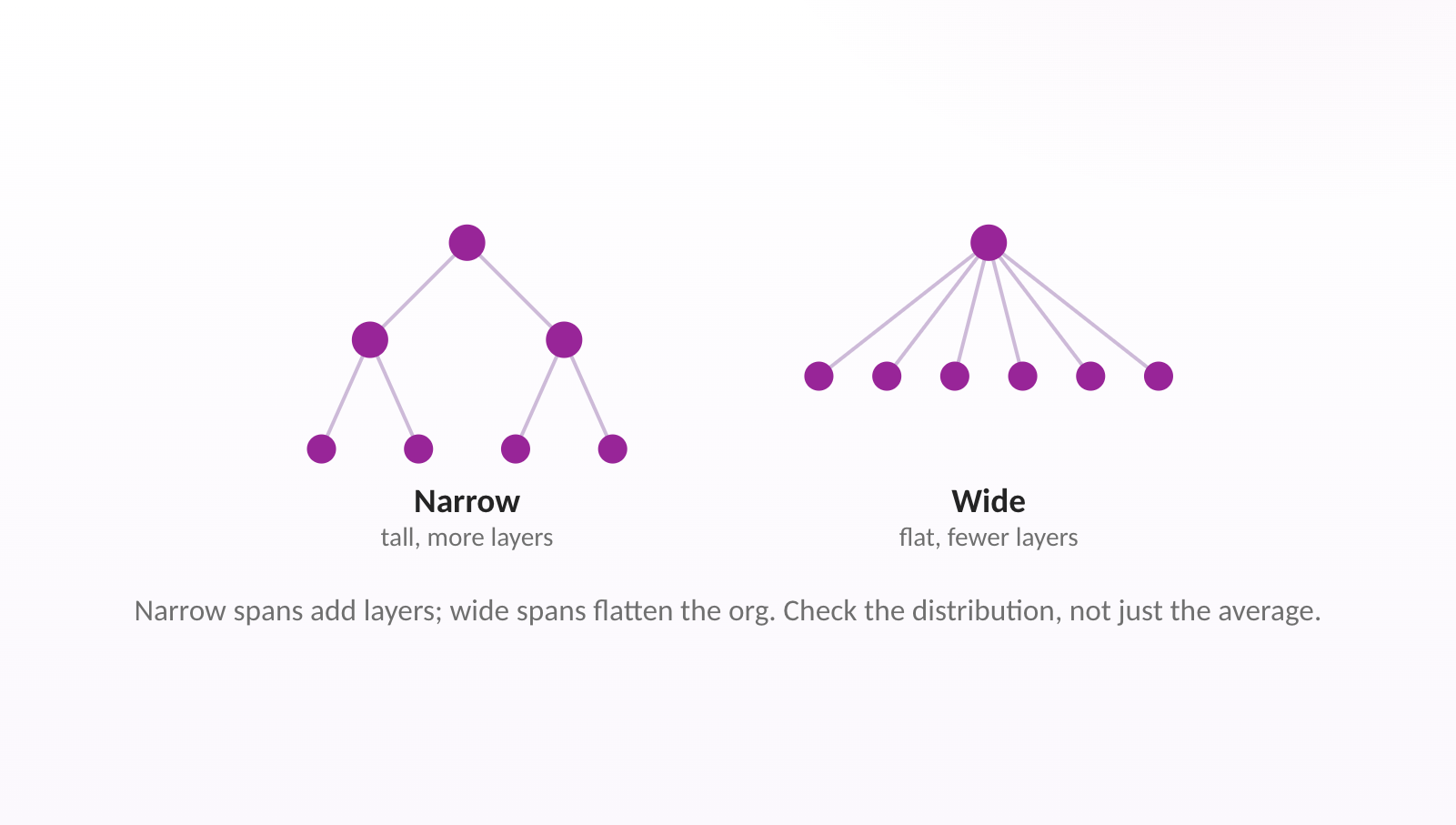
Span of control is the number of direct reports a manager is responsible for. A narrow span means few reports per manager and more layers in the organisation. A wide span means many reports per manager and a flatter structure. The right span depends on the type of work, team experience, and how much of the manager's time goes to their own individual work.
Also known as: management ratio, reports per manager, span of management
Reviewed
Key takeaways
- Span of control is the number of direct reports a manager has.
- Narrow spans add layers and slow decisions; wide spans flatten the org but can starve coaching.
- Average span = employees with a manager ÷ number of managers.
- Watch the distribution, not just the average; outliers hide inside a healthy-looking mean.
At a glance
- Formula
- Employees with a manager ÷ managers
- Typical
- Mid-to-high single digits for knowledge work
- Too narrow / wide
- Slow decisions / thin coaching
- Related
- Headcount, org design
Why does span of control matter?
Spans that are too narrow add layers, slow decisions, and raise management cost. Spans that are too wide leave people without enough coaching and attention. Span of control is one of the first things to check in any org design or restructure.
Wide vs narrow
| Narrow span | Wide span | |
|---|---|---|
| Reports per manager | Few | Many |
| Structure | Tall, more layers | Flat, fewer layers |
| Good for | Complex, novel, or high-risk work | Routine, standardised work, experienced teams |
| Risk | Slow decisions, micromanagement | Too little coaching, manager burnout |
How do you calculate span of control?
Average span of control = number of employees who have a manager ÷ number of managers
Track the distribution too, not just the average. One manager with 22 reports and five with 2 can average out to something that looks fine.
Worked example
A 120-person company has 14 managers and 119 people with a manager (everyone except the CEO). Average span = 119 ÷ 14 = 8.5. But a breakdown shows three managers with 2 reports each and one with 19. The fix is in the distribution, not the average.
Frequently asked questions
- What is a good span of control?
- There is no universal number. Many organisations land in the mid to high single digits for knowledge work, wider for standardised work. Check workload, not just the count.
- Span of control vs chain of command?
- Span is how wide each manager's team is. Chain of command is how many layers sit between the front line and the top.
- What factors affect the ideal span of control?
- Task complexity, how much coaching reports need, how standardised the work is, how experienced the team is, and how much the manager also does individual-contributor work. Complex, high-coaching work calls for narrower spans.
- How do you calculate span of control?
- Divide the number of employees who have a manager by the number of managers. 119 people and 14 managers is an average span of 8.5.
- What is the difference between span of control and chain of command?
- Span is how wide each manager's team is; chain of command is how many layers sit between the front line and the top.
- What happens if span of control is too wide?
- Managers cannot give enough coaching and attention, quality and development suffer, and manager burnout rises.
See it in practice
Compare performance management software
Related reading
Related terms