FTE (Full-Time Equivalent)
FTE (full-time equivalent) is a unit that converts the hours worked by all employees into the number of full-time employees those hours represent. One FTE equals one person working a full schedule, usually 40 hours a week. A part-timer on 20 hours counts as 0.5 FTE. It lets you compare workload and cost across mixed teams.
Also known as: full-time equivalent, how to calculate FTE, FTE calculation, 1.0 FTE
Reviewed
Key takeaways
- FTE (full-time equivalent) converts all working hours into the number of full-time people they add up to.
- Formula: total hours worked ÷ hours in one full-time week (usually 40).
- Headcount counts people; FTE counts capacity.
- Use FTE for budgeting, workload, and capacity planning; use headcount for licences and ratios.
At a glance
- Formula
- Total hours worked ÷ full-time week (often 40)
- 1.0 FTE
- One full-time employee (e.g. 40 hrs/week)
- 0.5 FTE
- A 20-hour-a-week part-timer
- Related
- Headcount, span of control
Why does FTE matter?
Headcount tells you how many people you employ. FTE tells you how much work capacity you have. Budgets, staffing plans, and benefits eligibility rules all run on FTE, not headcount. If half your support team is part-time, headcount will overstate your capacity every single time.
What common FTE values mean
FTE is written as a decimal of one full-time schedule (40 hours a week in this table). A few values come up constantly:
| FTE | Hours per week | What it usually means |
|---|---|---|
| 1.0 FTE | 40 | Full-time |
| 0.8 FTE | 32 | Four days a week |
| 0.75 FTE | 30 | Three-quarter time |
| 0.6 FTE | 24 | Three days a week |
| 0.5 FTE | 20 | Half-time |
| 0.25 FTE | 10 | One day a week |
How do you calculate FTE?
FTE = total hours worked by all employees ÷ hours in one full-time schedule
Use the same period on both sides. Weekly hours over 40, or annual hours over 2,080 (40 × 52).
Worked example
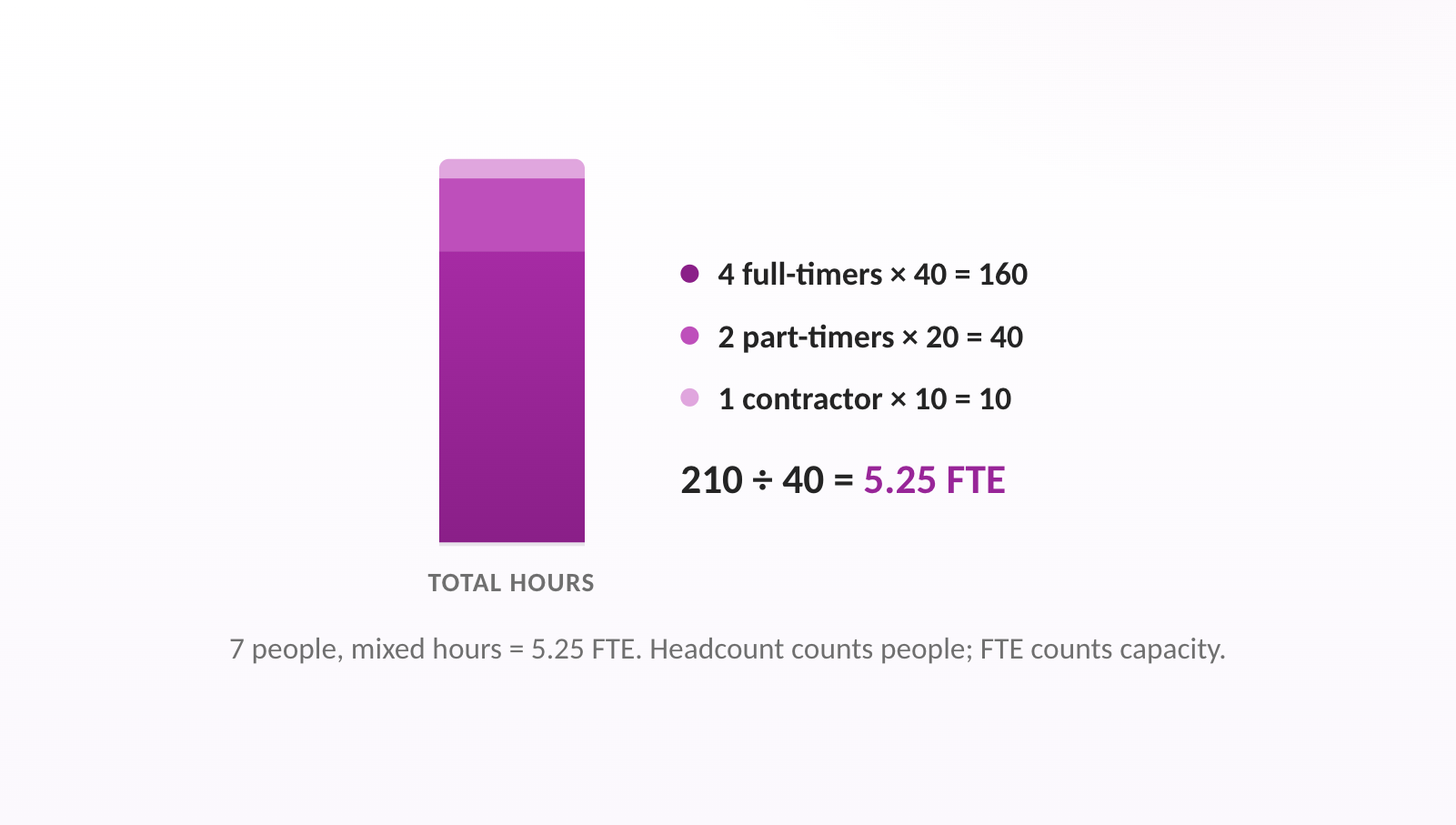
A team has 4 full-timers at 40 hours, 2 part-timers at 20 hours, and 1 contractor at 10 hours.
Total hours = 160 + 40 + 10 = 210. FTE = 210 ÷ 40 = 5.25 FTE. Headcount is 7.
Frequently asked questions
- Is FTE the same as headcount?
- No. Headcount counts people. FTE counts full-time workloads. Seven people can be 5.25 FTE.
- What does 0.8 FTE mean?
- The role is 80% of a full-time schedule, so 32 hours on a 40-hour week.
- What does FTE stand for?
- FTE stands for full-time equivalent. It is a unit that converts the hours worked by a mix of full-time and part-time staff into the number of full-time employees those hours represent, so you measure real work capacity rather than just a headcount.
- What does 0.5 FTE mean?
- 0.5 FTE means half of one full-time schedule. On a standard 40-hour week that is 20 hours, so someone working 20 hours a week counts as 0.5 FTE. Two people at 0.5 FTE each add up to 1.0 FTE of capacity.
- What does 1.0 FTE mean?
- 1.0 FTE (or 1 FTE) means one full-time equivalent: one person working a complete full-time schedule, usually 40 hours a week or about 2,080 hours a year. It is the baseline that every fractional FTE is measured against.
- How do you calculate FTE?
- FTE = total hours worked by all employees ÷ the hours in one full-time schedule, using the same period on both sides (for example weekly hours over 40, or annual hours over 2,080). As a worked example, 4 full-timers at 40 hours, 2 part-timers at 20, and 1 contractor at 10 is 210 total hours ÷ 40 = 5.25 FTE, even though the headcount is 7.
- How many hours is 1 FTE?
- One FTE is one full-time schedule. In most of the US and UK that is 40 hours a week, or roughly 2,080 hours a year (40 × 52). Some employers use a 37.5 or 35-hour week, so confirm the full-time number your organisation uses before converting part-time hours.
- How do you calculate FTE for part-time staff?
- Divide each person's weekly hours by a full-time week. Someone on 24 hours against a 40-hour week is 24 ÷ 40 = 0.6 FTE. Sum everyone's figures for total FTE.
- Why do companies track FTE?
- FTE makes workload, budgets, and productivity comparable across teams with different mixes of full- and part-time staff, and it is the standard denominator for cost-per-FTE and revenue-per-FTE metrics.
- Does FTE include contractors?
- It depends on your definition. Many companies calculate FTE for employees only and track contractor capacity separately. Whatever you choose, state the rule so the number is comparable over time.
See it in practice
Compare performance management software
Related reading
Related terms