Talent Density
You Don't Have a Hiring Problem. You Have a Talent Density Problem.
Your company is not understaffed. It is under-concentrated.
About This Series
This is the first in a five-part series on talent density. We wrote it for founders and people leaders who are working hard, genuinely care about their teams, and still feel like the company is not moving as fast as it should. We start with the idea that reframes the whole conversation.
Start with an honest question
If you are building a company and things feel slower than they should, the first instinct is almost always the same: we need more people.
More engineers to ship faster. More sales people to close more deals. More operators to hold things together while the founders focus on growth. The logic feels sound. More hands, more output.
But what if the slowness has nothing to do with how many people you have?
What if the real issue is not that your team is too small, but that the exceptional people on it are too spread out, too diluted by hires that are just... fine?
That is the idea behind talent density. And once you see it, it is hard to unsee.
The Netflix story that makes founders uncomfortable
In 2001, Netflix was in serious trouble. The dot-com crash had hit hard. The leadership team made a decision that no founder makes easily: they laid off a third of the company in a single month. One hundred and twenty people became eighty.
These were not easy conversations. These were people who had given their time, their energy, and their belief to the company. Letting them go was painful. It was also, as it turned out, clarifying.
In the weeks that followed, something unexpected happened:
- Projects that had been dragging started to land
- Decisions moved faster and with more confidence
- The energy in the room changed noticeably
- By early 2002, the team of eighty was scaling a subscription business the team of one hundred and twenty had struggled to run
Reed Hastings and Patty McCord sat with this honestly. They were not looking for a way to justify layoffs. They were trying to understand what had actually happened. What they found was that the thirty percent they had removed had been quietly consuming a disproportionate share of the team's energy, not through bad intentions, but simply by being in roles they were not exceptional at.
They gave this observation a name: talent density. The ratio of genuinely exceptional people to total headcount.
The Core Idea
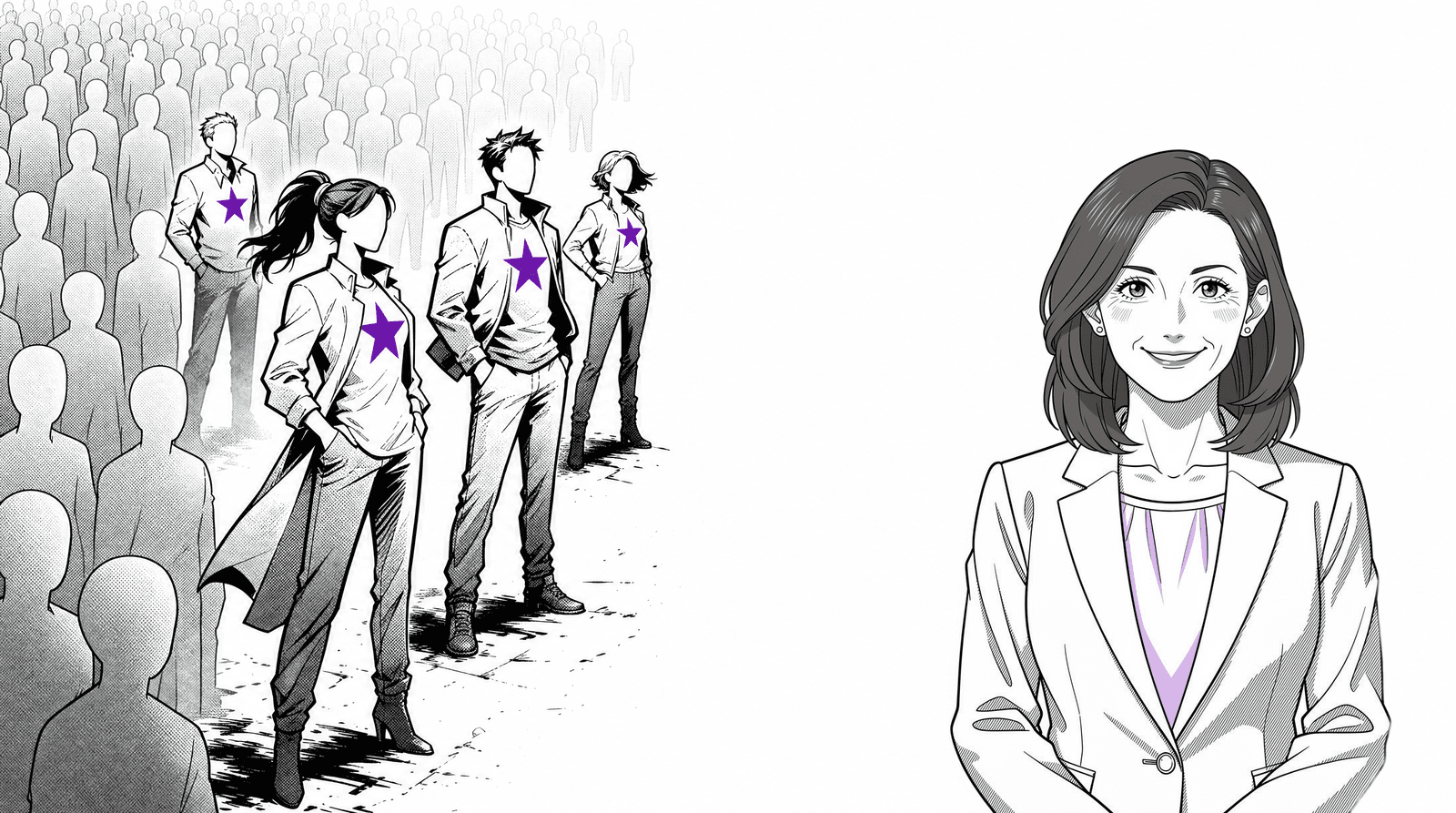
Talent density is not about headcount. It is about the proportion of your team who are genuinely exceptional at what they do. A concentrated team of great people will almost always outperform a larger team where great people are the minority.
Talent Density is not about treating people as numbers
Before we go further, we want to name something directly, because this is where the conversation can go wrong.
Talent density is not a framework for treating people as interchangeable resources. It is not a licence to be ruthless, to run constant performance tribunals, or to build a workplace where people are afraid to make mistakes. That model creates exactly the behaviours that destroy good culture.
What talent density is about is this: every person deserves to be in a role where they can do genuinely great work. Not adequate work. Not passable work. Work they are proud of, that stretches them, and that contributes something real.
When someone is in the wrong role, or on the wrong team, or in a company that has outgrown the version of them that joined, nobody wins. Not the company, and not the person.
The founders we most respect hold both things at once: high standards for what the work requires, and genuine care for the people doing it. That is the balance talent density asks you to find.
What the data actually shows
Here is what makes talent density more than a philosophical position: the research behind it is striking.
A landmark study by Ernest O'Boyle Jr. and Herman Aguinis, published in 2012 and covering over 633,000 individuals across knowledge-based fields, found that 94% of those populations did not follow a bell curve. They followed a power law. Key findings:
- A small number of people produced a disproportionately large share of total output
- In technical, creative, and leadership roles, a single exceptional contributor can produce up to 10x the output of an average peer
- The gap is not 20% or 30% more. It is an order of magnitude
Bill Gates captured this well: a great software engineer is not slightly better than an average one. They are worth ten thousand times more to the outcome.
The bell curve model, which most companies still use without questioning it, is built on the opposite assumption. It caps how many people can be rated as exceptional, protects the middle by design, and quietly signals to your best people that the system was not built to recognise what they actually contribute.
Output of an exceptional contributor vs. an average peer in knowledge-work roles (O'Boyle & Aguinis, 2012)
Of studied populations follow a power law, not a bell curve (Journal of Management, 2012)
Smaller team at Netflix post-2001, yet output and team energy both increased (Hastings & McCord, Netflix)
Talent Density Indicator (TDI)
TDI = (High Performers + High Potentials) ÷ Total Headcount × 100
Tracked quarterly. A rising TDI signals healthy density. A declining TDI is an early warning of dilution.
| TDR Range | Band | Status | What It Means |
|---|---|---|---|
| Under 15% | Low | High dilution risk | The adequacy tax is significant. Immediate action needed. |
| 15% to 25% | Developing | Room to improve | Proactive intervention recommended. Tighten hiring and development. |
| 25% to 40% | Strong | Healthy concentration | Focus on maintaining standards and deepening development. |
| Above 40% | Elite | Exceptional | Protect and compound this. Guard against regrettable attrition. |
The slow drift founders miss
We have worked with a lot of scaling companies. There is a pattern we see so often it has become almost predictable.
In the early days, the team is small and the standards are high, not because anyone wrote them down, but because every hire was someone the founder knew personally, vouched for, and believed in. The team moves fast. The culture feels alive.
Then growth kicks in, and the drift begins:
- Pressure to hire faster means the process gets compressed
- A few hires go through who are good enough but not great
- Nobody says anything because they are contributing and there is no time to revisit
- Things start to slow, decisions take longer, delivery gets inconsistent
- The best people start to feel the change, even if they cannot name it
- Some of them start looking elsewhere, not because the company is doing badly, but because what made it exciting has quietly diluted
This is not a failure of care. Most of the founders we work with care deeply about their teams. This is structural drift. It happens gradually, and then all at once. And by the time it is visible, it has usually been building for two or three years.
| Virtuous Cycle: High TDR | Vicious Cycle: Low TDR |
|---|---|
| Elite performers recruited | Mediocre performers tolerated |
| Collective standards rise | Collective standards dilute |
| Decision friction reduces | Decision friction accumulates |
| Organisational speed increases | Organisational speed decreases |
| Culture and clarity strengthen | Culture weakens, clarity fades |
| More elite talent attracted | High performers leave |
| Talent density rises further | Talent density falls further |
The Honest Question
Most scaling companies are not understaffed. They are under-concentrated. The question worth asking is not how many people do we need, but how many of the people we already have are genuinely exceptional at what they do, at this stage, right now.
What changes when you see your people this way
When you start thinking about talent density rather than headcount, a few important things shift in how you make decisions:
- Adding people stops being the automatic answer to every capacity problem
- One exceptional person in the right role often produces more than three people each doing parts of what that one person would do completely
- You start thinking about your existing team not as headcount, but as a concentration of capability that either compounds or dilutes depending on who surrounds them
- Exceptional people make each other better. They hold standards up, ask harder questions, and create conditions where everyone on the team rises
- Decisions about who joins, and who stays, start to feel like one of the most consequential things a founder can get right. Because they are
None of this means being careless with people. It means being clear about what you are building, and honest with yourself about whether every person in every role is genuinely set up to do their best work there.
What comes next in this series
This is the first of five posts. We start here, with the framing question, because everything else depends on it.
Is your company actually understaffed? Or is it under-concentrated?
In the next post, we make the cost concrete. Not the cost of a bad hire. The cost you are already paying every single day for every seat filled with someone adequate rather than exceptional. It does not appear on your P&L. But it is very real, and it compounds.