Attrition Rate
Attrition rate is the percentage of employees who leave an organisation over a set period, usually a month or a year. It covers resignations, retirements, and terminations. In many companies "attrition" specifically means departures where the role is not backfilled, while "turnover" covers all exits. Definitions vary, so state yours on every report.
Also known as: employee attrition, attrition meaning in HR, high attrition rate, attrition report
Reviewed
Key takeaways
- Attrition rate is the percentage of employees who leave over a period.
- Formula: leavers ÷ average headcount × 100.
- There is no universal “good” number. Compare against your own trend and your industry.
- Segment by team, manager, and tenure to find where the real problem is.
At a glance
- Formula
- Leavers ÷ average headcount × 100
- Healthy range
- Often ~10% or lower, but it varies widely by industry
- Measured
- Monthly or annually
- Related metrics
- Turnover, retention, headcount
Free calculator
Attrition rate calculator
Attrition rate = leavers ÷ average headcount × 100, where average headcount = (start + end) ÷ 2. Track it by team and manager, not just company-wide.
Why does the attrition rate matter?
Every exit costs recruiting time, lost knowledge, and slower teams. Attrition rate shows whether that cost is rising, and when you slice it by team, manager, or tenure, it tells you where the problem actually sits.
How do you calculate the attrition rate?
Attrition rate = (number of employees who left ÷ average headcount) × 100
Average headcount = (headcount at start + headcount at end) ÷ 2
Track voluntary and involuntary exits separately. They have different causes and different fixes.
Worked example
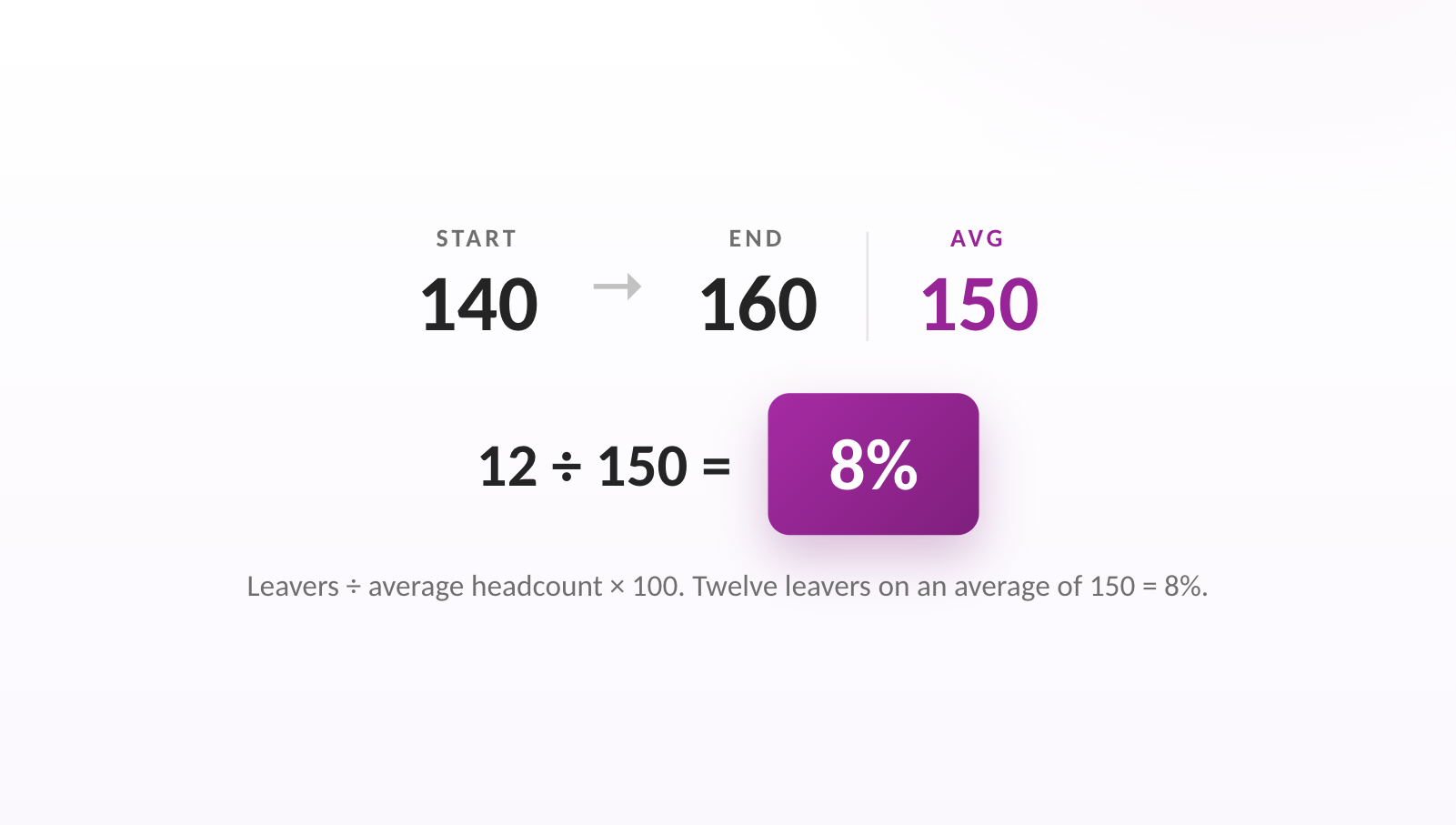
A company starts the year with 140 people and ends with 160. 12 people left.
Average headcount = (140 + 160) ÷ 2 = 150. Attrition rate = 12 ÷ 150 × 100 = 8%.
Frequently asked questions
- What is a good attrition rate?
- It depends heavily on industry, region, and role. Compare against your own trend and your sector, not a universal number.
- Attrition vs turnover?
- Many teams use them interchangeably. Where they differ, turnover counts every exit, and attrition counts exits where the role is eliminated or left unfilled.
- What causes high attrition?
- Common drivers are weak management, limited growth, below-market pay, unsustainable workload, and poor onboarding. Attrition concentrated in one team or under one manager usually points to a local problem, not a company-wide one.
- How do you reduce attrition?
- Use exit and stay interviews to find the real causes, fix the biggest driver first (often manager quality or pay), and track regrettable voluntary attrition by team so you can act before people leave.
- What is average headcount in the attrition formula?
- Average headcount = (headcount at start + headcount at end) ÷ 2. Using an average rather than a point-in-time number keeps the rate fair when the team grew or shrank during the period.
- Should involuntary exits count in attrition?
- Report total attrition, then split it. Involuntary exits (dismissals, layoffs) and regrettable voluntary exits tell very different stories, so leadership should watch regrettable voluntary attrition most closely.
See it in practice
Compare employee engagement software
Related reading
Related terms