Headcount
Headcount is the total number of individual people employed by an organisation at a specific point in time. Every person counts as one, whether they work full-time or part-time. Companies decide whether to include contractors, interns, and people on leave, and should state that rule in every report. Headcount is different from FTE, which measures work capacity in full-time units.
Also known as: employee headcount, headcount planning, total headcount
Reviewed
Key takeaways
- Headcount is the total number of people employed at a point in time; everyone counts as one.
- It differs from FTE, which measures work capacity in full-time units.
- Decide whether contractors, interns, and people on leave count, and state the rule.
- It drives budgets, licences, space, and the “average headcount” in attrition and turnover.
At a glance
- What it is
- People employed at a point in time
- vs FTE
- Headcount = people; FTE = capacity
- Used for
- Budgets, licences, ratios
- Related
- FTE, span of control, turnover
Why does headcount matter?
Headcount drives budgets, hiring plans, office space, software licences, and nearly every people metric that uses "average headcount" as its denominator, like attrition and turnover. Getting the definition wrong spreads errors across every report.
Headcount vs FTE
| Headcount | FTE | |
|---|---|---|
| Counts | People | Full-time workloads |
| A 20-hour part-timer | 1 | 0.5 |
| Best for | Licences, space, culture, ratios | Capacity, cost, workload planning |
Headcount planning
Headcount planning is the process of deciding how many people each team needs, in which roles, and when, based on business goals and budget. It is usually done annually and revisited each quarter.
Worked example
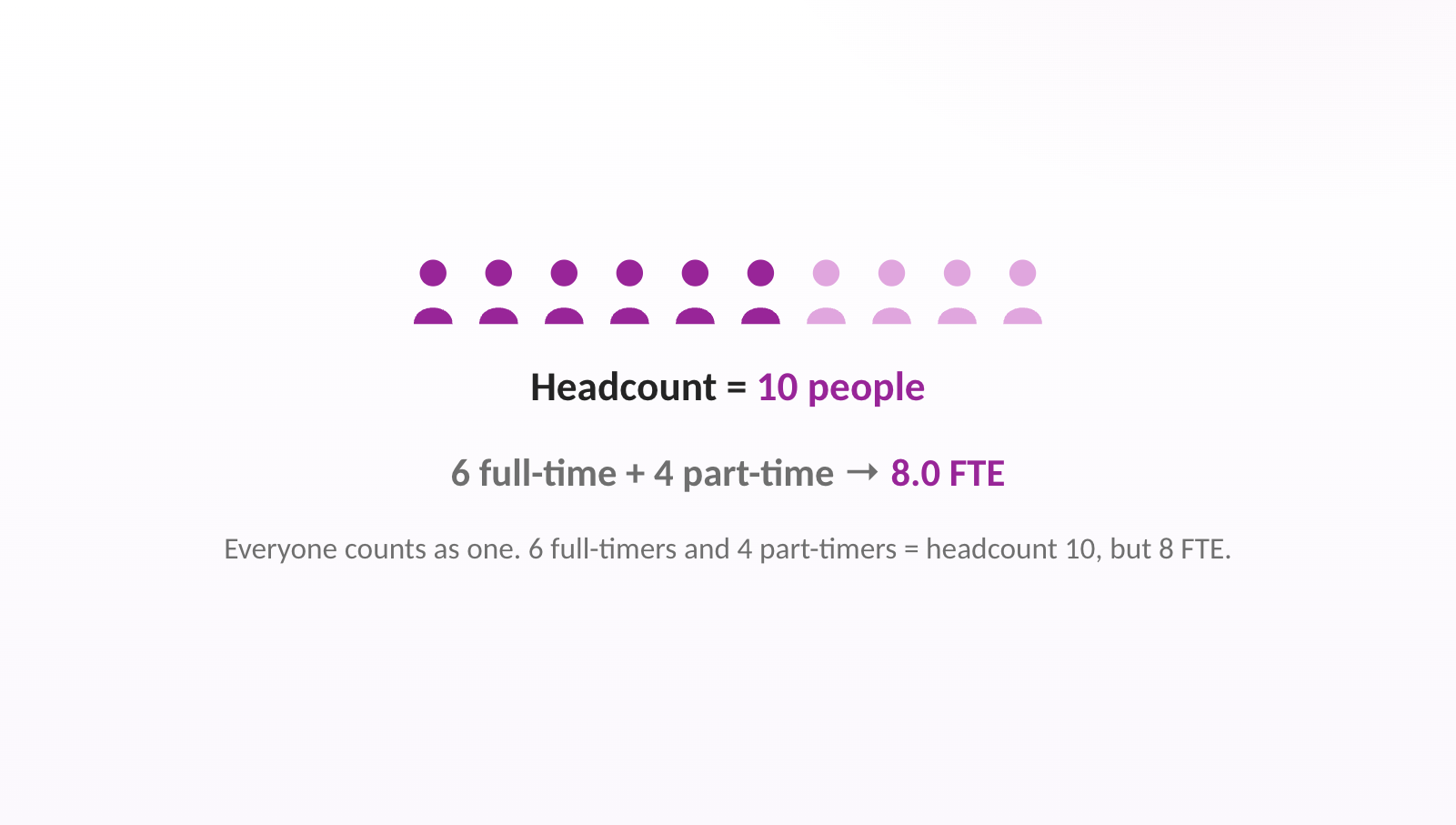
A team has 6 full-timers and 4 part-timers at 20 hours. Headcount = 10. FTE = 6 + (4 × 0.5) = 8. The software budget needs 10 seats. The capacity plan uses 8.
Frequently asked questions
- Do contractors count in headcount?
- It depends on your definition. Many companies report employee headcount and contractor headcount separately.
- What is average headcount?
- (Headcount at start of period + headcount at end) ÷ 2. It is the denominator for attrition and turnover rates.
- How do you calculate headcount?
- Headcount is a simple count of employees on a defined date. Each person counts as one, whether they work full or part time. That is the key difference from FTE, which weights people by hours worked.
- Is headcount one word or two?
- In HR and finance it is written as one word, headcount, when it means the number of employees. 'Head count' as two words is the general-English spelling.
- What is headcount planning?
- Headcount planning is forecasting how many people, in which roles, a company will need over a future period, then aligning hiring and budget to that plan. It links workforce demand to financial planning.
- What is the difference between headcount and FTE?
- Headcount counts people, where everyone is one. FTE counts capacity, where hours convert to full-time equivalents. Ten people on mixed hours might be 8.0 FTE.
- How do you calculate average headcount?
- (Headcount at the start of the period + headcount at the end) ÷ 2. It is the denominator for attrition and turnover rates.
- Does headcount include part-time employees?
- Yes. In headcount everyone counts as one, full-time or part-time. Use FTE if you need to reflect actual hours.
See it in practice
Compare performance management software
Related reading
Related terms