Employee Turnover
Employee turnover is the rate at which employees leave an organisation over a period and are typically replaced. It counts all separations: resignations, dismissals, layoffs, and retirements. Turnover rate is usually reported monthly or annually and broken into voluntary and involuntary turnover, because each points to different causes.
Also known as: turnover rate, staff turnover, employee turnover formula
Reviewed
Key takeaways
- Turnover is the rate at which employees leave and are replaced over a period.
- Formula: separations ÷ average headcount × 100.
- Split it: voluntary vs involuntary, regrettable vs non-regrettable.
- Regrettable voluntary turnover is the number leadership should watch most.
At a glance
- Formula
- Separations ÷ average headcount × 100
- Types
- Voluntary / involuntary, regrettable / not
- Measured
- Monthly or annually, by team
- Related
- Attrition, retention, headcount
Free calculator
Employee turnover calculator
Turnover rate = separations ÷ average headcount × 100, where average headcount = (start + end) ÷ 2. Split it into voluntary vs involuntary to find the number worth watching.
Why does employee turnover matter?
Every departure costs recruiting time, ramp-up time, and lost knowledge. High turnover in one team or under one manager is often the clearest signal of a local problem.
How do you calculate employee turnover?
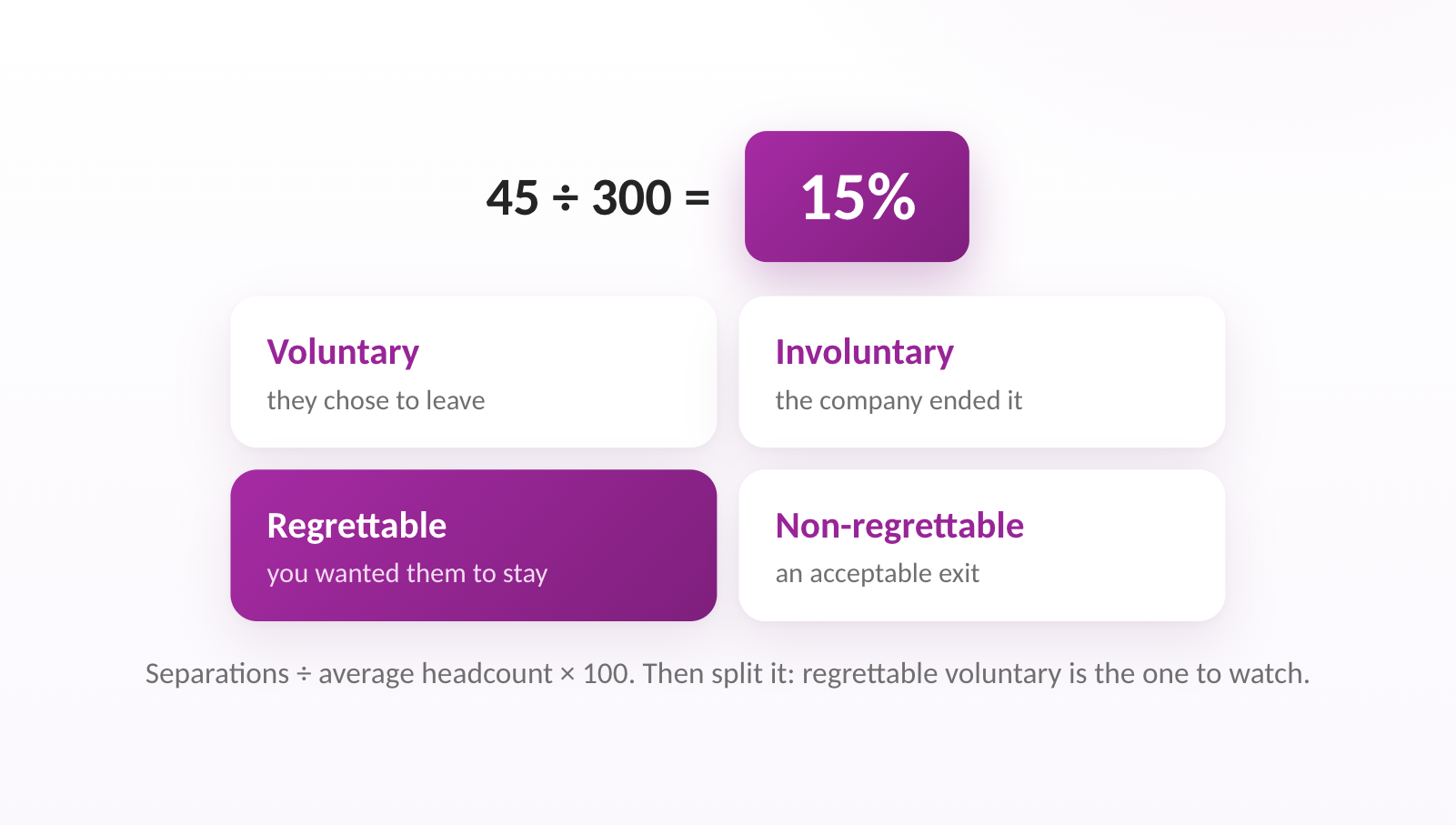
Turnover rate = (number of separations ÷ average headcount) × 100
Average headcount = (headcount at start + headcount at end) ÷ 2
What are the types of employee turnover?
- Voluntary: the employee chooses to leave
- Involuntary: the company ends employment
- Regrettable: you would have wanted them to stay
- Non-regrettable: a departure that is acceptable or even positive
Regrettable voluntary turnover is the number leadership should watch most closely.
Worked example
A 300-person company starts the year at 290 and ends at 310, so average headcount is 300. It records 45 separations: 33 voluntary and 12 involuntary.
Total turnover = 45 ÷ 300 = 15%. Voluntary turnover = 33 ÷ 300 = 11%.
Frequently asked questions
- Turnover vs attrition?
- Many teams use them interchangeably. Where they differ, turnover counts exits that get backfilled, and attrition counts roles left unfilled or removed. Pick a definition and keep it consistent.
- What causes high turnover?
- Common causes are poor management, limited growth, below-market pay, heavy workload, and weak onboarding.
- How do you calculate turnover rate?
- Separations ÷ average headcount × 100, where average headcount = (start + end) ÷ 2. 45 leavers on an average of 300 is 15%.
- What is a good turnover rate?
- It varies widely by industry. Compare against your sector and your own trend, and focus on regrettable voluntary turnover rather than the headline.
- What are the types of employee turnover?
- Voluntary vs involuntary, and regrettable vs non-regrettable. Losing a top performer is very different from letting a poor fit go.
- How much does employee turnover cost?
- Estimates range from a few months' to well over a year's salary per exit, counting recruiting, ramp-up time, and lost knowledge.
See it in practice
Compare employee engagement software
Related reading
Related terms