Buyer's Guide · October 2026
Best Succession Planning Software for 2026
A practical guide to the tools that run succession planning, from SAP SuccessFactors, Workday and Cornerstone to Lattice, PerformYard and ChartHop, sorted by how much real succession they actually do, with G2 ratings, pricing, and the 9-box-is-not-succession trap to avoid.


The verdict
- Best for deep, native enterprise succession in one data model
- Workday or SAP SuccessFactors, the two depth leaders with the full object model (critical roles, pools, nominations, readiness, 9-box, org and lineage charts) inside a single HR system. Quote-only, long to implement.
- Best for skills- and learning-linked succession
- Cornerstone, ties succession to a real skills ontology (SkyHive) and the strongest learning library, for enterprises that can absorb the configuration.
- Best mid-market, easy and affordable
- Lattice, a mature 9-box and calibration plus a dedicated succession module bundled free with Performance, at a published $10 to $13 per seat.
- Best for a skills- and competency-governed pipeline
- TalentGuard, real succession pools and a readiness engine on a governed skills framework at a mid-market price; validate it, as the review base is tiny.
- Best for org visualization and what-if modeling
- Ingentis org.manager or ChartHop, they visualize and model succession data that lives in your HRIS; strong scenarios, but they do not own or run succession.
- Best foundation underneath succession
- Sageo, not a succession tool, but the calibrated performance, competency and development inputs succession is only as good as, with EU AI Act-grade governance (de-identification, human review, audit trail) at a flat per-seat price.
Bottom line. Succession planning software splits into four tiers, and most of the field does not do real succession. Only the enterprise HCM suites (SAP SuccessFactors, Workday, Cornerstone, UKG, Darwinbox, PageUp, PeopleFluent) ship the full machinery (critical roles, pools, readiness, 9-box plus calibration, benches); the modern performance tools (Lattice, Quantum, PerformYard, Trakstar) offer a 9-box and light succession; org-visualization layers (ChartHop, Ingentis) show and model it; and some tools (Trakstar, isolved, ChartHop, arguably PerformYard) sell a 9-box as succession. TalentGuard is the skills specialist that bridges. Sageo is not a succession tool; it builds the calibrated performance, competency and development foundation succession depends on, with the AI governance the whole field is weak on.

For founders, CEOs, and people leaders trying to buy "succession planning software." The first thing to know is that most tools marketed for it do not actually do it. Several sell a 9-box grid as succession planning, which is like calling a thermometer a treatment plan. This guide defines what real succession planning requires, sorts the market by how much of it each tool genuinely delivers, and is honest about where Sageo does and does not fit.
A note on who wrote this
Sageo is a performance and culture platform, and it is not a succession planning tool: no 9-box, no successor slates, no talent pools, no readiness pipelines. We say that plainly, because the honest version is more useful than a stretch. Where Sageo is relevant is narrower and we are explicit about it near the end: it builds the competency, performance and development foundation that real succession planning is only as good as. Every competitor figure comes from vendor product and admin docs, G2, Capterra, TrustRadius and Gartner, and procurement aggregators as of October 2026. Succession-module reviews are thin across the whole field, so weigh suite-level ratings with care and demand real succession references before you buy.
1. Which succession planning software should you choose?
Match the tool to how much real succession machinery you need and the system your HR data already lives in:
- Deep, native succession inside one enterprise HR data model
- Workday or SAP SuccessFactors lead on the full object model (critical roles, pools, nominations, readiness, 9-box, org and lineage charts). Cornerstone adds the strongest learning and skills linkage. Expect quote-only pricing and long implementations.
- Mid-market, easy, affordable, with a credible 9-box
- Lattice (a dedicated succession module now bundled free with Performance, plus a mature 9-box and calibration), PerformYard (service-led, clean 9-box), or Quantum Workplace (engagement-first, with talent reviews and readiness in its top tier).
- A skills and competency-governed pipeline
- TalentGuard builds succession pools and a readiness engine on top of a governed skills framework. Strong depth for the price, but a near-zero review base and no calibration inside succession.
- Org visualization and what-if scenario modeling
- Ingentis org.manager over an enterprise HRIS (SAP, Workday, Oracle), or ChartHop for SMB and mid-market tech. These show and model succession data; they do not own or run it.
- The performance, competency and development foundation underneath it all
- Sageo, used alongside one of the above. It produces the calibrated, evidence-based, de-identified inputs a 9-box and a successor slate are only as trustworthy as. More in section 10.
The honest headline: only the enterprise HCM suites ship real succession planning end to end. Most other tools give you a 9-box talent review and call it succession. That is useful, but it is one input, not the plan. Decide how much of the real machinery you need before you shortlist, because the gap between the marketing and the product is wide in this category.
2. What does real succession planning require?
Use this as a checklist against any shortlist. A tool that marketing calls "succession" but that only ticks the first box or two is a talent review, not a succession platform.
- Critical-role identification
- A way to flag the roles the business cannot afford to leave vacant, and to see which of them have no plan. Only the enterprise suites and PageUp consistently do this as a named feature.
- Talent pools and successor nominations
- Named pools of high-potential people, and the ability to nominate specific successors (internal and external) against specific roles.
- Readiness levels
- A standard taxonomy (ready now, 1 to 2 years, 3-plus years, emergency cover) applied to each successor. This is where most lightweight tools stop short.
- 9-box plus calibration
- A performance-versus-potential grid, calibrated across managers so the placements mean the same thing everywhere. Watch for calibration living in a different module (common in SAP and TalentGuard).
- Bench strength and pipeline analytics
- Coverage reporting: how many ready successors each critical role has, where the gaps and single points of failure are.
- Development linkage
- A path from the gap to a plan, so an identified successor actually becomes ready. Succession without development is a list, not a pipeline.
The dividing line
Readiness levels, talent pools, and critical-role mapping are the three features that separate real succession tools from dressed-up 9-boxes. If a product cannot show you all three as named, shipped features, it is a talent-review tool. That is a fine thing to buy, as long as you know that is what you are buying.
3. The four tiers of the market
"Succession planning software" is not one category. The 15 tools here fall into four tiers by how much real succession they do, plus one specialist that bridges.
- 1. Enterprise HCM suites (full succession)
- SAP SuccessFactors, Workday, Cornerstone, UKG Pro, Darwinbox, PageUp, PeopleFluent. Real, named succession objects inside a larger HR system. Deep, quote-only, long to implement, built for 1,000-plus employees.
- 2. Modern performance platforms (9-box plus light succession)
- Lattice, Quantum Workplace, PerformYard, Trakstar Perform. Per-seat, affordable, easy to deploy, performance-led. Strong on 9-box and calibration, thin on benches, readiness and critical-role depth.
- 3. Org-charting and visualization layers
- Ingentis org.manager and ChartHop. They visualize and model succession data that lives elsewhere, with strong scenario and what-if modeling, but they do not own or govern it.
- 4. Payroll-first SMB suite
- isolved. A 9-box inside a payroll and HR core, and no real succession beyond it.
Sitting across tiers 1 and 2 is TalentGuard, a competency and skills-first specialist with real succession pools and a readiness engine, but no calibration inside succession and a tiny review base. And sitting underneath all of them is the foundation layer, the performance, competency and development data that succession depends on, which is where Sageo lives.
4. How do the succession tools compare?
| Tool | Tier | Succession depth | Pricing | G2 (reviews) |
|---|---|---|---|---|
| Sageo | Performance foundation | Feeds succession: competency framework, calibrated reviews, development; no 9-box, pools or benches | EUR 6 PEPM, published | n/a |
| SAP SuccessFactors | Enterprise suite | Full: flags, pools, nominations, 9-box, org and lineage charts | ~$38 PEPM suite (est) + implementation | 4.1 (1,475) |
| Workday | Enterprise suite | Full: plans, pools, readiness, nBox, bench reports | Quote; ~$14 to $28 PEPM core (est) | 4.2 (2,450) |
| Cornerstone | Enterprise suite | Full module: pools, grid, charts, skills linkage | ~$15 to $25 PUPM (est) + implementation | 4.0 (123) |
| UKG Pro | Enterprise suite | Module: successors, readiness, pipeline; flagged inflexible | Quote; ~$27 to $41 PEPM (est) | 4.3 (2,206) |
| Darwinbox | Enterprise suite | Suite module; 9-box and calibration undocumented | Quote; ~$5 to $25 PEPM (est) | 4.4 (238) |
| PageUp | Enterprise suite | Module: critical-role mapping, 9-box, bench; recruitment-first | Quote, premium | 4.4 (141) |
| PeopleFluent | Enterprise suite | Heritage module, under-invested, thin public docs | Quote, top-tier | 4.0 (32) |
| TalentGuard | Skills specialist | Pools plus readiness engine on a governed skills framework; no calibration in succession | ~$12/user/mo (unverified) | 4.6 (4) |
| Lattice | Modern performance | New dedicated module (Nov 2025) plus strong 9-box and calibration | $10 to $13/seat/mo; succession free | 4.6 (4,132) |
| Quantum Workplace | Modern performance | Talent reviews, calibration and readiness (top tier) | Quote, 3 tiers | 4.3 (915) |
| PerformYard | Modern performance | Native 9-box and competency readiness, labelled succession | $5 to $15 PEPM, published | 4.7 (1,261) |
| Trakstar Perform | Modern performance | 9-box report and calibration only | Quote (~$3.50 to $8/user category) | 4.2 (463) |
| ChartHop | Org visualization | Org charts plus a new (June 2026) 9-box; shallow | Modular PEPM, quote; ~$9K min | 4.4 (171) |
| Ingentis org.manager | Org visualization | Visualizes HRIS succession data; strong what-if modeling | Quote, add-on to HRIS | 4.7 (23) |
| isolved | Payroll-first SMB | 9-box only; no real succession | Quote; ~$25 to $50 PEPM (est) | 4.3 (1,328) |
5. How does each tool compare, in depth?
Grouped by tier. Sageo comes first because it is the odd one out, the foundation underneath the category rather than a succession tool, so you can see upfront what it does and does not do.
Sageo
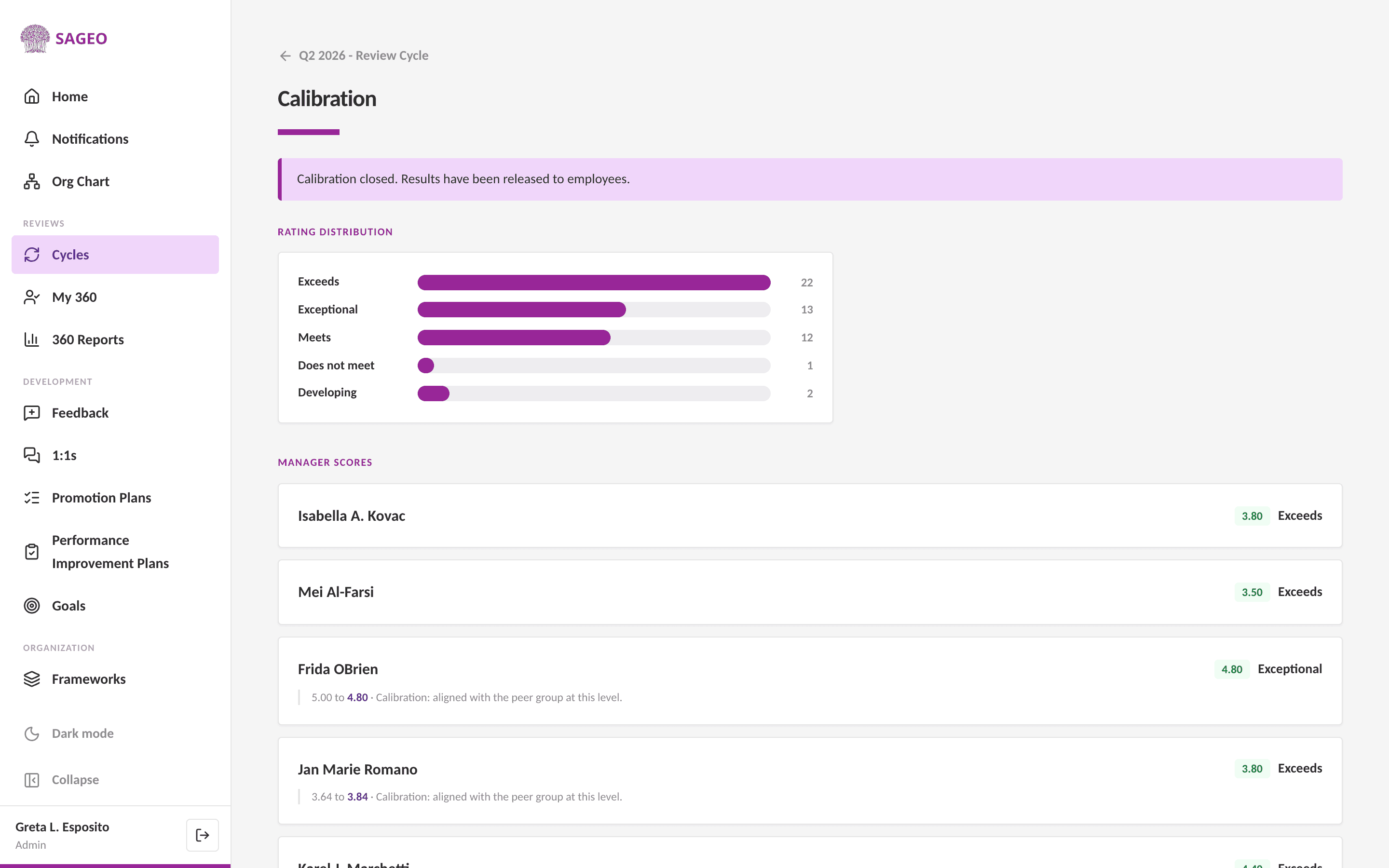
Sageo is a performance and culture platform, not a succession planning product. It has no 9-box, no successor slates, no talent pools, and no readiness pipelines. What it does is produce the layer succession planning is only as good as: a competency and levelling framework generated from your values, calibrated 360 reviews scored against it, 360 reports that already surface who to promote and who to support, and AI development plans to close the gaps. The 9-box you build in a succession tool is only as honest as the performance and potential read underneath it, and that read is what Sageo makes defensible.
Key features
A values-based competency and levelling framework
the role architecture succession maps against, generated by AI rather than bought as a generic library.
Calibrated 360 reviews with an immutable audit trail, so the performance signal feeding any talent grid is consistent and defensible
360 reports that surface top performers and who needs support across your whole line, the raw material of a talent review
AI development plans drafted from review gaps, so an identified high-potential actually becomes ready
Private-by-design AI
personal identifiers stripped before any LLM call, and a person reviews every AI output, with the calibration audit trail behind every decision.
Best for
Teams of 10 to 1,000 that want the performance, competency and development foundation right before, or alongside, a dedicated succession tool, and that care about defensible, auditable people decisions.
Pricing
EUR 6 per seat per month, every module included, billed annually with a 10-seat minimum. Published and flat, in a category that is overwhelmingly quote-only.
What users say
Praised
- values-based frameworks, calibration rigor, and a concrete AI-governance story.
Watch out for
- no 9-box, pools, benches or readiness pipelines. If you need those, pair Sageo with a dedicated succession tool.
- Sageo is rated for performance and culture, not as a succession tool, so it carries no succession-specific G2 score.
Where it fits: the foundation, not the plan. Build the competency, calibrated-performance and development layer in Sageo, then feed it into a succession tool (or a full HCM suite) when you need benches and readiness pipelines. Its standout is governance, covered in section 7.
Tier 1: Enterprise HCM suites (full succession)

See how Sageo actually works
An interactive walkthrough of frameworks, 360 reviews, calibration, and monthly 1:1s.
Explore the Walkthrough SAP SuccessFactors
SAP SuccessFactors has one of the most feature-complete succession modules on the market, the enterprise reference standard. Succession lives in its Succession and Development module, with the most explicitly named succession object model in the field.
Key features
Talent flags (Impact of Loss, Risk of Loss, Key Talent, Future Leader, Emergency Cover) plus a potential rating
Succession nominations (internal and external) with a configurable readiness rating, talent pools, and talent search
Matrix grid reports (two 9-box views), a succession org chart with inline plans and vacant positions, and a succession lineage chart that shows the knock-on impact of a move
A deep development layer (development goals, career paths, Career Explorer ML) and AI-Assisted Successor Insights, with the Joule career and talent agent reaching general availability around May 2026
Best for
Large enterprises, practically 1,000-plus employees, that need named, structured succession objects inside one HR system. Around 12,000 customers.
Pricing
No standalone succession price. Succession rides in the Full HCM Suite edition, estimated around $38 per employee per month, with implementation often $100,000 to $500,000-plus. A 1,000-person deployment runs roughly $400,000 to $1,000,000-plus in year one.
What users say
Praised
- named succession objects out of the box, 9-box, and the succession lineage chart.
Watch out for
- a dated, slow UX, a steep learning curve, value-for-money scores around 3.7, and calibration that lives outside the module in Performance and Goals.
- Rated 4.1 on G2 (1,475 reviews) and 4.5 on Gartner Peer Insights (around 1,590); it won a 2026 succession-planning Top Rated award on TrustRadius.
Where it fits: the depth leader for enterprises that want the full, explicit succession object model in one data model, and can absorb the cost and the implementation.
 Workday
Workday is the other enterprise depth leader, with succession built natively into Workday HCM on a single data model shared across performance, calibration, skills, learning and core HR. Its draw is that everything feeding succession lives in one system.
Key features
A Critical flag on jobs and positions feeding reports like Critical Open Positions, Positions Without Plans and average successors per role (bench coverage)
Succession plans (internal and external candidates, auto-populatable from pools), succession pools, and nominations with a required readiness value (ready now, 1 to 2 years)
nBox 9-box via Calibration (a Calibrate Team task with hierarchical sign-off and timestamped autosave), plus talent cards
Skills Cloud and a Career Hub (opportunity marketplace, career-path builder), and an early-access Succession Agent that recommends future leaders
Best for
Large enterprise and upper mid-market that want one unified system across the whole talent lifecycle. Around 11,500 customers, including 65-plus percent of the Fortune 500.
Pricing
Quote-only with a high total cost of ownership. Core HCM is estimated around $14 to $28 per employee per month delivered, with talent and succession bundled on top and AI priced through consumption-based Flex Credits. A 4,000-person example lists near $1.44M a year.
What users say
Praised
- one data model across succession, performance, calibration, skills and learning, plus calibration rigor and scale.
Watch out for
- cost, long implementations, a learning curve, and the Mobley v. Workday AI-bias litigation, which signals exposure for algorithmic talent recommendations.
- Rated 4.2 on G2 (around 2,450 reviews) and 4.4 on Gartner Peer Insights.
Where it fits: the single-data-model enterprise choice, strongest when succession must share one system with everything else. Weigh the AI-bias litigation overhang for your own governance stance.
Cornerstone OnDemand
Cornerstone is a learning and talent suite where succession rides on a shared skills and performance spine, unified under Cornerstone Galaxy. Its differentiator is native linkage between succession, a real skills ontology (SkyHive), and a market-leading learning library.
Key features
A Succession module with talent pools of high-performing and high-potential employees, a succession snapshot, talent search and succession tasks
A Performance and Potential grid (a four-quadrant, 9-box-style matrix covering performance, impact of loss, potential and probability of loss) with a color-coded helicopter view
Configurable readiness levels, risk categories and visual succession charting (bench strength, flight risk), per third-party write-ups
An AI Skills Engine on the SkyHive knowledge graph, and a 2025 move to a system of agents with AgentReady governance
Best for
Mid-market to large enterprise and government, typically 1,000-plus employees, that want succession wired to a genuine skills ontology and the strongest learning library in the set.
Pricing
Opaque, with no public tiers. Third-party estimates put the full talent suite around $15 to $25 per user per month, with a median verified contract near $19,920 a year and implementation 20 to 100 percent of year-one subscription.
What users say
Praised
- learning-linked development, the SkyHive skills ontology, and enterprise and public-sector scale.
Watch out for
- a clunky, dated UI and heavy admin burden (the dominant complaint), weak out-of-box reporting, and opaque pricing.
- Rated 4.0 on G2 (123 Performance reviews) and 4.1 on Capterra (35).
Where it fits: the choice when succession should be driven by skills and tightly linked to learning, for an enterprise that can absorb the configuration effort.
 UKG Pro
UKG Pro is an enterprise HCM, payroll and workforce-management suite where succession is a module inside UKG Pro Talent. It is payroll and WFM-first, with succession as one talent add-on, and its edge is predictive analytics trained partly on decades of Great Place To Work data.
Key features
A Succession module to find, track and compare successors for roles, assess readiness for future roles, and model the impact of a successor's move
Individual development plans and learning recommendations tied to succession
Predictive talent analytics
a Retention Predictor (12-month flight risk), a High Performer Predictor, and an Engagement Measure.
UKG Bryte AI, with a Promotion Agent as the nearest succession-adjacent capability; a 9-box and calibration appear in third-party write-ups but not UKG's official succession profile
Best for
Mid-market to large enterprise that want succession attached to a deep payroll, compliance and workforce-management core. Over 80,000 organisations across UKG.
Pricing
Quote-only, with succession bundled in the Talent add-on on top of the core (roughly $27 to $41 per employee per month for Pro), and implementation 40 to 70 percent of annual fees.
What users say
Praised
- payroll and compliance depth, predictive talent analytics, and scale.
Watch out for
- a reviewer calling the succession module "not very flexible," cross-module data-sharing complaints, long implementations, and the 2021 Kronos ransomware incident and $6M settlement in UKG's history.
- Rated 4.3 on G2 (around 2,206 reviews) and 8.2 on TrustRadius.
Where it fits: the pick when payroll and workforce management are the center of gravity and succession needs to sit beside them, with strong retention prediction as the standout.
 Darwinbox
Darwinbox is a modern, mobile-first cloud HCM suite, strong across India, South-East Asia and the Middle East and pushing into the US and UK. It markets succession as "continuity engineering," built on a skills ontology, and is a Gartner Challenger for Cloud HCM Suites.
Key features
Skills-first successor identification grounded in a skills ontology, with readiness measured by role
Individual development plans, a holistic talent profile, and a vertical-plus-lateral career architecture
Real-time dashboards for retirement risk, bench health and readiness levels, plus an AI attrition agent for flight risk
An aggressive 2025 agentic-AI build-out (a Super Agent orchestrator with MCP support); named 9-box, calibration and talent-pool containers are likely present but not publicly documented
Best for
Mid-market to large enterprise with an APAC or Middle East footprint that want a modern, mobile suite. Over 1,000 customers and 4 million-plus users across roughly 130 countries.
Pricing
Quote-based and highly variable, estimated $5 to $25 per employee per month, with a median buyer near $160,000 a year (low confidence) and implementation around $5,000 to $50,000.
What users say
Praised
- a unified modern suite, skills ontology, mobile UX, AI momentum and regional fit.
Watch out for
- under-documented succession internals, reporting and export complaints, and succession being absent from user reviews.
- Rated 4.4 on G2 (238 reviews) and 8.7 on TrustRadius (31).
Where it fits: the modern-suite choice for a globally distributed, mobile-first workforce, especially with an APAC or Middle East base, if you can live with thin public succession documentation.
PageUp
PageUp is an Australian unified talent suite whose center of gravity is recruitment, with succession as a bundled module in Performance and Succession. Its succession strength is an interactive, drag-and-drop 9-box calibration with live talent data.
Key features
Critical-role mapping (current and future critical roles with defined competencies)
Interactive drag-and-drop 9-box calibration, with talent data live in the discussion
A talent review (calibrate performance and potential, rate leadership capability) and a bench-strength view per role showing pipeline depth and successor readiness
Flight-risk flags and skill-gap monitoring with targeted training; all AI is recruiting-scoped, with no succession-specific AI
Best for
Mid-market to large and complex enterprise, strong in APAC, higher education, healthcare and government. Over 8 million users across 190-plus countries.
Pricing
Quote-only and perceived premium, with roughly a 5-month implementation and the weakest value-for-money sub-score in parts of the field.
What users say
Praised
- APAC, public-sector and higher-ed fit, recruitment depth, and the interactive 9-box.
Watch out for
- no succession AI, no documented org charts, talent pools or IDPs, weak reporting, and a steep learning curve. A 2018 data breach sits in its history (the succession module was stated to be unaffected).
- Rated 4.4 on G2 (141 reviews); succession ratings rest on very few reviews.
Where it fits: the choice for recruitment-led, APAC or public-sector organisations that want a hands-on 9-box calibration and bench-strength views in one suite.
PeopleFluent
PeopleFluent is a legacy integrated talent suite with genuine succession heritage (from Authoria), now owned within Learning Technologies Group. Its succession is a real module but under-invested, with thin public documentation.
Key features
A dedicated Succession and Development Planning product
track high-potentials and career-path options, understand your bench (skills, strengths, potential, who is ready).
A drag-and-drop calibration interface and succession-scenario planning
Predictive attrition analytics for flight risk
No "9-box", formal slates or numeric readiness ratings are named publicly; the public succession page is thin
Best for
Mid-market to large enterprise, including regulated industries, that already run PeopleFluent and value its configurability and calibration interface.
Pricing
Quote-only and top-tier on cost, with roughly a 5-month implementation.
What users say
Praised
- an integrated enterprise suite, configurability, and a genuine calibration and planning interface.
Watch out for
- thin public succession detail, a dated UX, small and old reviews, and ownership-transition uncertainty (LTG is being taken private by General Atlantic).
- Rated 4.0 on G2 (32 reviews) and 3.9 on Capterra (17), on a small and dated review base.
Where it fits: mostly a fit for existing PeopleFluent customers; its succession heritage is real but has been under-invested relative to the leaders.
The skills and competency specialist
 TalentGuard
TalentGuard is a competency and skills-first specialist where succession is the downstream output of a governed skills framework. It bridges the enterprise and mid-market tiers: real succession pools and a readiness engine at a fraction of enterprise cost, but a tiny review base.
Key features
Talent Finder (search by skills), an Ideal Candidate Criteria wizard, and unlimited succession pools (by role, person or project)
A Readiness Engine with real-time readiness scores and a Risk Mitigation Center for risk and gap analysis
A governed skills architecture (a versioned, SME-approved skills library with L1 to L5 behavioural anchors), career pathing and development planning
WorkforceGPT for role and skill taxonomies; calibration is not inside succession (it lives in a separate Competency Manager)
Best for
Mid-market to enterprise organisations that already believe in skills frameworks and want succession built on a governed competency ontology without an enterprise-suite price.
Pricing
Quote-based and role plus module based. A secondary source cites roughly $12 per user per month for the tier that holds succession, but the data is unreliable; confirm directly.
What users say
Praised
- the depth of competency and skills governance, and career pathing feeding succession.
Watch out for
- no calibration in succession, a dated UI, integration friction, and a near-zero succession review base from a small company.
- Rated 4.6 on G2, but on only 4 reviews, and the succession listing has none; treat all ratings as directional.
Where it fits: the specialist for a skills-governed succession pipeline on a mid-market budget. Validate it with a hands-on demo and references, given how thin the independent review signal is.
Tier 2: Modern performance platforms (9-box plus light succession)
 Lattice
Lattice is a modern performance, engagement and HRIS platform that shipped a dedicated Succession Planning module in November 2025. Its real strength is a mature, well-liked talent review, 9-box and calibration, and succession is now bundled free with Performance.
Key features
Mature talent reviews, 9-box and calibration; succession plans can be created directly from calibrations
A new succession hub tracking incumbents and successors, with readiness and attrition-risk tagging and a near-real-time bench-strength dashboard
Transparent per-seat pricing and a huge review base, the largest in this set
Lattice AI bundled in; no standardised readiness taxonomy or org-chart-driven critical-role automation yet
Best for
SMB to mid-market, and some enterprise, that want a credible 9-box and a first succession module without an enterprise-suite project. Around 5,000 customers.
Pricing
Published per-seat: Performance from $10 per seat per month with succession included free, a $4,000 annual minimum, and no implementation fees.
What users say
Praised
- 9-box and calibration quality, succession bundled free, polished UX and transparent pricing.
Watch out for
- no readiness taxonomy or named slates, no org-chart succession view, reporting-flexibility limits, and a succession module under a year old.
- Rated 4.6 on G2 (4,132 reviews, the largest base here) and 4.5 on Capterra (207).
Where it fits: the mid-market default for a strong 9-box and a free, if young, succession module at a published price. Pressure-test the reporting depth if a board wants formal bench coverage.
 Quantum Workplace
Quantum Workplace is an engagement-first platform with performance, development and recognition, where succession sits at the top of the Development tier on a talent-reviews engine. Its differentiator is linking engagement and retention signals into talent reviews.
Key features
Talent reviews rating Employee Impact, Growth Trajectory and Retention Risk, with a configurable grid (4-box, 9-box or 16-box) and a Calibration Mode
Successor nominations that pull into succession plans, plus succession readiness tracking in the Development tier
A Retention Radar and stay-interview flags feeding the review
Cue AI (summaries, action planning, goal generation) and AI competency mapping; no succession-specific AI, and no critical-role ID, org charts or named talent pools
Best for
Mid-market to large, knowledge-based and distributed workforces (healthcare is a strength) that want engagement, talent reviews and light succession in one platform. Around 2,200 customers.
Pricing
Quote-based across three modular tiers (Engagement, Performance, Development), with the richest succession features gated to the top tier and no free trial.
What users say
Praised
- engagement-to-retention linkage, talent reviews, calibration and modular rollout.
Watch out for
- no critical-role ID, org charts or named talent pools, succession gated to the top tier, and zero succession user validation.
- Rated 4.3 on G2 (915 reviews) and 4.6 on Capterra (around 160).
Where it fits: the choice when engagement and retention are the lead story and you want talent reviews and readiness to come along, rather than a deep standalone succession engine.
 PerformYard
PerformYard is a service-led performance and engagement platform where "Succession Planning" is a label on the Talent Development tier over a native 9-box, competency readiness and development goals. Its edge is people and support, with a clean 9-box inside the performance process.
Key features
A native 9-box (performance by potential) with calibration views, built into the performance process rather than a separate spreadsheet
Competency readiness (skills by role and level), development goals and data-driven career pathing
Reporting and analytics with 9-box and calibration views, plain-language AI report generation and employee insights
No critical-role ID, successor slates, readiness pipeline, org charts or flight-risk; the "succession" label outruns the workflow
Best for
SMB to mid-market (roughly 50 to 1,000 employees) that want clean reviews, a native 9-box and hands-on service over succession depth. Over 2,000 organisations.
Pricing
Published per-seat across two tiers at $5 to $15 per person per month, billed annually, with AI included free; the Talent Development tier holds the succession label. Vendr median around $13,565 a year.
What users say
Praised
- clean review cycles, repeatedly praised customer service and dedicated success managers, and the native 9-box.
Watch out for
- no real succession module, a clunky interface, limited customization, and an AI-training transparency gap.
- Rated 4.7 on G2 (1,261 reviews, the highest score in this set) and 4.6 on Capterra (188).
Where it fits: the service-led, value pick for a native 9-box inside the performance process. Just know the succession label is a 9-box and development goals, not benches and readiness pipelines.
Trakstar Perform
Trakstar Perform (now migrating to Mitratech Perform) is an SMB and mid-market performance tool that is honest about not doing true succession: its succession story is a 9-box report that "informs succession planning," plus solid calibration.
Key features
A configurable 9-box talent matrix built on review data (axes, labels and thresholds, with CSV and PDF export)
Genuine calibration with logged adjustments (timestamp and rationale) and pre- and post-reports
Strong 360 and multi-rater reviews and customizable cycles
No named-successor tracking, critical-role mapping, readiness timelines, bench strength, org charts or flight-risk; no AI applied to succession
Best for
SMB to mid-market teams (roughly 50 to 1,000-plus) that want easy performance reviews and a 9-box for talent identification, not succession management.
Pricing
Quote-based; the category benchmark is roughly $3.50 to $8 per user per month (not confirmed Trakstar rates), and some reviewers flag contract lock-in.
What users say
Praised
- easy performance reviews, strong 360, customizable cycles and calibration.
Watch out for
- no true succession (a 9-box report only), clunky integrations, and inconsistent support.
- Rated 4.2 on G2 (463 reviews, under Mitratech Perform) and 4.4 on Capterra (287).
Where it fits: an honest 9-box for talent identification inside a straightforward performance tool. Take its own framing at face value: talent identification, not succession management.
Tier 3: Org-charting and visualization layers
ChartHop
ChartHop is a people-analytics and org-chart platform, not a purpose-built succession tool. Its succession story is a real-time org chart plus people data and a brand-new 9-box, a visualization layer rather than a managed workflow.
Key features
A built-in Nine Box (and 12-box or 16-box) shipped June 2026 inside its Bubble Chart; a visualization, not a governed workflow
Real-time org charts and scenario and headcount planning, with a finance impact view
People analytics with AI-surfaced flight-risk alerts, and strong two-way HRIS sync (around 29 integrations)
No successor slates, readiness tiers, bench-strength tracking or critical-role scoring; succession is absent from its own product pages
Best for
SMB to mid-market, tech-leaning teams that want org charts, headcount and scenario planning, with a 9-box as a visual add-on.
Pricing
Modular per-employee pricing, now quote-only, with roughly a $9,000 minimum and implementation around $5,000 to $25,000-plus. No separate succession SKU.
What users say
Praised
- real-time org charts, scenario and headcount planning, and strong HRIS sync.
Watch out for
- no successor pools, readiness or bench, a new and unproven 9-box, and no critical-role ID or career pathing.
- Rated 4.4 on G2 (171 reviews) and 4.6 on Capterra (79).
Where it fits: an org-chart and analytics layer with a visual 9-box, for teams that want to see and model people data, not run a governed succession process.
Ingentis org.manager
Ingentis org.manager is an org-charting, org-design and workforce-modeling layer that sits on top of an HRIS (SAP, Workday, Oracle, ADP, UKG). It visualizes and models succession data that lives in the source system; it does not own or compute it.
Key features
Identify key and critical positions in the org chart, with a weak-succession overview flagging under-covered roles and retirement-timing analysis
Talent pools and profiles (surfacing readiness, risk and flexibility read from the HRIS), a succession chain that ranks candidates and flags succession loops, and a 9-box matrix
Best-in-class automatic org charts plus drag-and-drop sandbox what-if modeling (reorg, M&A, consolidation), with no write-back
An SAP Endorsed, premium-certified app; "AI-ready" positioning only, with no shipped succession AI
Best for
SMEs to global enterprise, skewing to large SAP, Workday and Oracle shops that want best-in-class org visualization and scenario modeling over their existing HR data. Over 2,000 customers.
Pricing
Quote-only, as an add-on to the HRIS, with a budget license plus add-ons and implementation and consulting.
What users say
Praised
- org-chart flexibility, scenario and what-if modeling, deep SAP, Workday and Oracle integration, and support.
Watch out for
- it is a layer, not a source of truth (data must exist in the HRIS), no write-back, and thin succession user validation.
- Rated 4.7 on G2 (23 reviews) and 4.7 on Capterra (65, with a 5.0 support sub-score), on a modest sample.
Where it fits: the enterprise visualization and reorg-modeling layer over an existing HRIS, when the data already lives in SAP or Workday and you want to see and simulate it, not govern it.
Tier 4: Payroll-first SMB suite
isolved
isolved is a payroll-first HCM suite (payroll, HR, benefits, time) for US SMB and mid-market, with no dedicated succession module. A 9-box inside its Share and Perform module is the ceiling of its succession capability.
Key features
A 9-box inside Share and Perform (performance versus potential), described in its own materials as the extent of its succession capability
Development plans tied to career paths and competencies, 360s, goals, and a Learn and Grow LMS (95,000-plus courses)
Predictive people analytics for turnover risk, and interactive org charts (visualization only, no succession overlays)
No critical-role ID, successor bench, readiness or role-tied talent pools; a Signal retention agent is the only succession-adjacent AI
Best for
US SMB to mid-market that want a strong payroll, HR, benefits and time core, where a 9-box is enough of a "succession" story. Roughly 145,000 to 200,000 employers.
Pricing
Quote and partner-based and modular, with a teaser near $9 per employee and a realistic loaded SMB range around $25 to $50 per employee per month; talent modules are paid add-ons.
What users say
Praised
- a strong payroll, HR, benefits and time core, SMB fit and breadth.
Watch out for
- no succession module (the 9-box is the whole story), bugs and slow fixes, hidden fees, and limited reporting.
- Rated 4.3 on G2 (1,328 reviews) and 3.9 on Capterra (656).
Where it fits: a payroll-first SMB suite where succession is a 9-box, not a process. Buy it for the payroll and HR core, not for succession.
6. Is a 9-box the same as succession planning?
No, and conflating them is the most common and most expensive mistake in this category. A 9-box is a performance-versus-potential grid: a snapshot that helps you talk about talent. Succession planning is the process of making sure your critical roles have ready, developing successors. The grid is one input; the plan is the whole job.
Several tools here market "succession" but deliver only a 9-box: Trakstar (a 9-box report, and it says so honestly), isolved (a 9-box inside performance), ChartHop (a new, visual 9-box), and arguably PerformYard (a 9-box with a succession label). That is not a criticism of the 9-box, which is genuinely useful. It is a warning to read the feature list, not the headline. If a product cannot show you named successor pools, a readiness taxonomy, and critical-role coverage, you are buying a talent review, and you should price and plan accordingly.
The buyer's move: in every demo, ask the vendor to show you an actual critical role with its successor bench, each successor's readiness level, and the development plan closing the gap. If they can only show you a grid, you have your answer.
7. How is AI changing succession, and the EU AI Act risk?
AI is the loud theme for 2025 and 2026, but in succession specifically it is mostly announced, not shipped. Two things actually matter for a buyer today.
- Most succession AI is still roadmap
- Only Workday (an early-access Succession Agent) and SAP (live Successor Insights, with the Joule agent reaching general availability around May 2026) have genuinely succession-targeted AI. What you mostly get today is assistive: summaries, skills inference, and flight-risk prediction (UKG, isolved, Darwinbox, Lattice, Quantum, ChartHop). Useful, but not autonomous succession.
- Succession AI is high-risk under the EU AI Act
- Using AI to recommend, rank or score people for promotion and succession is high-risk under Annex III of the EU AI Act, which brings human-oversight, transparency, record-keeping and non-discrimination duties, and the deployer (you) carries them. Almost no vendor in this field publishes a specific EU AI Act stance, and the Mobley v. Workday case shows the litigation exposure around algorithmic talent decisions is real.
The question to put to every vendor
If an AI suggests a successor or scores potential, who reviews it, what data was it trained on, is personal data stripped before processing, and can you produce an audit trail of the decision? This is exactly the oversight the AI Act expects, and it is the one area where the whole field is weak. Sageo was built around it: identifiers stripped before any LLM call, a person approves every AI output, and an immutable audit trail behind every decision. See our plain-English guide to the EU AI Act for what high-risk actually requires.
8. How much does succession planning software cost?
This is one of the least transparent categories in HR software. Two patterns dominate.
- The enterprise tier is quote-only
- SAP, Workday, Cornerstone, UKG, Darwinbox, PageUp and PeopleFluent all sell succession bundled inside a larger suite, never standalone, on quotes that run from tens of thousands to seven figures a year once implementation is included. Implementation alone is often 20 to 100 percent of the first-year subscription.
- Only two publish real per-seat pricing
- Lattice ($10 to $13 per seat, with succession free on the Performance plan, a $4,000 minimum) and PerformYard ($5 to $15 per person). ChartHop used to publish and moved to quote-only. Everyone else is quote-based.
- Watch: succession is never the whole bill
- In the suites, succession is a module on top of a core HCM, so the real cost is the whole platform, not a succession line item. Budget for the suite.
- Watch: implementation and time-to-value
- Enterprise implementations run many months to over a year. If you need a working talent review in a quarter, the mid-market performance tools (Lattice, PerformYard) get there far faster than the suites.
9. What should you ask before you buy?
- Show me a real critical role with its successor bench, each successor's readiness level, and the development plan closing the gap. Can the product actually do this, or is it a 9-box?
- Does it have named talent pools, successor nominations, a readiness taxonomy, and critical-role mapping as shipped features, not roadmap?
- Where does calibration live? In several suites it sits outside the succession module, which changes the workflow.
- What system does our HR data already live in, and does this tool read from it or duplicate it? Visualization layers like Ingentis and ChartHop need the data to exist elsewhere.
- If AI suggests successors or scores potential, who reviews it, what is it trained on, is personal data de-identified, and can we produce an audit trail? This is an EU AI Act high-risk use.
- Can you give me a reference customer who actually runs succession on this, not just the LMS or payroll? Succession reviews are thin everywhere.
- What is the real total cost, including the suite the module sits in and the implementation, and how long to a working process?
10. Where does Sageo fit?
Sageo is not a succession planning tool, and that is the honest version. It has no 9-box, no successor slates, no talent pools, and no readiness pipelines. What it is is the foundation succession planning is only as good as.
The foundation, not the plan: a succession decision is only as sound as the performance and potential read underneath it. If that read is a manager's gut feeling, the fanciest 9-box in the world just makes a guess look official. Sageo produces the other thing: a competency framework built from your values, calibrated reviews scored against it, 360 reports that surface who to promote and who to support, and development plans to close the gaps. Build that first, and whatever succession tool you add sits on honest inputs.
- A values-based competency and levelling framework, the role architecture a successor bench maps against, generated by AI rather than bought as a generic library.
- Calibrated, auditable performance data, so the talent-grid placements feeding succession are consistent and defensible rather than a popularity contest.
- AI development plans drawn from review gaps, turning an identified high-potential into a ready one.
- The one thing the whole field is weak on: AI governance. Succession and promotion AI is high-risk under the EU AI Act, and Sageo strips identifiers before any LLM call, keeps a person in the loop on every AI output, and holds an immutable audit trail, at a published per-seat price in a quote-only category.
Honest limits
If you need named benches, readiness pipelines, critical-role coverage and succession org charts, buy a dedicated succession tool or an HCM suite from the tiers above, and pair it with Sageo. Sageo's job is to make the inputs trustworthy and the AI defensible, which is the part most tools quietly assume you already have. For many teams, getting that foundation right is the higher-leverage move than buying succession software on top of shaky data.
11. How was this guide researched?
Compiled in October 2026 from vendor product and administrator documentation, G2, Capterra, TrustRadius and Gartner Peer Insights listings, and procurement aggregators. Ratings and review counts are as of that date and are mostly suite-level, because dedicated succession-module listings carry almost no reviews across the field, so treat succession-specific claims as directional and demand real succession references. Quote-only prices are estimates from public data, and figures marked (est) are not list prices. Several products marketed as "succession" are, on inspection, a 9-box, which this guide flags. All product names are trademarks of their owners, and this guide is not endorsed by any of them.
Frequently asked questions
What is succession planning software?
Succession planning software helps a company make sure its critical roles have identified, developing successors. Real succession tools include critical-role mapping, named talent pools and successor nominations, readiness levels (ready now, 1 to 2 years), a 9-box with calibration, bench-strength analytics, and development linkage. Many tools marketed for succession only provide a 9-box talent grid, which is one input, not the full plan.
What is the best succession planning software?
It depends on how much real succession you need. For deep enterprise succession in one data model, Workday or SAP SuccessFactors; for skills- and learning-linked succession, Cornerstone; for an easy, affordable mid-market tool, Lattice (succession free with Performance) or PerformYard; for a skills-governed pipeline, TalentGuard; and for org visualization and scenario modeling, Ingentis or ChartHop. Sageo is the performance and development foundation you build underneath whichever you choose.
Is a 9-box grid the same as succession planning?
No. A 9-box is a performance-versus-potential grid, a snapshot that helps you discuss talent. Succession planning is the process of ensuring critical roles have ready successors, which also needs talent pools, readiness levels, critical-role mapping, bench analytics and development plans. Several tools (Trakstar, isolved, ChartHop, arguably PerformYard) market a 9-box as succession, so read the feature list, not the headline.
How much does succession planning software cost?
Most of the category is quote-only. The enterprise suites (SAP, Workday, Cornerstone, UKG, Darwinbox, PageUp, PeopleFluent) sell succession bundled inside a larger HCM suite, running from tens of thousands to seven figures a year once implementation is included. Only Lattice ($10 to $13 per seat, succession free on Performance) and PerformYard ($5 to $15 per person) publish real per-seat pricing.
Does succession planning AI fall under the EU AI Act?
Yes. Using AI to recommend, rank or score people for promotion and succession is high-risk under Annex III of the EU AI Act, which brings human-oversight, transparency, record-keeping and non-discrimination duties, and the deployer (the employer) carries them. Almost no succession vendor publishes a specific EU AI Act stance, so ask who reviews AI suggestions, what the model is trained on, whether personal data is de-identified, and whether you can produce an audit trail.
What is the difference between succession planning and talent management software?
Talent management is the broader category covering performance, goals, development, compensation, learning and succession. Succession planning is one module within it, focused specifically on identifying and developing successors for critical roles. Many succession tools are therefore modules inside a larger talent-management or HCM suite rather than standalone products.

Written by
Deepti GuptaCo-founder, Sageo
18+ years building people functions from the ground up at Myntra, Freshworks and Dream11, scaling teams from 100 to 2,500 people and designing company-wide performance and compensation systems. Sageo automates the frameworks she has built by hand throughout her career.

Reviewed by
Vinayak RaviCo-founder, Sageo
19+ years of B2B SaaS go-to-market leadership. He built the organic growth engine at Freshworks through its rise to a public company and has led demand generation at some of the sector's fastest-scaling software startups.
Product names and logos are trademarks of their respective owners, shown here for identification only and not as endorsements.
All guides