Compliance Guide · October 2026
The New York Pay Transparency Law, in Plain Terms
What the state law really requires, how New York City's version differs, and how to get compliant across both without tracking two rulebooks by hand.



A note on who wrote this
This is general information from the team behind Sageo, written for people leaders getting oriented. It is not legal advice and does not account for your specific situation. New York has a state law and a separate New York City law that overlap, and local rules change, so verify the current rules with qualified New York counsel before acting. The figures in any example are illustrative.
The short version
- New York has two layers that stack. State law covers the whole state. New York City has its own, older ordinance on top. If you hire into the city, both can apply to the same posting.
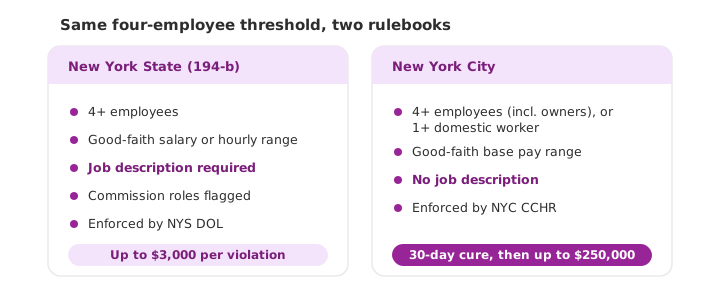
- State law (Labor Law 194-b) applies to private employers with 4 or more employees and requires a good-faith pay range plus a job description in every job, promotion, and transfer posting. Commission-based roles have to say so.
- The city law applies to employers with 4 or more employees (counting owners) or one or more domestic workers, with at least one employee in the city. It requires a good-faith minimum and maximum base salary or wage range. It does not require a job description.
- The threshold is low. Four employees pulls in most real businesses, which is why New York reaches far more small employers than California does.
- State penalties run up to $3,000 per violation. The city gives a 30-day cure on a first complaint, then civil penalties up to $250,000. The groundwork that avoids all of it, honest ranges built on a real job architecture, is the part you can start today.
1. What the New York pay transparency law actually is
New York did not pass one law. It built a stack.
The city moved first. New York City's Salary Transparency Law took effect on 1 November 2022, amending the city's Human Rights Law so that leaving a pay range out of a job advertisement became an unlawful discriminatory practice. The state followed. New York Labor Law Section 194-b extended a posting rule across the entire state, and it went further than the city in one respect by also requiring a job description.
Around those two posting rules sits a wider set of long-standing New York protections: the right of employees to discuss their wages, detailed written wage notices at hire, and a statewide salary history ban. Together they make New York one of the most comprehensive pay transparency regimes in the country. For an employer, the practical job is handling two overlapping posting rules at once.
2. Why it reaches you, even from outside New York
The trigger is the job, not your head office. A company based in London, Bengaluru, or San Francisco is in scope the moment it advertises a role that will be performed, even partly, in New York.
Remote work widens that reach. The state rule covers positions performed at least partly in New York and remote positions that report to a supervisor or office located in New York, wherever the person physically sits. The city rule covers any role that can or will be performed, in whole or in part, in New York City, including from home. So a fully remote job that reports into a New York manager generally needs a compliant range, even if nobody ever sets foot in the state.
New York was an early mover, and the framework you build to satisfy it, clean pay bands, documented criteria, a job architecture that holds together, is most of what California, Washington, Colorado, and the next state ask for too. Build it once and you are ahead of the next law instead of chasing each one.
3. The two layers, kept straight
The single most useful thing to hold in your head is which rule is doing what. They overlap but they are not identical.
- State law (194-b) covers the whole state
- Range plus job description, with a commission flag. Enforced by the New York State Department of Labor.
- New York City law sits on top for city-based roles
- Range only, base pay, no job description required. Enforced by the NYC Commission on Human Rights.
A role performed in Buffalo answers to the state rule alone. A role performed in Manhattan answers to both, so you satisfy the stricter combination: a range, a job description, and a commission flag where relevant, with the range expressed as good-faith base pay. When in doubt for a city role, meet both.
4. The state rule: Labor Law 194-b
If you are a private employer with 4 or more employees, every advertisement for a job, promotion, or transfer opportunity has to carry two things.
- A good-faith pay range
- The minimum and maximum annual salary, or the minimum and maximum hourly rate, that you honestly believe is accurate at the time of posting. No open-ended ranges.
- A job description, where one exists
- This is the state's addition and the thing employers most often miss, because the city law does not ask for it.
If the role is paid wholly or partly on commission, the posting has to say so. The rule applies to internal postings as much as external ones, so a promotion or transfer opening gets the same range and description as an outside hire.
Beyond postings: the rest of the state regime
Three more state duties sit alongside 194-b, and they apply to employers of every size, not just those with four or more.
- Wage discussion protection
- Employers cannot stop employees discussing their pay, though reasonable limits on time and place are allowed.
- Wage notices at hire
- New hires get a written wage notice, in English and in their primary language, and have to acknowledge it in writing. Those acknowledgments are kept for six years.
- Advance notice of changes
- Employees get seven days' notice of a change to their wage information.
5. The city rule: NYC Salary Transparency Law
New York City's version is narrower in what it asks for but harsher in what it costs.
It applies to employers with 4 or more employees (the count includes owners and can include independent contractors and family members) or to any employer with one or more domestic workers, as long as at least one employee works in the city. The four do not have to work in the same place or all in the city; one in-city employee is enough.
Every advertisement for a job, promotion, or transfer opportunity that can or will be performed in the city has to carry a good-faith minimum and maximum salary or hourly range. Two details catch people out.
- "Salary" means base pay only
- The city range is base wage or salary. Bonuses, commissions, equity, and benefits do not go in the range, though you can describe them separately.
- The range cannot be open-ended
- "$80,000 and up" or "up to $120,000" fails. If there is genuinely no flexibility, the minimum and maximum can be identical, for example "$30 per hour."
Unlike the state, the city does not require a job description in the advertisement.
6. The salary history ban
Both layers rest on top of New York's statewide salary history ban, in force since 2020. Employers may not ask applicants or their current employers about pay history, and may not rely on history to decide whether to hire or what to offer. New York City banned the practice even earlier. If an applicant offers the number unprompted, it can be considered, but it cannot be requested. The purpose matches the rest of the regime: stop past underpayment from setting future pay.
7. Penalties and enforcement
Two enforcers, two very different ceilings.
State (194-b): enforced by the New York State Department of Labor's Division of Labor Standards. A complaint can be filed by an applicant, an employee, their representative, or a bargaining agent. Violations carry civil penalties of up to $3,000 per violation, and the law also bars retaliation against anyone who asks for the pay information the law requires.
New York City: enforced by the NYC Commission on Human Rights, where a missing range is treated as an unlawful discriminatory practice. The city gives a genuine on-ramp: no civil penalty for a first complaint if the employer cures it within 30 days of the Commission's notice. Miss that window, or commit a later violation, and penalties run up to $250,000. The Commission can also order back pay, policy changes, training, and other relief, and current employees have a private right of action.
Recordkeeping matters on both. Hold the history of your pay ranges, job descriptions, and wage-notice acknowledgments, the latter for six years, so you can show good faith if a posting is ever challenged. The through-line is familiar: the cheap moment to fix a range is before a complaint, not after.
8. The hard part: honest ranges you can defend
Most of this is procedural. Put a range and a description in the posting, flag commission, keep your records. The part that takes real work is making the range honest in the first place.
A good-faith range is only possible if you know what the role is worth and where a hire should land, which means a job architecture that holds together: levels that mean something, criteria for moving between them, and pay bands tied to both. Without it you are either posting a defensive band that invites scrutiny, or guessing, and across internal promotions and transfers the guessing compounds. Two people in comparable roles drift into different bands for reasons nobody can reconstruct, and the posting rule puts that drift on public display.
This is where pay transparency stops being a posting exercise and becomes an organisation-design one. The criteria you set for pay and progression are the same criteria your managers use in reviews, promotions, and offers. If they are inconsistent, New York's posting rules will expose it the next time you advertise a promotion. If they are clean and applied the same way for everyone, most of the risk is gone before anything is posted.
9. A readiness plan you can start now
Six moves, roughly in order. The posting fixes are quick. The foundation is slow, so start it first.
- 1. Work out which layers you are in
- Four or more employees puts you in the state rule. Any in-city employee at that size, or a domestic worker, adds the city rule. Map where your roles are performed and where remote roles report.
- 2. Fix postings for the stricter combination
- For city roles, meet both: a good-faith base-pay range, a job description, and a commission flag where relevant. For the rest of the state, range plus description plus commission flag. Audit live postings now, internal ones included.
- 3. Close out the rest of the state duties
- Wage notices at hire in the right languages, written acknowledgments kept six years, seven days' notice of wage changes, and no rules that stop staff discussing pay.
- 4. Fix the job architecture and pay bands
- The slow one. Build documented, gender-neutral levels, competencies, and progression criteria so your ranges are honest and your pay decisions are defensible. Everything else leans on this.
- 5. Run a privileged internal pay audit
- A trial pay-equity run on current data, ideally under legal privilege, to find exposure before a complaint does. Fixing a gap quietly now is far cheaper than fixing it in public.
- 6. Rewrite hiring and progression
- Strip salary-history questions, base offers on documented criteria rather than negotiation alone, and write progression rules down so they are applied the same way for everyone.
10. Where Sageo fits, and where it does not
We build Sageo, so take this in the spirit our guides are written in: we will tell you plainly what we do not cover. New York compliance is bigger than any one tool, and it needs a few different partners.
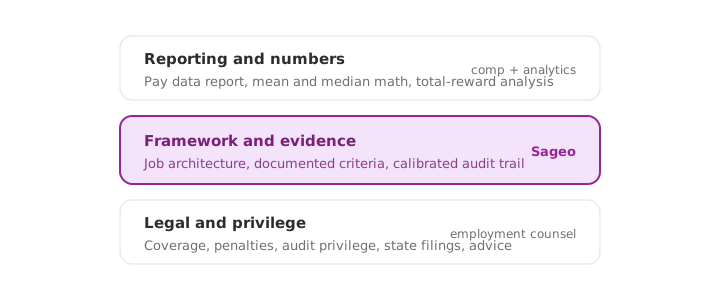
Sageo sits on the framework and evidence layer, which is steps four and five above, the part that takes longest. It turns your values and levels into a gender-neutral competency framework, keeps pay and progression decisions tied to documented criteria, and holds a calibrated, auditable record of how performance and advancement calls were made. That is exactly what you need when a good-faith range has to be honest, and when a promotion posting has to show a defensible band.
What Sageo helps with
- A gender-neutral competency and levelling framework, generated from your culture rather than bought as a static matrix.
- Documented, consistent criteria for pay progression and promotion.
- The job architecture that honest good-faith ranges rest on.
- A calibrated performance record with an audit trail you can defend.
What you need elsewhere
- Total-reward analysis across bonuses, commission, and equity.
- New York-specific legal advice and privilege over an audit.
- The posting pipeline and wage-notice generation in the right languages.
- Payroll data and record retention systems.
In short: a comp or people-analytics partner runs the numbers, New York employment counsel owns the legal risk, and Sageo makes sure the framework underneath both is clean, consistent, and documented. Get that foundation right and the rest gets much easier.
See it in SageoThe gender-neutral framework behind an honest pay rangeSee how Sageo turns your values and levels into a documented, defensible competency framework, with a calibrated audit trail behind every pay and progression call.Related guideThe California Pay Transparency Law, in Plain TermsHiring in California too? SB 642 just tightened the pay scale standard and widened equal pay.Related guideThe EU Pay Transparency Directive, in Plain TermsThe European counterpart, with gender pay gap reporting and the 5% joint-assessment trigger.How this guide was researched
Built from New York Labor Law Section 194-b, the New York City Human Rights Law salary transparency provisions and the Commission's guidance, the New York State Department of Labor's pay transparency materials, and current practitioner guidance, checked in October 2026. Where the state and city rules diverge, each was verified against its own enforcing agency.
- New York Labor Law 194-b
- The statewide posting rule, thresholds, and the job-description and commission duties.
- New York State Department of Labor, Pay Transparency
- Coverage, remote-work treatment, complaints, and penalties.
- NYC Human Rights Law and NYC Commission on Human Rights guidance
- The city threshold, base-pay range rule, 30-day cure, and $250,000 ceiling.
- Practitioner guidance, October 2026
- The state-versus-city comparison, recordkeeping, and enforcement detail.
Frequently asked questions
Who has to comply with New York's pay transparency law?
The state law applies to private employers with 4 or more employees for any job, promotion, or transfer opportunity performed at least partly in New York, or performed remotely while reporting to a New York supervisor or office. New York City's separate law applies to employers with 4 or more employees, counting owners, or any employer with at least one domestic worker, as long as one employee works in the city. Several other state-wide duties, such as wage discussion rights and wage notices, apply to employers of every size.
How is the New York City pay transparency law different from the state law?
Both use a four-employee threshold and both require a good-faith pay range in postings. The state law additionally requires a job description in the advertisement and a flag for commission-based roles, and caps penalties at $3,000 per violation. The city law requires only a base-pay minimum and maximum, no job description, and is enforced by the NYC Commission on Human Rights with a 30-day cure for a first complaint and penalties up to $250,000 after that. For a role performed in the city, satisfy both by meeting the stricter combination.
Does New York's pay transparency law cover remote jobs?
Yes. The state rule covers roles performed at least partly in New York and remote roles that report to a supervisor or office in New York, regardless of where the person works. The city rule covers any role that can or will be performed, in whole or in part, in New York City, including from home. A fully remote job reporting into a New York manager generally needs a compliant range.
What must a New York job posting include?
At the state level: a good-faith minimum and maximum annual salary or hourly range, a job description where one exists, and a statement if the role is commission-based. For a New York City role, a good-faith minimum and maximum base salary or hourly range that is not open-ended; if there is no flexibility, the minimum and maximum may be identical. Internal postings for promotions and transfers are covered the same way as external job ads.
What are the penalties for violating New York's pay transparency law?
State violations carry civil penalties of up to $3,000 per violation, enforced by the New York State Department of Labor, plus a ban on retaliation against anyone who requests the required pay information. New York City treats a missing range as an unlawful discriminatory practice: no penalty for a first complaint cured within 30 days of notice, then civil penalties up to $250,000 for an uncured or subsequent violation, along with possible back pay and other relief. Current employees have a private right of action under the city law.
Can employers ask about salary history in New York?
No. New York has banned salary history inquiries statewide since 2020, and New York City banned them earlier. Employers may not ask applicants or their former employers about pay history, or rely on it to decide whether to hire or what to pay. A figure volunteered without prompting may be considered but may not be solicited.

Written by
Deepti GuptaCo-founder, Sageo
18+ years building people functions from the ground up at Myntra, Freshworks and Dream11, scaling teams from 100 to 2,500 people and designing company-wide performance and compensation systems. Sageo automates the frameworks she has built by hand throughout her career.

Reviewed by
Vinayak RaviCo-founder, Sageo
19+ years of B2B SaaS go-to-market leadership. He built the organic growth engine at Freshworks through its rise to a public company and has led demand generation at some of the sector's fastest-scaling software startups.
Product names and logos are trademarks of their respective owners, shown here for identification only and not as endorsements.
All guides