Salary Benchmarking
Salary benchmarking is the process of comparing the pay for your roles against market data for similar roles, at similar levels, in similar locations and industries. Companies use it to set salary ranges, make competitive offers, and check internal fairness. The output is usually a pay range per role and level, anchored to a target market percentile.
Also known as: pay benchmarking, compensation benchmarking, salary survey, market pay
Reviewed
Key takeaways
- Salary benchmarking compares your pay to market data for similar roles, levels, and locations.
- The output is a pay range per role, anchored to a target percentile (for example P50 or P75).
- Compa-ratio (salary ÷ range midpoint) flags who is underpaid or overpaid.
- Benchmark at least yearly; pay that lags the market drives regrettable turnover.
At a glance
- Output
- A pay range per role and level
- Target
- A market percentile (P50, P75)
- Check
- Compa-ratio = salary ÷ midpoint
- Cadence
- At least annually
Why does salary benchmarking matter?
Pay that falls behind the market drives regrettable turnover and slows hiring. Pay set by negotiation alone creates unfair gaps inside the same team. Benchmarking gives every pay decision a defensible reference point.
How do you conduct salary benchmarking?
- Define your roles and levels clearly, based on scope, not titles.
- Pick your market: location, industry, company size.
- Choose data sources: salary surveys, compensation data providers, public postings.
- Match roles to the closest benchmark job by responsibilities.
- Set your pay position: for example, the 50th percentile (P50) for most roles, the 75th (P75) for hard-to-hire roles.
- Build ranges around that midpoint and review annually.
Compa-ratio
Compa-ratio = employee's salary ÷ midpoint of their pay range
1.0 means paid exactly at midpoint. Below 0.9 or above 1.1 is usually worth a look.
Worked example
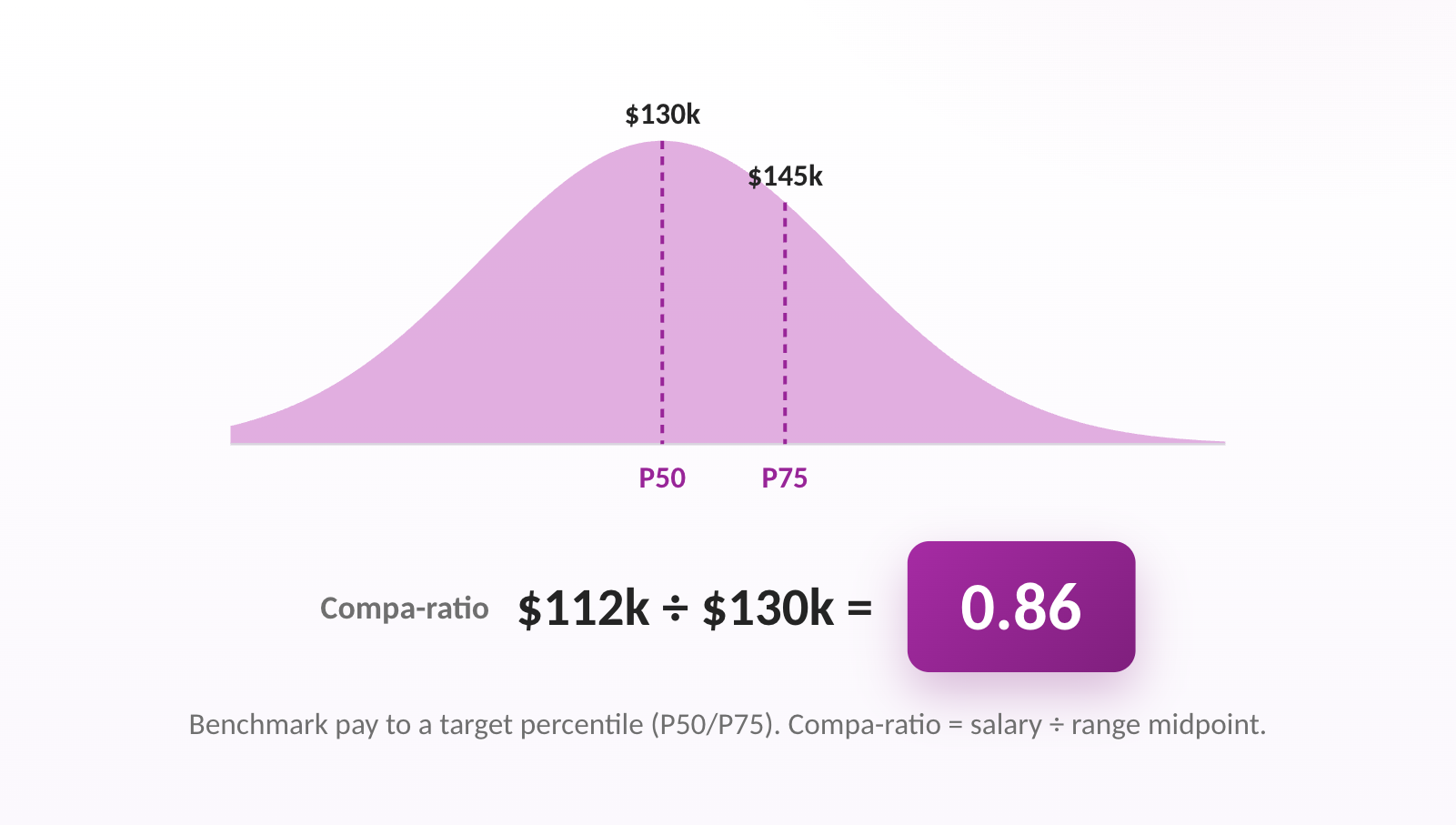
Market data puts a senior product designer at P50 $130,000 and P75 $145,000 in your market. You target P50 with a ±15% range: $110,500 to $149,500. A designer earning $112,000 has a compa-ratio of 0.86, so she goes on the list for the next review cycle.
Frequently asked questions
- How often should you benchmark salaries?
- At least once a year, and before opening a hard-to-fill role.
- What does P50 mean?
- The 50th percentile, or median. Half the market pays more, half pays less.
- How do you conduct salary benchmarking?
- Define roles by scope, pick your market (location, industry, size), choose data sources, match roles to benchmark jobs, set a target percentile, and build ranges around the midpoint.
- What is compa-ratio?
- An employee's salary ÷ the midpoint of their pay range. 1.0 is exactly at midpoint; below ~0.9 or above ~1.1 is usually worth a look.
- What do P50 and P75 mean?
- Market percentiles. P50 is the median (half pay more, half less); P75 means 75% of the market pays less. Many firms target P50 for most roles and P75 for hard-to-hire ones.
- What data sources are used for salary benchmarking?
- Paid compensation surveys (such as Radford, Mercer, or WTW), industry-specific surveys, and aggregated job-board data. Match your roles to the survey's benchmark jobs by scope, not just title.
See it in practice
Compare performance management software
Related terms