Compliance Guide · October 2026
EEO-1 Reporting, in Plain Terms
What the EEO-1 Component 1 report actually asks of you, who has to file it, how the mechanics work, and what the EEOC's 2026 move to scrap it changes, and does not change, for your obligations right now.



A note on who wrote this
This is general information from the team behind Sageo, written for people leaders getting oriented. It is not legal advice and does not account for your specific situation. Federal rules are in active flux in 2026, and state and local requirements vary and are changing quickly, so verify the current rules for every jurisdiction you employ in with qualified counsel before acting. Headcount figures in any example are illustrative.
The short version
- The EEO-1 Component 1 report is a once-a-year demographic census of your US workforce, filed with the EEOC. It sorts every employee into one of 10 job categories, then counts them by sex and by one of 7 race or ethnicity groups.
- It is mandatory, not voluntary, once you cross a threshold. Private employers with 100 or more employees are covered. So are federal contractors with 50 or more employees and a contract of 50,000 dollars or more.
- The count is a single snapshot. You pick one pay period between October 1 and December 31 of the reporting year and report everyone on that payroll, full-time and part-time.
- The whole requirement is under threat. In 2026 the EEOC voted to propose rescinding the EEO-1 and its sibling reports. As of mid-October 2026 that is still a proposal, not a final rule, so current filing and recordkeeping duties remain fully in effect.
- Even if the federal report disappears, your demographic data obligations do not. California, Colorado, Illinois, and other states run their own reporting regimes, several of them explicitly built to survive a federal rollback. The clean workforce data you need does not go away.
1. What the EEO-1 report actually is
The EEO-1 Component 1 report, formally Standard Form 100, has been around since 1966. It is an annual filing that gives the US Equal Employment Opportunity Commission a snapshot of your workforce demographics, organised by job category, race or ethnicity, and sex.
The report itself is deceptively simple: a grid. Down one side sit 10 job categories, from executives to service workers. Across the top sit the demographic groups, 7 race or ethnicity classifications crossed with sex. Every employee you count lands in exactly one cell. The EEOC aggregates these grids across the country to monitor employment patterns and to support investigations of discrimination.
The thing to hold onto is that Component 1 counts people, not dollars. It asks how many of each kind of worker you have in each kind of role. It does not ask what you pay them. There was once a Component 2 that collected pay data, but it was used only for 2017 and 2018 and has not been collected since. When people say "EEO-1" today, they mean Component 1.
2. Who has to file
Coverage is triggered by size and by your relationship to the federal government. You are required to file if any of the following is true.
- You are a private employer with 100 or more employees.
- You are a federal contractor with 50 or more employees and a federal contract, subcontract, or purchase order worth 50,000 dollars or more.
- You hold first-tier subcontractor or prime contractor status under that threshold.
- You employ more than 50 workers and act as an issuing and paying agent for US Savings Bonds, or as a depository of government funds, in any amount.
A few points that trip people up. The headcount includes both full-time and part-time employees. It is measured against your chosen snapshot payroll, not an annual average, so a company hovering near 100 can be in scope one year and out the next. And the report covers your employees only. You do not report on job applicants, and independent contractors are a separate question governed by how they are actually classified.
3. The three things you report on every employee
Before the mechanics make sense, three classifications do the work. Each employee gets counted once on each axis, and never in more than one bucket per axis.
- Job category
- Every person in the snapshot is sorted into exactly one of 10 EEO-1 job categories, based on the kind of work they do, not their title. More on the full list below.
- Sex
- The EEO-1 Component 1 collection currently recognises male and female. Employers may voluntarily report non-binary employees in the remarks section, but the main grid is still built on two categories.
- Race or ethnicity
- Seven groups, based on federal standards set by the Office of Management and Budget. The strongly preferred method is employee self-identification, offered as a voluntary question. Where an employee declines, you may rely on employment records or observer identification to complete the report.
4. The 10 job categories and 7 demographic groups
The two lists below are the backbone of the whole report. Get the mapping right once and the filing becomes a data exercise.
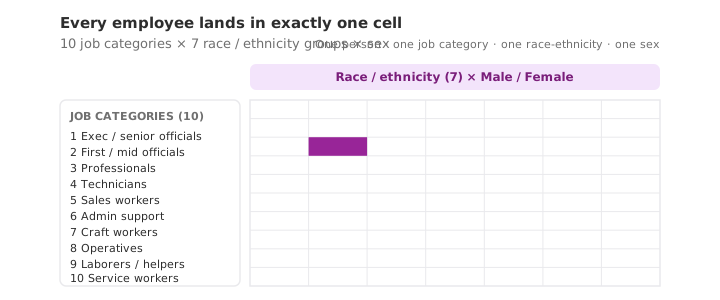
The 10 job categories, in the order the EEOC lists them
- Executive and senior-level officials and managers
- First and mid-level officials and managers
- Professionals
- Technicians
- Sales workers
- Administrative support workers
- Craft workers
- Operatives
- Laborers and helpers
- Service workers
The 7 race and ethnicity groups
- Hispanic or Latino (of any race)
- White (not Hispanic or Latino)
- Black or African American
- Native Hawaiian or Other Pacific Islander
- Asian
- American Indian or Alaska Native
- Two or More Races
The job category is assigned on the substance of the role, which is where judgement enters. Two people with the same title can belong in different categories if the work differs, and a clean internal job architecture is what lets you make that call consistently rather than guessing each year.
5. The workforce snapshot period
The EEO-1 does not ask for a yearly average or a December 31 headcount. It asks for a single pay period.
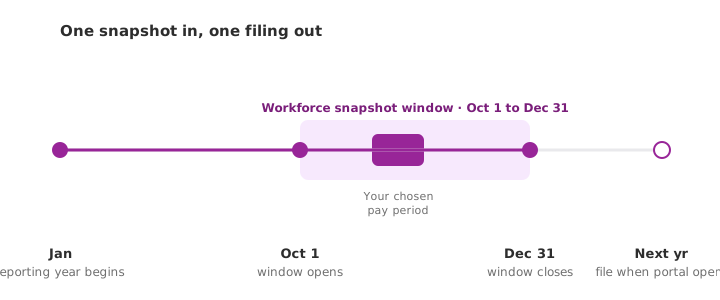
You choose any one pay period that falls between October 1 and December 31 of the reporting year. That is your workforce snapshot period. Every employee on the payroll during that pay period gets counted: full-time, part-time, temporary, and remote. Anyone who left before the period or started after it is out. You are free to pick a different pay period from one year to the next.
Because the snapshot sits in the final quarter, the data you need for a given year's report is generated at the end of that year, and the filing happens the following year once the EEOC opens its portal. The deadline is set annually by the Office of Management and Budget, usually announced on the EEOC's website, and has typically fallen in spring or early summer. This is why the fourth quarter matters even when no portal is open: the data has to be captured in the window, not reconstructed later.
6. How you actually file
The filing runs through the EEOC's online portal at eeocdata.org/eeo1. The shape of it, once you have the data, is straightforward.
- Register or update your credentials
- First-time filers request a login through the EEO-1 Component 1 Online Filing System. Returning filers confirm their company details are current.
- Collect and classify the data
- Invite employees to self-identify sex and race or ethnicity, ideally as part of onboarding rather than a scramble each autumn. Pull the headcount from your HRIS as of the snapshot pay period, and assign every employee to one job category, one sex, and one race or ethnicity group.
- Choose your report type
- A single-establishment employer files one report. A multi-establishment employer files more: a report for the headquarters, a separate report for each establishment, and a consolidated report covering the entire workforce. Establishments with 50 or more employees get their own full breakdown.
- Submit and verify
- Enter the workforce data and the snapshot pay-period dates, certify the information, and, if filing online, make sure you click through to confirm the report is actually filed rather than just saved. An unverified report is not a filed report.
The mechanics are not the hard part. The hard part is upstream: having clean, self-identified demographic data and a defensible job-category mapping before the window opens.
7. Where the federal requirement stands right now
This is the part no 2024 or early-2025 guide can tell you, because the ground shifted in 2026. The EEO-1 is under active threat of elimination, and the timeline matters.
On May 14, 2026, the EEOC submitted a proposed rule to the White House Office of Management and Budget to rescind the EEO-1 and its sibling reports. On July 21, 2026, the Commission voted 2 to 1 to issue that proposed rule, and it was published in the Federal Register on July 23, 2026. A public comment period ran and closed on August 24, 2026, and the Commission held a public hearing on August 11, 2026, where most speakers opposed the change. As of mid-October 2026, no final rule had been published.
Proposed, not final
The July 2026 vote approved a proposal. Before anything takes effect, the EEOC has to review the public comments, issue a final rule, and survive likely legal challenges, a process expected to take months. Until a final rule lands, current EEO-1 filing and recordkeeping obligations remain fully in effect.
What the proposal would do, if finalised, is eliminate the EEO-1 along with the EEO-3 (unions), EEO-4 (state and local government), EEO-5 (public school systems), and EEO-6 (higher education), plus the recordkeeping rules tied specifically to preparing them. What it would not do is remove the EEOC's power to request workforce records during a charge investigation, issue subpoenas, or pursue enforcement. Broader personnel-record retention duties would also survive.
The honest guidance: every employment firm tracking this says the same thing. Keep filing. Confirm your snapshot data and job-category assignments so you can complete a report if the EEOC opens the portal, and do not dismantle your demographic data collection on the strength of a proposal that may change, may be litigated, or may be reversed by a future Commission.
8. Why your data obligations survive a federal rollback
Even in the world where the federal EEO-1 disappears entirely, the demographic workforce data behind it does not become optional. Several states run their own regimes, and some were written specifically to outlast a federal retreat.
- California, the most demanding
- Under SB 1162, every private employer with 100 or more employees and at least one worker in California must file an annual pay data report with the Civil Rights Department, due the second Wednesday of May. This obligation is independent of the federal EEO-1: you cannot satisfy it by submitting an EEO-1, and you owe it regardless of whether you file federally at all. California's report also goes further, adding median and mean hourly pay by race, ethnicity, and sex within each job category. As of January 1, 2026, SB 464 strengthened the penalty framework behind it.
- Colorado, built for the rollback
- It will require private employers with at least 100 employees to file state demographic workforce data covering race, ethnicity, sex, and job category even if federal EEO-1 reporting ends, and it specifies the EEO-1 data format as it existed on March 1, 2026, so the federal form lives on as a state template.
- Illinois
- Covered employers must obtain an Equal Pay Registration Certificate, which carries its own demographic and pay data reporting on a recurring cycle.
- States that currently tie to the federal rule
- Massachusetts and Minnesota, for example, could see their obligations affected if the federal requirement is rescinded, but that is not guaranteed, and several are positioned to legislate independently.
The structural point
The specific federal form may or may not survive 2026. The need to know your workforce by job category and demographic group, and to defend how roles are classified and how people are paid within them, is not going anywhere. Build the underlying data and architecture once, and you are ready for whichever regime actually binds you.
9. Penalties, confidentiality, and getting it wrong
EEO-1 data is held confidentially by the EEOC and is not published in a form that identifies individual employers. It is used for aggregate reporting and to support discrimination investigations.
Failing to file, or filing something incomplete or inaccurate, carries real consequences. A court can compel a non-filing employer to file. For federal contractors the exposure is sharper: inaccurate or missing reports can put a contract at risk and jeopardise eligibility for future federal work. And an inaccurate report is not a neutral error. Because the data can surface in a discrimination charge, a filing that misclassifies roles or demographics can undercut your position exactly when you need it to hold.
The quiet risk is misclassification. Two employees doing comparable work who end up in different job categories for reasons nobody can reconstruct is the same architecture problem that shows up in pay equity, promotion decisions, and every other people process. The EEO-1 just makes it visible once a year.
10. The hard part: a job architecture you can defend
Most of the EEO-1 is a data exercise. Pull the headcount, map the categories, count the cells, file. The part that is genuinely hard, and the part that pays off far beyond this one report, is being able to say with evidence why a given role sits in a given category.
As companies grow, titles multiply and levels drift. Two people doing similar work land in different bands, or get sorted into different EEO-1 categories, for reasons that made sense at the time and nobody wrote down. When a report, an audit, or a charge investigation asks you to justify those placements, "it's always been that way" is not an answer.
A documented, consistently applied job architecture is what turns the EEO-1 from an annual guessing game into a lookup. The same levels and criteria that tell you which EEO-1 category a role belongs in are the ones your managers use in reviews, promotions, and pay decisions. If they are inconsistent, every one of those processes carries the same hidden risk. If they are clean, the EEO-1 is a byproduct of work you already did.
11. A readiness plan you can start now
You do not need to wait for the EEOC to resolve the rescission before getting your house in order. Most of this work is valuable whichever way the federal rule lands.
- 1. Confirm whether you are covered
- Count full-time and part-time employees against the 100-employee threshold, and check the 50-employee federal-contractor test separately. Reassess when your headcount moves near the line.
- 2. Make self-identification part of onboarding
- Collect sex and race or ethnicity through a voluntary self-identification question at hire, not through an autumn scramble. Clean source data is the whole game.
- 3. Capture the snapshot in the window
- Pick a pay period between October 1 and December 31 and pull the headcount then, even in a year when no portal is open. You cannot reconstruct a fourth-quarter snapshot in spring.
- 4. Fix the job-category mapping
- Tie each EEO-1 category to your actual levels and role definitions, so classification is a rule, not a judgement call made under deadline. This is the slow work, so start here.
- 5. Map your state obligations
- Identify every state you employ in, and flag the independent regimes, California above all, that you owe regardless of the federal outcome.
- 6. Keep filing until told otherwise
- Treat the federal requirement as live. Preserve records, complete the report if the portal opens, and document the business reasons you collect demographic data so the rationale survives any change in the rule.
12. Where Sageo fits, and where it does not
We build Sageo, so take this in the spirit our guides are written in: we will tell you plainly what we do not cover. EEO-1 compliance touches payroll, legal, and government filing systems, and it needs more than one partner.
Sageo sits on the framework and architecture layer, which is steps four and ten above, the part that takes longest and outlasts any single report. It turns your levels and roles into a documented, gender-neutral competency and levelling framework, keeps classification decisions tied to criteria you can point to, and holds a calibrated, auditable record of how role and advancement calls were made. That is exactly what you need when someone asks why two people sit in different job categories or different pay bands.
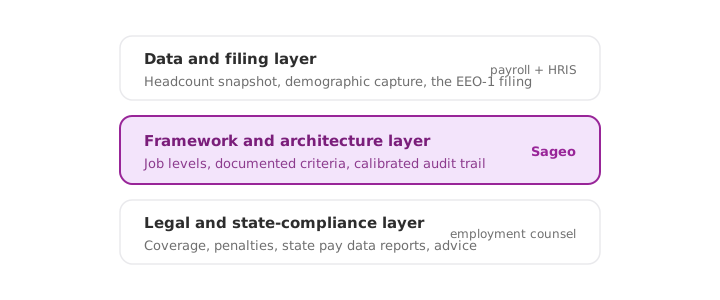
What Sageo helps with
- A documented, consistent job-levelling and competency framework, generated from your culture rather than bought as a static matrix.
- A defensible mapping from your real roles to the levels that drive EEO-1 job categories.
- A calibrated record of role and promotion decisions with an audit trail you can produce.
- The job-architecture foundation that both EEO-1 classification and pay equity rest on.
What you need elsewhere
- The headcount snapshot, demographic data capture, and the EEO-1 filing itself, through your HRIS or payroll system.
- Self-identification survey collection and storage.
- State-specific pay data report filings, California and others, and their pay calculations.
- Legal advice on coverage, penalties, and the shifting federal rule.
In short: your HRIS or payroll partner captures the snapshot and files the report, employment counsel owns the legal and state-compliance risk, and Sageo makes sure the job architecture underneath both is clean, consistent, and documented. Get that foundation right and the annual filing stops being a scramble.
See it in SageoThe documented job framework behind every classification callSee how Sageo turns your levels and roles into a documented, defensible competency and levelling framework with a calibrated audit trail.Related guideBest HR Compliance SoftwareThe EEO-1 is one filing in a wider compliance stack. See the four categories of HR compliance tools and which job each does.How this guide was researched
Built from the EEOC's own EEO-1 Component 1 materials, several practitioner guides, and legal-tracker reporting on the 2026 rescission proposal, checked in October 2026. The federal rule status is the fastest-moving part and was verified against current legal reporting.
- EEOC, EEO-1 Data Collections and Component 1 materials
- Official source for thresholds, job categories, race and ethnicity classifications, the workforce snapshot period, and filing instructions.
- EEOC proposed rule, 91 FR 46332 (July 23, 2026)
- The Notice of Proposed Rulemaking to rescind EEO-1 through EEO-6 reporting, and the procedural timeline around it.
- Jackson Lewis, Foley, Littler, and other employment-firm analyses (2026)
- The vote, the comment period and hearing, what the proposal does and does not change, and the guidance to keep filing.
- State regime trackers (California CRD, SB 1162 and SB 464, Colorado, Illinois)
- The independent state reporting obligations and the ones explicitly built to survive a federal rollback.
- HR and payroll platform guides (Rippling, Paylocity, and others)
- Practical filing mechanics, report types, and the self-identification process.
Frequently asked questions
Who has to file an EEO-1 report?
Private employers with 100 or more employees must file, as must federal contractors with 50 or more employees and a federal contract worth 50,000 dollars or more. The headcount includes full-time and part-time employees and is measured against the pay period you select as your workforce snapshot, so a company near the threshold can move in and out of scope year to year. The report covers employees only, not job applicants.
What is the workforce snapshot period for the EEO-1?
It is a single pay period that you select, falling anywhere between October 1 and December 31 of the reporting year. Every employee on the payroll during that pay period is counted, full-time, part-time, temporary, and remote, and sorted by job category, sex, and race or ethnicity. You can choose a different pay period from one year to the next, but it must sit in that fourth-quarter window.
What are the EEO-1 job categories and demographic groups?
There are 10 job categories, from executive and senior-level officials and managers down through professionals, technicians, sales and administrative workers, craft workers, operatives, laborers, and service workers. Each employee is also counted by sex, currently male or female, and by one of 7 race or ethnicity groups: Hispanic or Latino, White, Black or African American, Native Hawaiian or Other Pacific Islander, Asian, American Indian or Alaska Native, and Two or More Races. Every employee lands in exactly one cell of that grid.
Is the EEO-1 report being eliminated in 2026?
The EEOC has proposed eliminating it. The Commission voted on July 21, 2026, to issue a proposed rule rescinding the EEO-1 and related reports, published it on July 23, and ran a comment period that closed August 24. As of mid-October 2026 this remains a proposal, not a final rule, so current filing and recordkeeping obligations are still fully in effect. A final rule would still have to clear review and likely legal challenge, so employers are advised to keep filing until told otherwise.
If the federal EEO-1 goes away, do I still have to report demographic data?
Very likely yes, depending on where you employ people. California requires a pay data report under SB 1162 that is independent of the federal EEO-1 and cannot be satisfied by filing one. Colorado has moved to require state demographic workforce data even if the federal requirement ends, pinning it to the EEO-1 format as of March 1, 2026. Illinois has its own Equal Pay Registration Certificate regime. The specific federal form may change, but the obligation to know and report your workforce demographics does not disappear.
What happens if I file the EEO-1 late or get it wrong?
A court can order a non-filing employer to file. For federal contractors, missing or inaccurate reports can threaten an existing contract and future eligibility for federal work. Because EEO-1 data can surface in a discrimination charge, an inaccurate filing, especially one that misclassifies roles, can also weaken your position in an investigation. The most common underlying problem is inconsistent job-category assignment, which a documented job architecture prevents.

Written by
Deepti GuptaCo-founder, Sageo
18+ years building people functions from the ground up at Myntra, Freshworks and Dream11, scaling teams from 100 to 2,500 people and designing company-wide performance and compensation systems. Sageo automates the frameworks she has built by hand throughout her career.

Reviewed by
Vinayak RaviCo-founder, Sageo
19+ years of B2B SaaS go-to-market leadership. He built the organic growth engine at Freshworks through its rise to a public company and has led demand generation at some of the sector's fastest-scaling software startups.
Product names and logos are trademarks of their respective owners, shown here for identification only and not as endorsements.
All guides