Compliance Guide · October 2026
The EU Pay Transparency Directive, in Plain Terms
What Directive (EU) 2023/970 actually requires, where transposition really stands right now, and how to get ready without waiting for your own government to move.



A note on who wrote this
This is general information from the team behind Sageo, written for people leaders getting oriented. It is not legal advice and does not account for your specific situation. National implementing laws vary and are changing quickly, so verify the current rules for every country you employ in with qualified local counsel before acting. The figures in the pay gap example are illustrative.
The short version
- The Directive makes equal pay for equal work enforceable through transparency. Pay, progression, and hiring now have to rest on objective, gender-neutral criteria you can document and defend.
- The deadline for countries to write it into national law was 7 June 2026. That date has passed, and most have missed it. The rules arrive country by country, on different clocks.
- The first gender pay gap reports fall due in June 2027 for employers with 150 or more workers, based on 2026 pay data. That reference year is already behind you.
- A gap of 5 percent or more in any group doing equal work, if you cannot justify it, forces a joint pay assessment with worker representatives. Remedies are uncapped and the burden of proof sits with the employer.
- The slow, unglamorous work, a defensible job architecture and consistent pay and progression criteria, is the part that takes the longest. It is also the part you can start today, whatever your government is doing.
1. What the Directive actually is
Equal pay for equal work is one of the European Union's founding principles. The problem has never been the principle. It has been proving a breach, because pay sits behind closed doors and the person who suspects they are underpaid is the one who has to show it.
Directive (EU) 2023/970, adopted in 2023 and known as the EU Pay Transparency Directive, flips that. It uses transparency and reporting to surface gaps that used to stay hidden, and it moves the burden of proof onto the employer once a worker makes a credible claim. The gender pay gap across the EU still sits at roughly 13 percent, and progress on closing it has been slow. This is the EU's attempt to force the pace.
A directive is not a law you can read and comply with directly. It sets a floor that each of the 27 member states has to write into its own national law, choosing its own thresholds, enforcement, and penalties within the limits the text sets. So the real rules you follow are national rules. The Directive tells you what the least strict version of them looks like. Several countries are already going further.
2. Why it reaches you, even outside the EU
The trigger is headcount in an EU country, not where your company is based. A business headquartered in London, Bengaluru, or San Francisco that employs enough people in an EU member state is in scope for that country's rules. For a scaling company with a few engineers in Germany, a sales team in France, and a support hub in Poland, that is three different national regimes to track at once.
There is a wider reason to care. Pay transparency is not an EU-only story. Comparable rules are moving in the United Kingdom, parts of the United States and Canada, and elsewhere. The frameworks you build to satisfy the Directive, a clean job architecture, gender-neutral criteria, documented progression, tend to meet or exceed what those other regimes ask for. Build it once properly and you are ahead of the next three laws, not scrambling after each one.
3. The four concepts everything rests on
Before the obligations make sense, four definitions do most of the work. Local implementation can widen any of them.
Workers. Anyone with an employment contract or relationship, read broadly. The preamble pulls in fixed-term staff, agency workers, and people in management. Domestic, on-demand, platform workers, trainees, and apprentices can fall in too. Some transparency rules reach job applicants before they are hired at all.
Pay. Not just salary. Basic wage plus any other direct or indirect consideration, in cash or in kind: bonuses, overtime, allowances, and benefits. A gap hiding in pension contributions or bonus eligibility counts the same as a gap in base pay.
The gender pay gap. The difference between average pay for women and for men, expressed as a percentage of average male pay. You calculate it across the whole organisation and, more pointedly, within categories of workers doing the same work or work of equal value.
Work of equal value. The one that catches people out. Two jobs with different titles can be of equal value, judged on objective, gender-neutral criteria: skills, effort, responsibility, and working conditions. Countries must supply tools to assess it. Doing it honestly is slow, detailed work.
4. What the Directive actually requires
The obligations fall into four buckets. Thresholds and dates below are the Directive's minimum. National law can tighten them.
Gender pay gap reporting
How often you report depends on size, and the first deadlines run from June 2027. You report on the previous calendar year, which is why 2026 pay data already matters.
| Employer size | First report due | Then |
|---|---|---|
| 250+ workers | 7 June 2027 | Every year |
| 150 to 249 workers | 7 June 2027 | Every 3 years |
| 100 to 149 workers | 7 June 2031 | Every 3 years |
| Under 100 | Not required | Countries may still set a lower threshold |
Reports go to the relevant public authority and to workers and their representatives, broken down by category of worker doing the same work or work of equal value. In countries that do not delay, an employer with 150 or more workers that still has unresolved gaps may see them surface in that first mandatory report.
The joint pay assessment
This is the sharp end. If your report shows a gap of at least 5 percent in any category of workers doing equal work, and you cannot justify it on objective gender-neutral grounds, and you have not fixed it within six months, you must run a joint pay assessment. It is an audit, and it cannot be done quietly in a back room.
The 5% trigger
An unexplained gap of 5 percent or more in any equal-work category is the line that forces a joint pay assessment, carried out with worker representatives and open to the labour inspectorate and equality body on request. Any unjustified difference it finds has to be remedied.
New transparency rights for workers
The pay-setting criteria you use, including pay levels and progression, have to be objective, gender-neutral, and easily accessible. Workers gain a right to ask for their own pay and the average pay levels, broken down by sex, for people doing the same or equal-value work. You have to remind them of that right every year and answer within a reasonable time, and no later than two months. Pay secrecy clauses that stop people discussing their pay are out. Countries may exempt employers under 50 workers from publishing progression criteria, but not from the rest.
Transparency in hiring
Candidates get the pay or pay range before the interview, so negotiation starts from real information. You cannot ask about pay history. Vacancy notices and job titles have to be gender-neutral, and the process run without discrimination. Much of this means rewriting templates you have used for years.
5. The dates that matter
One timeline runs underneath all the national variation. The reporting clock is tied to the Directive, not to how fast any one country legislates.
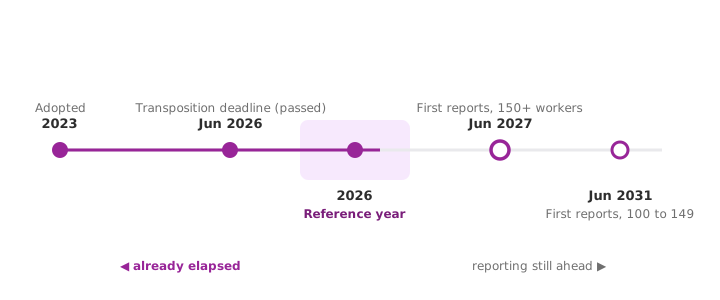
- 2023: Directive (EU) 2023/970 adopted. A three-year window opens for member states to transpose it.
- 7 June 2026: Transposition deadline. Passed. Only a handful of countries had full national law in force on the day.
- Calendar year 2026: the reference year for the first reports. The pay data you report in 2027 is the data you are generating now.
- 7 June 2027: First gender pay gap reports due for employers with 150 or more workers. 250+ then report annually; 150 to 249 every three years.
- 7 June 2031: First reports due for employers with 100 to 149 workers, every three years thereafter.
6. Where transposition actually stands
This is the part no 2024 or early-2025 guide can tell you, because the picture changed through 2026. As of early-to-mid October 2026, more than three years after adoption and four months after the deadline, implementation is a patchwork. Only a small group of countries transposed on time. Several of the largest economies are still drafting.
- Fully transposed, in force
- Slovakia, Italy, Lithuania, Malta, Greece. Slovakia moved first; Italy, Lithuania and Malta had law in force around the 7 June 2026 deadline; Greece followed in July 2026, becoming the fifth.
- Partially transposed, some rules live
- Belgium, Estonia, Poland, Portugal (draft). Belgium has moved on parts of the public sector and asked the Commission for a six-month extension. Estonia's recruitment-stage rules took effect in July 2026. Full transposition is still outstanding.
- Draft or early stages, not yet law
- Germany, France, Spain, Ireland, Netherlands, Finland, Bulgaria. Most are targeting entry into force in 2027. Spain's existing equal-pay law already sits close to the Directive. Germany and France were still at draft or cabinet stage through October 2026.
- Paused or no public text, watch closely
- Sweden, Hungary, Luxembourg. Sweden paused pending EU-level discussion. Others have signalled intent without a published bill. Timelines here are genuinely uncertain.
The clock is not moving
Belgium formally asked Brussels to push the deadline back by six months. The Commission refused requests to delay and warned that late member states can face infringement proceedings under Article 258 of the Treaty. The direction of travel is clear: the clock is not moving, even where national law is.
This snapshot reflects the position in October 2026 and moves almost weekly. Confirm the current status for every country you employ in before you rely on it.
7. What is actually inside a pay gap
A headline pay gap number scares people, and most of it usually has an explanation. The work is separating the part that legitimate factors account for from the part that does not. Here is the shape of that calculation, using an illustrative example rather than real figures.
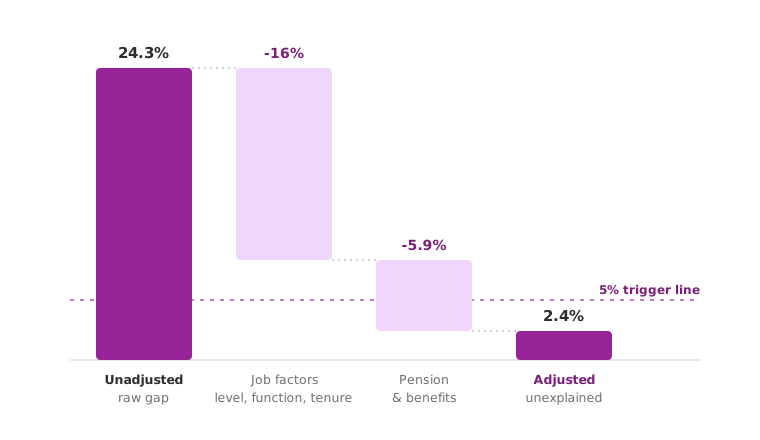
- Step 1, Unadjusted: -24.3% (the raw gap)
- Average pay for women against average pay for men, with nothing controlled for. It looks alarming and tells you very little on its own.
- Step 2, Explained: ~21.9% (the part with reasons)
- Pension and benefits structure, job level, function, and tenure account for most of it, roughly 16 percent from job factors and 5.9 percent from pension and benefits in this example. Legitimate, but still worth watching, since lower female representation in senior roles is itself a problem.
- Step 3, Adjusted: -2.4% (the unexplained residue)
- What is left after the legitimate factors. This is the number the Directive cares about, and the one you have to justify or fix. A small-looking residual can still breach the 5 percent trigger inside a specific category.
The lesson for reporting is that the category-level view matters more than the company-wide headline. A business can look fine in aggregate and still carry an unexplained gap above 5 percent inside one job family, which is exactly what triggers an assessment.
8. Penalties and enforcement
Each country sets its own penalties, but the Directive fixes a floor. Workers can bring individual claims. Compensation is uncapped and includes recovery of back pay and bonuses. There are protections against retaliation, courts can order compliance, and there are national fines on top. The single most consequential change is the reversed burden of proof: once a worker shows a credible case, the employer has to prove there was no discrimination, not the other way around.
Spain shows what active enforcement looks like, since its national law already sits close to the Directive. In 2024 its Labour Inspectorate opened more than 11,500 equality-related actions. Inspections targeting gender-based pay discrimination rose by over 28 percent year on year, to 1,162. Those produced 120 compliance orders and 16 sanctioning reports, affected 740 employees, and drew fines of roughly 197,760 euros. Courts have added their own: one employer was fined around 91,000 euros for a large pay gap plus a missing pay register and equality plan, and in another case a court ordered 13,000 euros in compensation to a woman underpaid against a male counterpart in the same role.
The concept of work of equal value is moving to center stage, with real potential for an increase in equal pay litigation. The time to assess your risk is before it is all out in the open.
9. The hard part: proving work of equal value
Most of the reporting mechanics are a data exercise. Work of equal value is not. It asks you to compare jobs that look nothing alike on paper and decide whether they carry equal weight, on criteria you can defend to a worker representative, an inspector, and eventually a court.
That comparison needs a job architecture that actually holds together. Over the years, as companies grow, job titles multiply, levels drift, and two people doing comparable work end up in different bands for reasons nobody can reconstruct. A gender-neutral, documented evaluation system is what lets you say, with evidence, that two roles are or are not of equal value. Without it, you are defending pay decisions you cannot explain.
This is also where pay transparency stops being a compliance project and becomes an organisation-design project. The criteria you set for pay and progression are the same criteria your managers use in reviews, promotions, and hiring. If they are inconsistent, the Directive will expose it. If they are clean and applied the same way for everyone, most of the risk disappears before a report is ever filed.
10. A readiness plan you can start now
You do not need your government to finish legislating before you begin. The reference year is already running, and the longest-lead work does not depend on the final text. Six moves, roughly in order.
- 1. Make it a board-level issue
- Name the legal, financial, and reputational exposure out loud, to the people who own the budget. Pay transparency that lives only in HR will not get the cross-functional support it needs.
- 2. Build the cross-functional team
- HR, payroll, compensation and benefits, legal, and data analytics all have a piece. The implications cross every one of these functions, so pull them in from the start rather than at report time.
- 3. Map your footprint and thresholds
- Count workers per EU country. That tells you which national regimes apply, which reporting thresholds you hit, and from when. For a multi-country team, this alone surfaces surprises.
- 4. Fix the job architecture and criteria
- The slow one. Build a gender-neutral, documented set of levels, competencies, and progression criteria so you can defend work of equal value. Start here, because it takes the longest and everything else leans on it.
- 5. Run a privileged internal audit
- Do a trial pay-equity run on current data to find your risk areas before anything is public. Involve lawyers so privilege can be asserted over the findings where possible. Fixing a gap quietly now is far cheaper than explaining it in a mandatory report.
- 6. Rebuild hiring and progression
- Rewrite vacancy templates and job titles to be gender-neutral, add pay ranges, remove pay-history questions, and make sure progression criteria are written down and applied consistently. Check contracts for pay-secrecy clauses while you are there.
11. Where Sageo fits, and where it does not
We build Sageo, so take this in the spirit our guides are written in: we will tell you plainly what we do not cover. Pay transparency is bigger than any one tool, and it needs a few different partners.
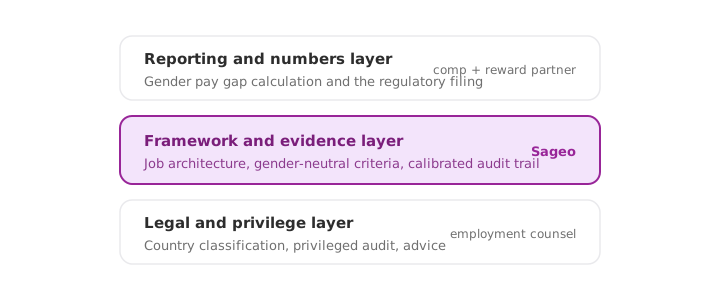
Sageo sits on the framework and evidence layer, which is steps four and five above, the part that takes longest. It turns your values and levels into a gender-neutral competency framework, keeps pay and progression decisions tied to documented criteria, and holds a calibrated, auditable record of how performance and advancement calls were made. That is precisely what the Directive asks you to be able to produce when someone asks why two people are paid differently.
What Sageo helps with
- A gender-neutral competency and levelling framework, generated from your culture rather than bought as a static matrix
- Documented, consistent criteria for pay progression and promotion
- A calibrated performance record with an audit trail you can defend
- The job-architecture foundation that work of equal value rests on
What you need elsewhere
- The statistical gender pay gap calculation and the regulatory filing itself
- Total-reward and benefits equity analysis across pensions and bonuses
- Country-specific legal advice and privilege over an audit
- Payroll data and the reporting pipeline to each national authority
In short: a comp or reward analytics partner runs the numbers, employment counsel owns the legal risk, and Sageo makes sure the framework underneath both is clean, consistent, and documented. Get that foundation right and the rest gets much easier.
See it in SageoThe gender-neutral framework the Directive asks you to produceSee how Sageo turns your values and levels into a documented, defensible competency framework, with a calibrated audit trail behind every pay and progression call.How this guide was researched
Built from the Directive's text, two detailed practitioner guides, and live transposition trackers checked in October 2026. The country status is the fastest-moving part and was verified against current legal-tracker reporting.
- Directive (EU) 2023/970
- The legislative text itself, via EUR-Lex. The source of truth for thresholds, rights, and definitions.
- European Commission, EU action for equal pay
- Official framing, deadline, and the Gender Equality Strategy 2026 to 2030 commitment to enforcement.
- Littler, EU Pay Equity and Transparency At a Glance (March 2026)
- Key concepts, obligations, penalties, and the Spain enforcement figures.
- Aon, In-Depth Guide to the EU Pay Transparency Directive
- The readiness roadmap, the 13 percent gap, and the unadjusted-to-adjusted pay gap worked example.
- Transposition trackers (Ius Laboris, Pinsent Masons, Lexology, and others), October 2026
- Country-by-country status, Belgium's extension request, and the Commission's infringement warning.
Frequently asked questions
Who does the EU Pay Transparency Directive apply to?
It applies to employers with workers in the EU, triggered by headcount in a member state rather than where the company is based. A business headquartered in London, Bengaluru, or San Francisco is in scope for a country's rules once it employs enough people there. Reporting duties start at 150 or more workers from June 2027 and reach employers with 100 to 149 workers from June 2031, while some transparency rights, such as giving candidates a pay range, apply regardless of size.
When are the first gender pay gap reports due?
The first reports fall due on 7 June 2027 for employers with 150 or more workers, based on 2026 pay data, which is why the reference year is already running. Employers with 250 or more then report every year, those with 150 to 249 every three years, and those with 100 to 149 workers from 7 June 2031. National law can set lower thresholds, so confirm the position for every country you employ in.
What is the 5 percent rule in the Pay Transparency Directive?
If a gender pay gap report shows a gap of at least 5 percent in any category of workers doing equal work, and the employer cannot justify it on objective, gender-neutral grounds and has not fixed it within six months, the employer must run a joint pay assessment with worker representatives. Any unjustified difference it finds has to be remedied. The gap is measured per equal-work category, so a company can look fine in aggregate and still cross the trigger inside one job family.
Does the EU Pay Transparency Directive apply to companies outside the EU?
Yes. The trigger is employing people in an EU member state, not where the company is headquartered. A non-EU company with enough staff in an EU country is in scope for that country's implementing law, so a business with teams in several member states may have to track several national regimes at once.
What is work of equal value under the Directive?
Work of equal value means two jobs that can carry equal weight even with different titles, judged on objective, gender-neutral criteria: skills, effort, responsibility, and working conditions. It is the concept that catches employers out, because it requires a documented job-evaluation method you can defend to a worker representative, an inspector, and ultimately a court. A clean, gender-neutral competency and levelling framework is what makes an equal-value comparison defensible.
What are the penalties for breaching the Directive?
Each country sets its own penalties on a floor the Directive fixes. Workers can bring individual claims, compensation is uncapped and includes back pay and bonuses, and there are national fines on top. The most consequential change is the reversed burden of proof: once a worker shows a credible case, the employer has to prove there was no pay discrimination. Spain, whose national law already sits close to the Directive, opened more than 11,500 equality-related actions in 2024, which shows what active enforcement looks like.

Written by
Deepti GuptaCo-founder, Sageo
18+ years building people functions from the ground up at Myntra, Freshworks and Dream11, scaling teams from 100 to 2,500 people and designing company-wide performance and compensation systems. Sageo automates the frameworks she has built by hand throughout her career.

Reviewed by
Vinayak RaviCo-founder, Sageo
19+ years of B2B SaaS go-to-market leadership. He built the organic growth engine at Freshworks through its rise to a public company and has led demand generation at some of the sector's fastest-scaling software startups.
Product names and logos are trademarks of their respective owners, shown here for identification only and not as endorsements.
All guides