Compliance Guide · October 2026
The California Pay Transparency Law, in Plain Terms
What SB 1162 actually requires, what the 2026 SB 642 amendments just changed, and how to get compliant without turning your whole comp process upside down.



A note on who wrote this
This is general information from the team behind Sageo, written for people leaders getting oriented. It is not legal advice and does not account for your specific situation. California's rules changed on 1 January 2026 and local ordinances can go further, so verify the current rules with qualified California counsel before acting. The figures in any example are illustrative.
The short version
- California has two linked obligations. One is pay transparency in postings, from SB 1162. The other is annual pay data reporting to the state, also from SB 1162. They cover different employers and they are easy to confuse.
- Any employer with 15 or more employees must publish a pay scale in every job posting, including postings run through a third party. That has been true since 1 January 2023.
- On 1 January 2026, SB 642 changed the rules. The pay scale you post now has to be a good-faith estimate of what you expect to pay a new hire on day one, not a vague range for the role in general. The definition of wages for equal pay widened to cover all forms of pay, and the window to bring an equal pay claim moved to three years.
- Employers with 100 or more employees file an annual pay data report with the California Civil Rights Department, broken down by job category, race, ethnicity, and sex, with mean and median pay in each group. A separate report covers workers supplied by labor contractors.
- Posting violations run from $100 to $10,000 each, and thin pay records shift the burden onto you in a dispute. The slow, worthwhile work, a defensible job architecture and consistent pay criteria, is the part that takes longest and the part you can start today.
1. What the California pay transparency law actually is
California runs on a pay-secrecy problem it has been chipping at for years. The salary history ban landed in 2018. The big move came with SB 1162, signed by Governor Newsom in September 2022 and in force since 1 January 2023. It did two separate things at once, which is the first thing people get wrong.
First, it made pay transparency a posting rule: show the pay, up front, to anyone who might apply. Second, it turned California's pay data reporting into a public-accountability tool, forcing large employers to hand the state a demographic breakdown of what they pay. The first rule is about job seekers. The second is about the state spotting patterns across an entire workforce. You can be covered by one and not the other.
Then, on 8 October 2025, the Governor signed SB 642, the Pay Equity Enforcement Act. Its changes took effect on 1 January 2026, and they are the reason a guide written in 2024 or early 2025 will now steer you wrong. SB 642 tightened the definition of a pay scale, widened what counts as wages for equal pay, and gave employees longer to sue.
2. Why it reaches you, even from outside California
The trigger is where the work happens and where the candidate could see the posting, not where your head office sits. A company based in London, Bengaluru, or New York is in scope the moment it hires in California at the covered size. For a distributed team, that is the catch: a remote role that can be filled from California generally needs a California-compliant pay scale, because a California-based applicant can apply to it.
There is a wider reason to care. California was the template. New York, Washington, Colorado, Illinois, and a growing list of states now run their own versions, each with its own thresholds and quirks. The framework you build to satisfy California, clean pay bands, documented criteria, a job architecture that holds together, is most of what the next state asks for too. Build it once and you are ahead of the next law instead of scrambling after it.
3. The two obligations, kept separate
Almost every mistake here comes from blurring these two rules. Keep them apart.
- Pay scale in postings is a disclosure rule
- Triggered at 15 or more employees. It is about what you tell applicants and your own staff.
- Pay data reporting is a filing rule
- Triggered at 100 or more employees. It is about what you tell the state.
A 40-person startup posts pay scales but files nothing. A 400-person company does both. A 12-person company does neither under state law, though it should still watch the trend. Everything in sections 4 and 5 follows from which of these two you are in.
4. The posting rule: pay scale disclosure
If you have 15 or more employees, three things apply.
- Every job posting carries a pay scale
- This covers your own postings and any you pay a third party to announce, post, or publish. A recruiter cannot strip the range out on your behalf.
- Applicants get the pay scale on request
- For the role they are applying to.
- Current employees get the pay scale on request
- For their own current position.
A "pay scale" is the salary or hourly wage range. It does not have to include bonuses, equity, or benefits in the posted range, though you can add them.
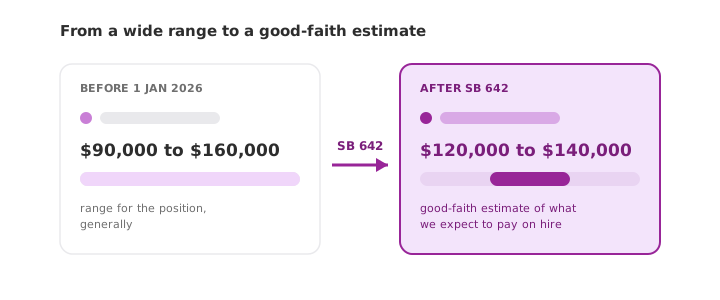
What SB 642 changed about the pay scale
This is the sharp 2026 update. The old definition let you post the range you expected to pay "for the position" at large. The amended definition requires a good-faith estimate of the salary or wage range you reasonably expect to pay upon hire. In plain terms, the posted range now has to describe the offer a real new hire could actually land on, not a theoretical span covering every tenure and level stuffed under one title. Wide, defensive ranges are the thing this closes off.
5. The filing rule: annual pay data reporting
Separate obligation, higher threshold, different audience. If you are a private employer with 100 or more employees, or you use 100 or more workers hired through labor contractors, you file an annual pay data report with the California Civil Rights Department (CRD).
The report is not a headcount. For each job category it breaks pay down by race, ethnicity, and sex, slotting employees into the pay bands the US Bureau of Labor Statistics uses in its Occupational Employment Statistics survey. Inside each category you report the median and mean hourly rate for every combination of race, ethnicity, and sex. If you use labor contractors at the threshold, you file a second, separate report naming every contractor, and the contractors must hand you the data to build it.
| What | Who files | Deadline |
|---|---|---|
| Employee pay data report | Private employers with 100+ employees | On or before the second Wednesday of May, for the prior calendar year |
| Labor contractor pay data report | Employers using 100+ workers via labor contractors | On or before the second Wednesday of May, for the prior calendar year |
The report goes to the CRD. The mean-and-median-by-group structure is the part that exposes gaps, because a workforce that looks balanced in aggregate can carry a clear gap inside a single job category.
6. The salary history ban
Older than SB 1162 and still in force. Since 2018 California employers have been barred from asking job applicants about their salary history, and from relying on past pay to set an offer or make a hiring decision. If an applicant volunteers the number, you may consider it, but you cannot ask for it. The point is the same as the rest of the regime: break the loop where yesterday's underpayment follows a person into their next job.
7. What SB 642 changed about equal pay
SB 1162 is the transparency statute. California's Equal Pay Act, Labor Code 1197.5, is the one that actually bans paying people differently for substantially similar work. SB 642 amended it on 1 January 2026, and three changes matter.
- "Another sex," not "the opposite sex"
- The ban now reaches pay disparities against an employee of another sex, which brings non-binary employees and differences in gender identity or expression squarely inside the protection. Equal pay for substantially similar work now has to hold across all genders, not just between men and women.
- "Wages" means everything
- For the Equal Pay Act specifically, wages now cover all forms of pay: bonuses, stock, stock options, allowances for things like cleaning or gasoline, hotel accommodation, and travel reimbursement. A gap hiding in equity grants or allowances counts the same as a gap in base salary. This expanded definition applies to the Equal Pay Act only, not to the rest of the Labor Code.
- Three years to sue, up to six years of back pay
- The window to bring an Equal Pay Act claim moved to three years from the alleged violation. An employee can recover for the full stretch the violation ran, capped at six years. SB 642 also spelled out that a violation happens each time an unlawful pay decision is adopted, each time someone becomes subject to it, and each time affected pay is actually paid out, which keeps the clock alive far longer than a single hiring date.
The through-line: unexplained pay differences in California are now easier to challenge, cover more forms of pay, more kinds of difference, and more time.
8. Penalties and enforcement
Two enforcers, two kinds of exposure.
Posting and pay scale violations: handled by the Labor Commissioner. Fail to put a pay scale in a posting, or refuse one on request, and penalties run from no less than $100 to no more than $10,000 per violation. The first violation can draw no penalty if you fix it, but repeat or willful violations do not get that grace, and for a company posting at volume the per-posting math adds up fast.
Recordkeeping is its own trap: you must keep each employee's job title and wage rate history for the length of their employment and for at least three years after it ends, open to the Labor Commissioner on request. Fail to keep those records and you hand the other side a rebuttable presumption in their favour if a claim is filed. The burden of disproving the claim shifts to you.
Equal pay claims run through the courts and the CRD, now on the wider SB 642 terms: more time, more forms of pay, uncapped exposure on the compensation side. The practical effect of all three is the same. The cheap moment to find and fix a gap is before it is in a posting, a filing, or a complaint.
9. The hard part: defensible pay in the first place
Most of this is mechanics. Put a range in a posting, keep your records, file the report. The part that actually takes work is being able to explain, with evidence, why two people are paid what they are paid.
SB 642's good-faith pay scale quietly raises that bar. A tight, honest range is only possible if you know what the role is worth and where a new hire should land, which means you need a job architecture that holds together: levels that mean something, criteria for moving between them, and pay bands tied to both. Without it, you are either posting a defensive range that no longer complies, or guessing.
The same foundation answers the equal pay question. When the Equal Pay Act asks why one person earns more than another doing substantially similar work, "because of these documented, gender-neutral criteria, applied the same way to everyone" is a defence. "Because that is what we negotiated at the time" is not. This is where pay transparency stops being a posting exercise and becomes an organisation-design one. The criteria you set for pay and progression are the same criteria your managers use in reviews, promotions, and offers. If they are inconsistent, California will surface it. If they are clean and applied evenly, most of the risk is gone before anything is ever posted or filed.
10. A readiness plan you can start now
Six moves, roughly in order. The posting fixes are quick. The foundation is slow, so start it first.
- 1. Confirm which rules you are in
- Count your California-relevant headcount. 15 or more means you post pay scales. 100 or more means you also file with the CRD. Using 100 or more labor-contractor workers means a second filing. Get this right before anything else.
- 2. Fix your postings for the 2026 standard
- Every posting, including recruiter-run ones, needs a good-faith pay scale that reflects what you would actually pay on hire, not a legacy wide band. Audit live postings now.
- 3. Clean up recordkeeping
- Make sure you hold job title and wage history for every employee, retained through employment and three years past it. This is your cheapest insurance against the rebuttable presumption.
- 4. Fix the job architecture and pay bands
- The slow one. Build documented, gender-neutral levels, competencies, and progression criteria so your pay scales are honest and your equal pay decisions are defensible. Everything else leans on this.
- 5. Run a privileged internal pay audit
- Do a trial pay-equity run on current data, ideally under legal privilege, to find exposure before the CRD report or a complaint does. Fixing a gap quietly now is far cheaper than explaining it later, especially under SB 642's wider terms.
- 6. Rewrite hiring and progression
- Strip salary-history questions from applications and interviews, make sure offers rest on documented criteria rather than negotiation alone, and write progression rules down so they are applied the same way for everyone.
11. Where Sageo fits, and where it does not
We build Sageo, so take this in the spirit our guides are written in: we will tell you plainly what we do not cover. California compliance is bigger than any one tool, and it needs a few different partners.
Sageo sits on the framework and evidence layer, which is steps four and five above, the part that takes longest. It turns your values and levels into a gender-neutral competency framework, keeps pay and progression decisions tied to documented criteria, and holds a calibrated, auditable record of how performance and advancement calls were made. That is exactly what you need when a good-faith pay scale has to be honest, or when the Equal Pay Act asks why two people doing similar work are paid differently.
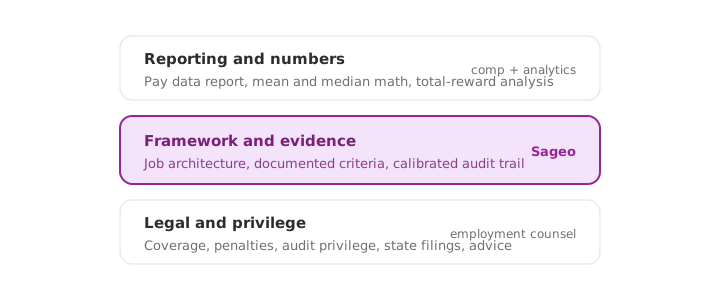
What Sageo helps with
- A gender-neutral competency and levelling framework, generated from your culture rather than bought as a static matrix.
- Documented, consistent criteria for pay progression and promotion.
- The job architecture that honest good-faith pay scales rest on.
- A calibrated performance record with an audit trail you can defend.
What you need elsewhere
- The statistical CRD pay data report and the filing itself.
- Total-reward analysis across bonuses, equity, and allowances.
- California-specific legal advice and privilege over an audit.
- Payroll data and the reporting pipeline to the CRD.
In short: a comp or people-analytics partner runs the CRD numbers, California employment counsel owns the legal risk, and Sageo makes sure the framework underneath both is clean, consistent, and documented. Get that foundation right and the rest gets much easier.
See it in SageoThe gender-neutral framework behind an honest pay scaleSee how Sageo turns your values and levels into a documented, defensible competency framework, with a calibrated audit trail behind every pay and progression call.Related guideThe New York Pay Transparency Law, in Plain TermsHiring in New York too? The state and city both run posting rules, with a far higher penalty ceiling.Related guideThe EU Pay Transparency Directive, in Plain TermsThe European counterpart, with gender pay gap reporting and the 5% joint-assessment trigger.How this guide was researched
Built from the text of SB 1162 and SB 642, California Labor Code sections 432.3 and 1197.5, the California Civil Rights Department's pay data reporting rules, and current practitioner guidance, checked in October 2026. The SB 642 changes are the fastest-moving part and were verified against legal-tracker reporting on the 1 January 2026 amendments.
- SB 1162 and SB 642
- The statutes themselves, the source of truth for thresholds, definitions, and the 2026 changes.
- California Labor Code 432.3 and 1197.5
- The pay transparency and equal pay provisions as amended.
- California Civil Rights Department, pay data reporting
- Who files, the deadline, and the required breakdowns.
- Practitioner guidance (CDF Labor Law and others), October 2026
- The SB 642 analysis, penalty figures, and recordkeeping exposure.
Frequently asked questions
Who has to comply with California's pay transparency law?
Two different thresholds. Any employer with 15 or more employees must include a pay scale in every job posting, including postings run through a third party, and must give applicants and current employees the pay scale on request. Separately, private employers with 100 or more employees, or 100 or more workers hired through labor contractors, must file an annual pay data report with the California Civil Rights Department. A company can be covered by the posting rule without hitting the reporting threshold.
What changed in California pay transparency law in 2026?
SB 642, the Pay Equity Enforcement Act, took effect on 1 January 2026. It redefined a pay scale as a good-faith estimate of what the employer reasonably expects to pay a new hire upon hire, rather than a broad range for the position in general. It widened the Equal Pay Act's definition of wages to cover all forms of pay, including bonuses, stock, and allowances. It extended the time to bring an equal pay claim to three years, with recovery of up to six years of back pay, and it changed opposite sex to another sex so the protection reaches non-binary employees.
Does California's pay transparency law apply to remote jobs?
Generally yes, if the role can be filled from California. The posting rule is tied to who could apply and where the work could be performed, not where the company is based, so a remote position open to California-based candidates typically needs a California-compliant pay scale. Confirm edge cases with counsel, since the treatment of fully remote and multi-state postings is fact-specific.
What are the penalties for violating California's pay transparency law?
Pay scale and posting violations carry civil penalties from $100 to $10,000 per violation, enforced by the Labor Commissioner, with a chance to avoid a penalty on a first violation if it is fixed. Failing to keep the required job title and wage history records creates a rebuttable presumption in favour of an employee who files a claim, shifting the burden onto the employer. Equal pay claims run through the courts and the Civil Rights Department with uncapped compensation exposure, now on SB 642's wider three-year terms.
Is pay data reporting the same as the pay scale rule?
No, and conflating them is the most common mistake. The pay scale rule is a disclosure obligation triggered at 15 employees and aimed at applicants and staff. Pay data reporting is a filing obligation triggered at 100 employees and aimed at the state, requiring mean and median pay broken down by job category, race, ethnicity, and sex. Different thresholds, different audiences, different work.
Can employers ask about salary history in California?
No. Since 2018, California employers have been prohibited from asking applicants about their salary history and from relying on past pay to set compensation or make hiring decisions. If a candidate volunteers the figure without being asked, the employer may consider it, but may not solicit it.

Written by
Deepti GuptaCo-founder, Sageo
18+ years building people functions from the ground up at Myntra, Freshworks and Dream11, scaling teams from 100 to 2,500 people and designing company-wide performance and compensation systems. Sageo automates the frameworks she has built by hand throughout her career.

Reviewed by
Vinayak RaviCo-founder, Sageo
19+ years of B2B SaaS go-to-market leadership. He built the organic growth engine at Freshworks through its rise to a public company and has led demand generation at some of the sector's fastest-scaling software startups.
Product names and logos are trademarks of their respective owners, shown here for identification only and not as endorsements.
All guides