Pay Transparency
Pay transparency is the practice of openly sharing how pay is set, inside and outside an organisation. It ranges from publishing salary ranges in job adverts, to telling employees how their pay compares with their peers, to reporting gender pay gaps. Many governments now require it: the EU Pay Transparency Directive and a growing list of US state and city laws set minimum standards for employers.
Also known as: salary transparency, pay range transparency, open pay, wage transparency
Reviewed
Key takeaways
- Pay transparency means being open about pay ranges, how pay is decided and pay gaps.
- It is increasingly a legal requirement, led by the EU directive and US state laws.
- It only works if pay decisions already follow clear, defensible rules.
- Start with job levels and salary bands, then fix unexplained gaps before you publish.
At a glance
- Levels
- Ranges in job ads, internal pay bands, fully open salaries
- Key laws
- EU Directive 2023/970; Colorado, California, New York and other US states
- Needs first
- Job levels, salary bands, a pay equity audit
- Related
- Salary benchmarking, compa-ratio, merit increase
Why does pay transparency matter?
When pay is hidden, unexplained gaps between people doing similar work can grow unnoticed, including gaps by gender. Transparency makes those gaps visible and pushes employers to justify pay decisions with clear criteria. For candidates, published ranges save time on both sides. For employees, understanding how pay is set builds trust, as long as the system behind it holds up.
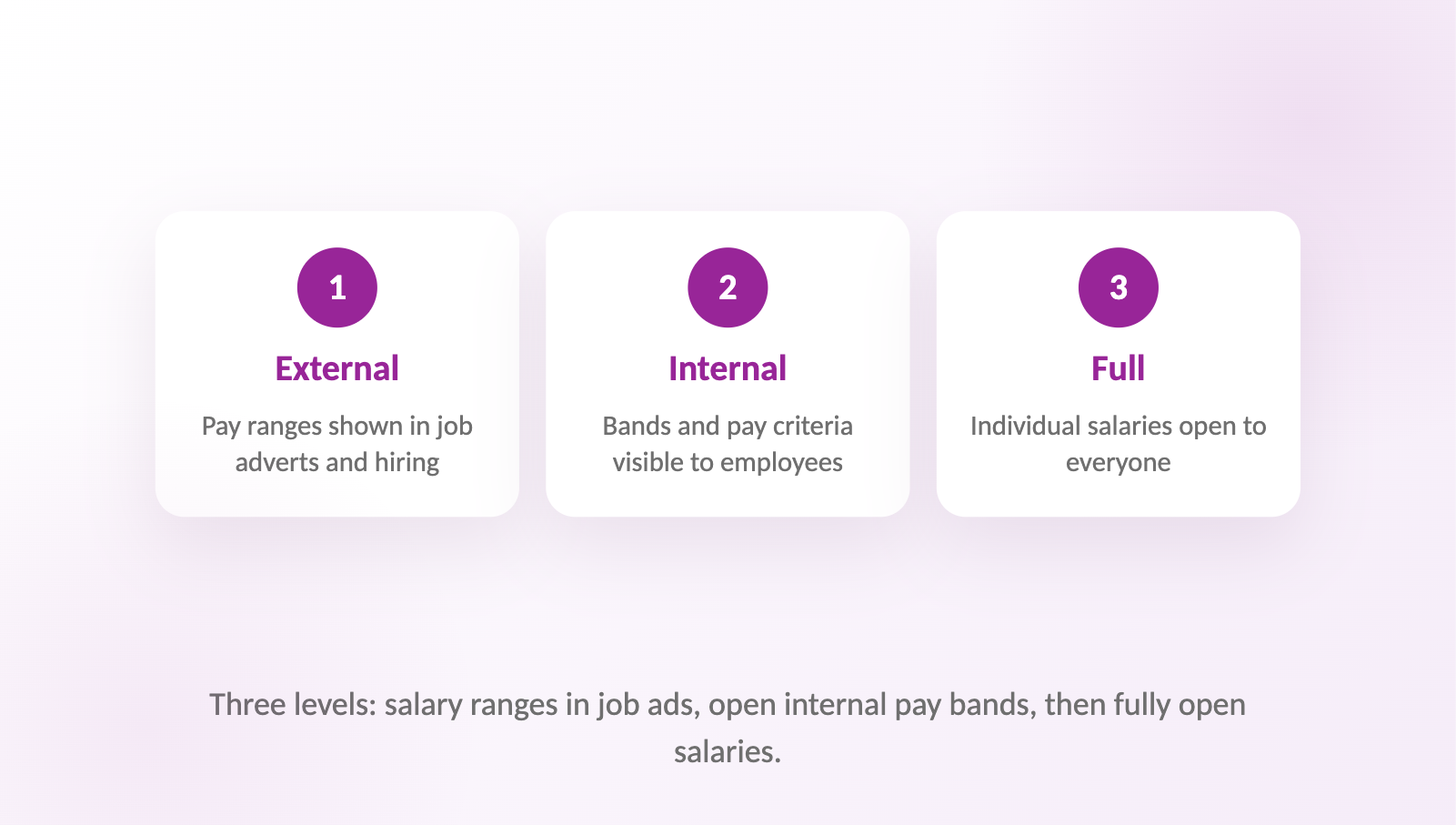
The three levels of pay transparency
- External: salary ranges in job adverts and during hiring.
- Internal process: employees can see salary bands for each level and the criteria for pay rises and promotions.
- Full openness: individual salaries are visible to everyone, as at some startups and in parts of the public sector.
Pay transparency laws
EU Pay Transparency Directive. Directive (EU) 2023/970 had to be written into national law by 7 June 2026. It requires employers to share pay ranges with candidates, bans asking about salary history, gives employees the right to request pay information, and sets gender pay gap reporting for organisations with 100 or more employees. A gap of 5% or more that can't be justified triggers a joint pay assessment. See our EU Pay Transparency Directive guide for the full detail and deadlines.
United States. There is no federal pay transparency law, but many states and cities require salary ranges in job postings. These include Colorado, California, Washington, New York State, New York City, Illinois, Minnesota, Massachusetts and New Jersey. See our guides to the California and New York laws.
How do you prepare for pay transparency?
- Define job levels so similar roles are grouped consistently.
- Set salary bands for each level, using salary benchmarking.
- Run a pay equity audit to find gaps that can't be explained by level, performance or location.
- Fix unjustified gaps before publishing anything.
- Write down the criteria for starting pay, merit increases and promotions.
- Train managers to explain pay decisions confidently.
Worked example
A 400-person company with offices in Germany and the US prepares for new pay rules. It groups 180 job titles into 40 roles across 6 levels and sets a salary band for each. A pay equity audit finds women in two engineering levels earn 7% less on average, with no difference in rating or tenure to explain it. The company corrects the gap in the next pay cycle, then starts listing ranges in every job advert.
Frequently asked questions
- What does pay transparency mean?
- Being open about pay: sharing salary ranges, explaining how pay decisions are made, and in some cases reporting pay gaps or individual salaries.
- Is pay transparency required by law?
- In a growing number of places, yes. EU member states must apply the Pay Transparency Directive, and many US states and cities require salary ranges in job adverts.
- When does the EU Pay Transparency Directive apply?
- Member states had to transpose it by 7 June 2026. Gender pay gap reporting phases in by company size, starting with the largest employers.
- Do I have to share every employee's salary?
- No. Most laws require ranges for candidates and information on request for employees, not publishing individual salaries.
- What are the benefits of pay transparency?
- Fairer pay, fewer unexplained gaps, more trust, and faster hiring because candidates know the range up front.
- What are the risks?
- Publishing ranges exposes inconsistencies that already exist. Companies without clear levels and criteria can face difficult conversations, so audit and fix pay first.
Sources
See it in practice
Compare talent management software
Related reading
Related terms