Merit Increase
A merit increase is a permanent rise in an employee's base pay, awarded for their performance over the past period. It is usually given once a year after the performance review, as a percentage of salary. Higher performers get bigger increases, often guided by a merit matrix that also considers where the person sits in their salary band. It differs from a cost-of-living adjustment, which goes to everyone regardless of performance.
Also known as: merit raise, merit pay increase, performance-based raise, merit-based pay rise
Reviewed
Key takeaways
- A merit increase is a performance-based rise in base salary, usually given yearly.
- In recent years, typical merit budgets in the US have run at around 3% to 4% of payroll.
- A merit matrix sets the increase by performance rating and position in the pay band.
- Merit pay is only fair if ratings are consistent, so calibrate before you allocate.
At a glance
- Based on
- Performance rating, plus position in salary band
- Timing
- Usually yearly, after the review cycle
- Typical size
- Around 3% to 4% average in recent US budgets
- Related
- Compa-ratio, performance review, pay transparency
Why do merit increases matter?
Merit increases are the most common way companies link pay to performance. Done well, they reward the people driving results and help keep them. Done badly, with inconsistent ratings or tiny gaps between top and average performers, they feel arbitrary and can do more harm than good. Because each increase compounds into future salary, merit decisions shape pay equity for years.
Merit increase vs cost-of-living adjustment vs bonus
| Merit increase | Cost-of-living adjustment (COLA) | Bonus | |
|---|---|---|---|
| Based on | Individual performance | Inflation or local prices | Individual, team or company results |
| Who gets it | Varies by performance | Usually everyone | Varies |
| Permanent? | Yes, added to base pay | Yes, added to base pay | No, one-off payment |
How does a merit matrix work?
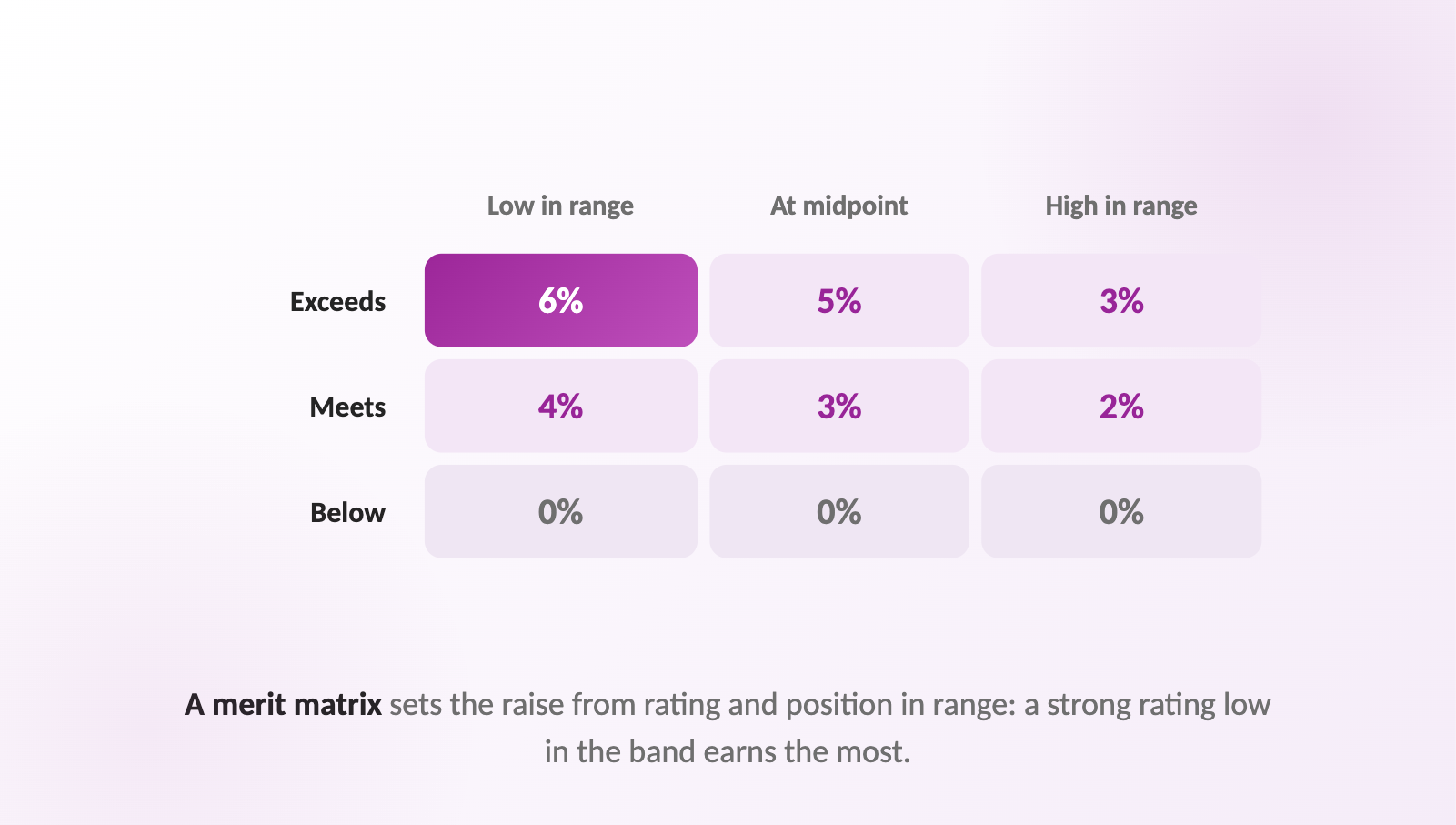
A merit matrix sets a recommended increase for each combination of performance rating and compa-ratio (where pay sits within the band). People paid low in their range get a bigger increase for the same rating, so pay moves towards the midpoint.
| Rating | Below midpoint (compa-ratio under 0.95) | At midpoint (0.95 to 1.05) | Above midpoint (over 1.05) |
|---|---|---|---|
| Exceeds expectations | 6% | 5% | 4% |
| Meets expectations | 4% | 3% | 2% |
| Below expectations | 0% to 1% | 0% | 0% |
Illustrative figures; set your own to fit your budget.
Worked example
Jordan earns 60,000 and is rated "exceeds expectations". The midpoint of Jordan's band is 66,000, so the compa-ratio is 60,000 ÷ 66,000 = 0.91, below midpoint. The matrix gives 6%, so Jordan's new salary is 60,000 × 1.06 = 63,600. A colleague on the same rating who already earns 70,000 (compa-ratio 1.06) gets 4%.
Frequently asked questions
- What is a merit increase?
- A permanent rise in base salary awarded for an employee's performance, usually once a year after their review.
- What is a typical merit increase?
- In recent years, US merit budgets have averaged around 3% to 4%, with top performers often receiving more. Check current salary budget surveys for your market.
- What is the difference between a merit increase and a promotion increase?
- A merit increase rewards performance in the same role. A promotion increase comes with moving to a higher level and is usually larger.
- Are merit increases guaranteed?
- No. They depend on performance and the company's budget. Some companies freeze merit pay in difficult years.
- How do you calculate a merit increase?
- Multiply current base salary by the merit percentage from the matrix. For example, 50,000 × 4% = 2,000, for a new salary of 52,000.
- What is a merit budget?
- The total amount, usually a percentage of payroll, set aside for merit increases in a cycle. Managers allocate it across their team.
Sources
- WTW, Salary Budget Planning Report; Mercer, US Compensation Planning Survey (annual)
See it in practice
Compare talent management software
Related reading
Related terms