Compa-Ratio
Compa-ratio (short for comparative ratio) compares an employee's base salary with the midpoint of the salary range for their role. It is calculated as salary divided by range midpoint. A compa-ratio of 1.0 (or 100%) means the person is paid exactly at the midpoint; below 1.0 means below the midpoint, and above 1.0 means above it. HR teams use it to spot pay gaps, guide merit increases and check that pay is consistent.
Also known as: comparative ratio, compa ratio, compensation ratio, CR
Reviewed
Key takeaways
- Compa-ratio = base salary ÷ midpoint of the salary range.
- 1.0 (100%) means paid at midpoint; most ranges allow roughly 0.80 to 1.20.
- Group compa-ratios reveal whether a team or demographic is paid consistently.
- It is only as good as your salary ranges, so benchmark them first.
At a glance
- Formula
- Base salary ÷ range midpoint
- Reading
- 1.0 = at midpoint; under 1.0 = below; over 1.0 = above
- Typical span
- About 0.80 to 1.20, depending on range width
- Related
- Salary benchmarking, merit increase, pay transparency
Free calculator
Compa-ratio calculator
Compa-ratio = base salary ÷ range midpoint. 1.0 (100%) means paid exactly at the midpoint of the range. Most ranges span roughly 0.80 to 1.20.
Why does compa-ratio matter?
Compa-ratio turns pay into a number you can compare across people with different roles and salaries. Individually, it shows whether someone is paid low or high for their range. In groups, it shows whether a team, location or gender is paid consistently. That makes it one of the main tools for pay equity analysis and for preparing for pay transparency rules.
How do you calculate compa-ratio?
Compa-ratio = Base salary ÷ Range midpoint
Multiply by 100 to express it as a percentage. For a group compa-ratio, divide the total salaries of the group by the total of their range midpoints, or average the individual compa-ratios.
How do you read compa-ratio?
| Compa-ratio | What it usually means |
|---|---|
| Under 0.80 | Paid below the range; likely needs correcting |
| 0.80 to 0.95 | New to the role or still developing |
| 0.95 to 1.05 | Fully competent, paid at market |
| 1.05 to 1.20 | Highly experienced or a consistent top performer |
| Over 1.20 | Above the range; review the range or the role level |
Worked example
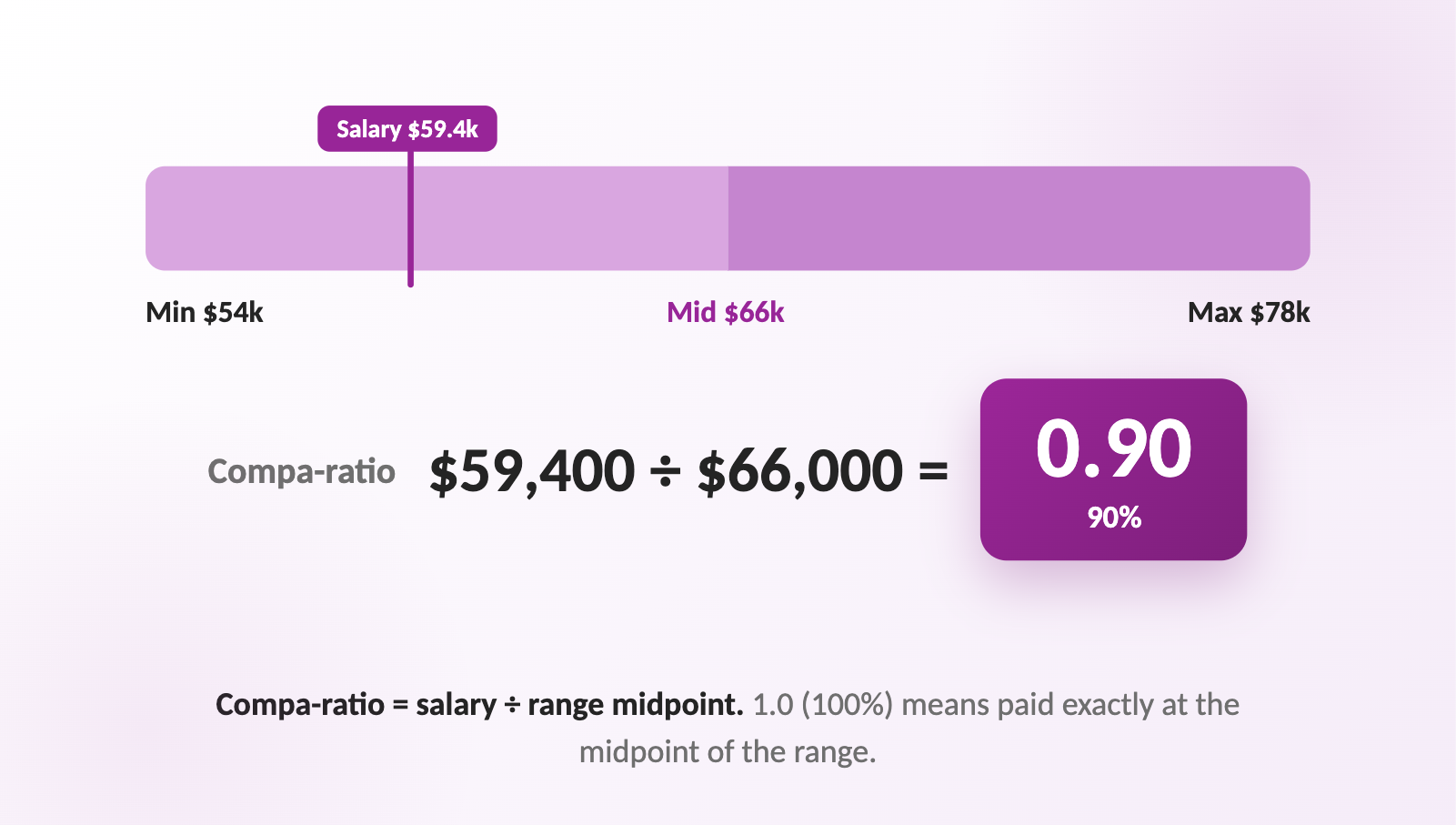
The salary range for a senior analyst is 54,000 to 78,000, so the midpoint is 66,000. Maya earns 59,400. Her compa-ratio is 59,400 ÷ 66,000 = 0.90 (90%). She has been rated "exceeds expectations" for two years, so the low compa-ratio flags a pay gap to fix in the next merit cycle. Her colleague Sam earns 72,600: 72,600 ÷ 66,000 = 1.10 (110%).
Frequently asked questions
- What is a good compa-ratio?
- Around 1.0 for someone fully competent in their role. Between 0.80 and 1.20 is normal; where someone should sit depends on their experience and performance.
- What does a compa-ratio of 0.85 mean?
- The employee earns 85% of the range midpoint. That is common for people new to a role, but worth reviewing for experienced, strong performers.
- What is the difference between compa-ratio and range penetration?
- Compa-ratio compares salary to the midpoint. Range penetration shows how far salary sits between the range minimum and maximum, from 0% to 100%.
- How do you calculate a group compa-ratio?
- Add up all salaries in the group and divide by the sum of their range midpoints. Comparing group results by gender or location can reveal pay equity gaps.
- How is compa-ratio used in merit increases?
- Many merit matrices give larger increases to people with lower compa-ratios for the same rating, moving pay towards the midpoint over time.
- Can compa-ratio be above 1.2?
- Yes, but it usually means the person is paid above their range, which suggests the range is out of date or the role should be levelled higher.
Sources
- WorldatWork, *The WorldatWork Handbook of Total Rewards* (2nd edition, 2021)
See it in practice
Compare talent management software
Related reading
Related terms