Pay Equity
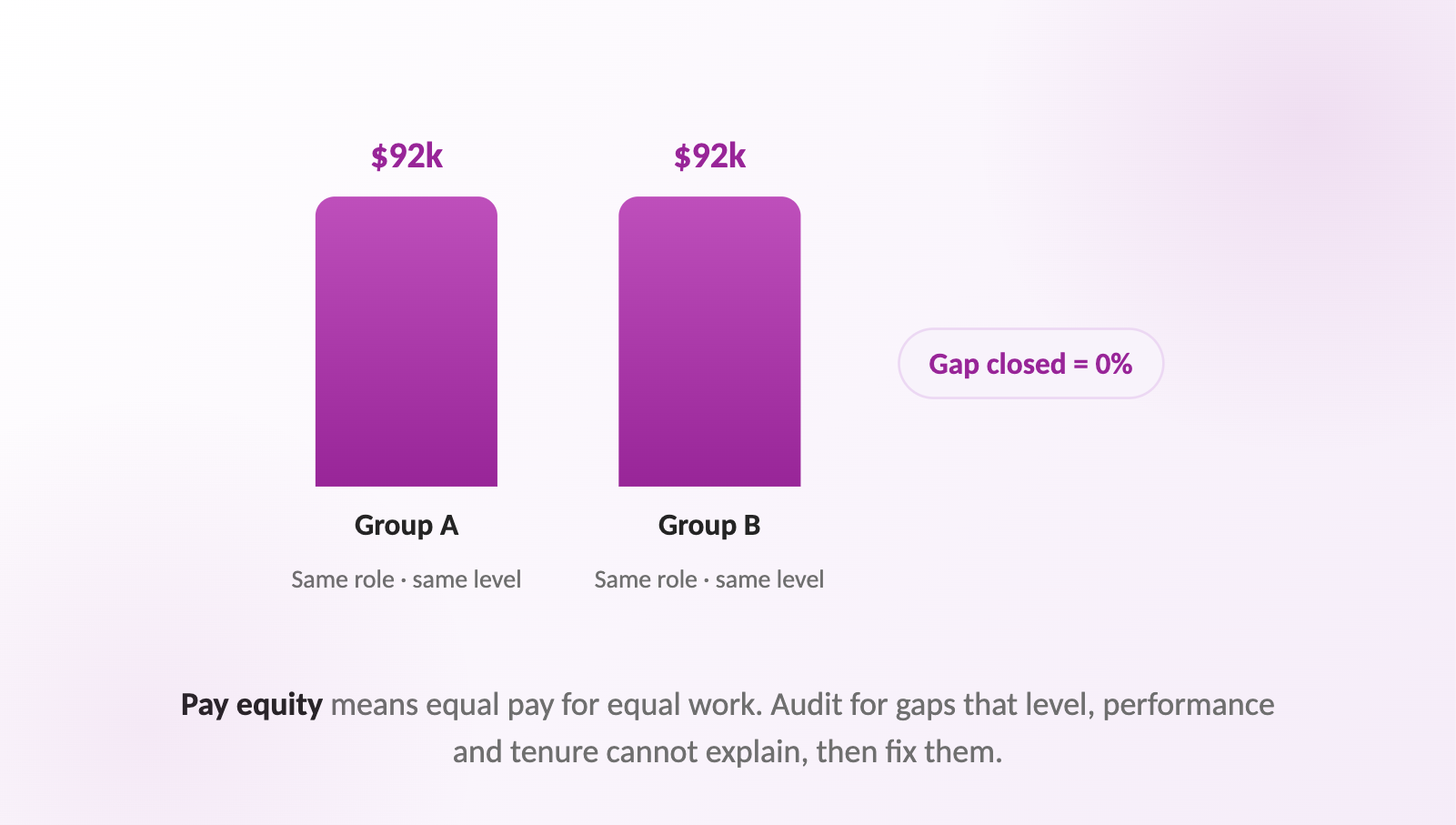
Pay equity means paying people the same for the same work, or for work of equal value, regardless of gender, race or other personal characteristics. Differences in pay are fine when they are explained by legitimate factors such as level, experience, performance or location. Pay equity is about finding and fixing the differences those factors cannot explain. Equal pay laws in the US, UK and EU make it a legal requirement, not just good practice.
Also known as: pay parity, equal pay, pay fairness, compensation equity
Reviewed
Key takeaways
- Pay equity means equal pay for the same work or work of equal value.
- Some pay differences are legitimate; pay equity targets the ones you cannot explain.
- A pay equity audit compares like-for-like groups after controlling for level, tenure, performance and location.
- Fix gaps in the next pay cycle, then change the process that created them.
At a glance
- Means
- Equal pay for equal or equal-value work
- Measured by
- Adjusted pay gap; compa-ratio by group
- Key laws
- US Equal Pay Act 1963; UK Equality Act 2010; EU Directive 2023/970
- Related
- Pay transparency, compa-ratio, salary band
Why does pay equity matter?
Unexplained pay gaps are unfair to the people affected, and they are expensive: they create legal risk, hurt retention and damage trust when they come to light. Pay transparency laws are making gaps more visible. Under the EU Pay Transparency Directive, a gender pay gap of 5% or more in any category of workers that cannot be justified must be addressed through a joint pay assessment.
Pay equity vs pay equality vs the gender pay gap
| Term | What it compares | Example |
|---|---|---|
| Pay equality | Same pay for exactly the same job | Two junior engineers on the same level paid the same |
| Pay equity | Same pay for work of equal value, after legitimate factors | A role in support and one in operations judged equal in skill and responsibility |
| Gender pay gap (unadjusted) | Average pay of all women vs all men | Often driven by fewer women in senior roles |
| Adjusted pay gap | Pay difference for comparable roles and profiles | The core measure in a pay equity audit |
How do you run a pay equity audit?
- Group comparable roles by level and job family.
- Collect the data: base pay, bonus, level, tenure, performance rating, location and demographic data.
- Compare groups using compa-ratio or average pay within each level.
- Control for legitimate factors, often with a regression analysis, to find the adjusted gap.
- Investigate outliers one by one before drawing conclusions.
- Fix unexplained gaps with pay adjustments, then fix the cause, such as starting pay negotiation or inconsistent merit increases.
- Repeat yearly, and before publishing any pay ranges.
Worked example
A company compares 60 software engineers at level 3. The average compa-ratio is 1.02 for men and 0.95 for women. After controlling for tenure, rating and location, a 4% gap remains. Most of it traces back to starting salaries: new hires who negotiated harder started higher. The company raises 9 salaries in the next cycle and moves to fixed starting pay per level.
Frequently asked questions
- What is pay equity?
- Paying employees equally for the same work or work of equal value, regardless of gender, race or other characteristics, once legitimate factors are taken into account.
- What is the difference between pay equity and pay parity?
- They are often used as synonyms. Pay parity is sometimes used more narrowly for equal pay between two named groups, such as men and women.
- Is pay equity a legal requirement?
- Yes in many places. The US Equal Pay Act 1963, the UK Equality Act 2010 and the EU Pay Transparency Directive all require equal pay for equal work or work of equal value.
- What factors can legitimately explain pay differences?
- Level, job family, relevant experience, performance and location are common ones. They must be applied consistently and not act as a proxy for gender or race.
- How often should you run a pay equity audit?
- At least once a year, and before major pay decisions such as the annual merit cycle or publishing salary ranges.
- What is an adjusted pay gap?
- The pay difference between groups after controlling for legitimate factors such as role, level and experience. It shows the gap that the pay system cannot explain.
Sources
- Directive (EU) 2023/970 on pay transparency, Official Journal of the European Union
- US Equal Pay Act of 1963; UK Equality Act 2010
See it in practice
Compare talent management software
Related reading
Related terms