Salary Band
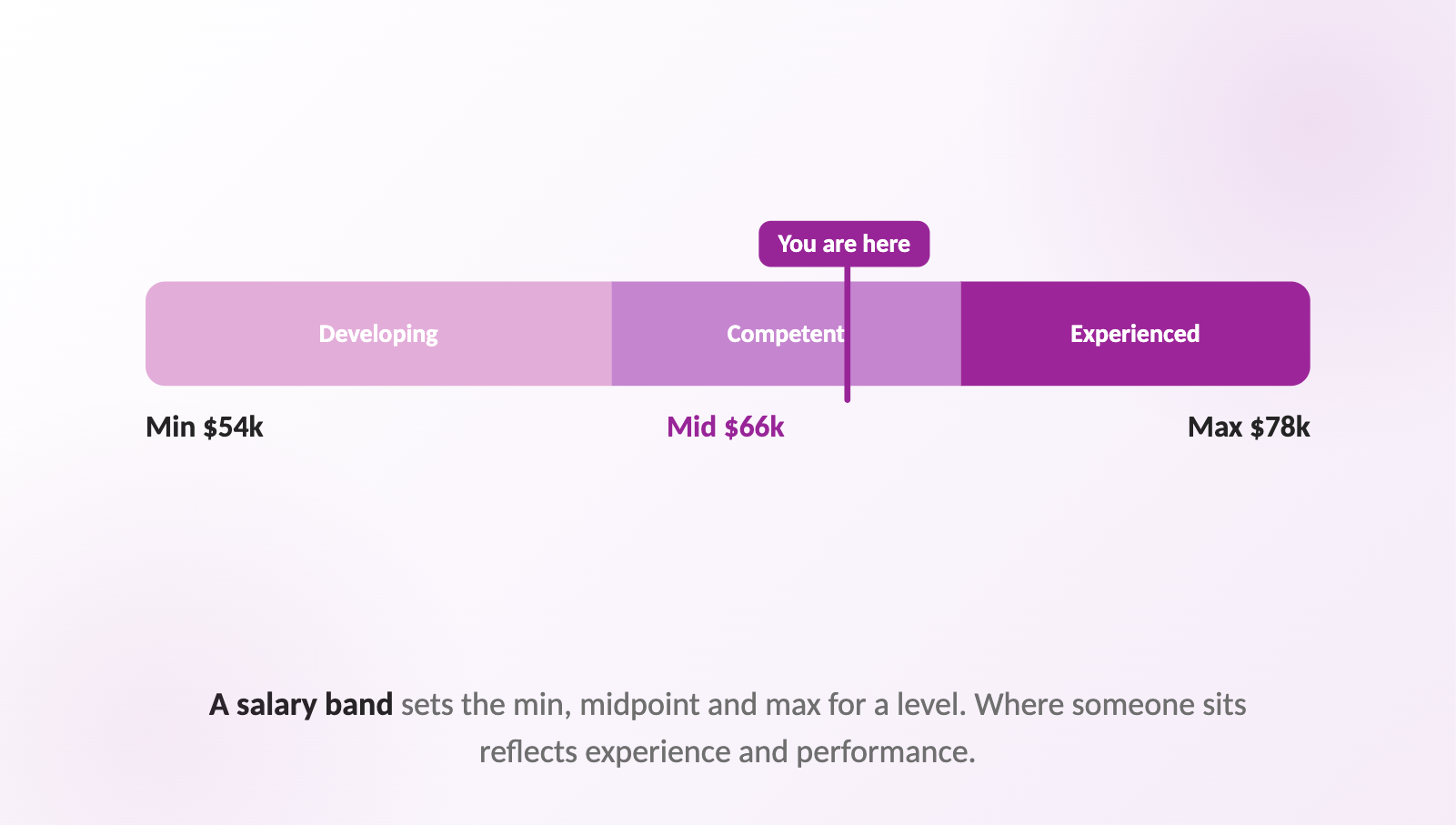
A salary band (or pay band) is the range of pay an organisation sets for a role or level, from a minimum to a maximum, with a midpoint that usually reflects the market rate. Everyone in that role or level should be paid somewhere inside the band. Bands keep pay consistent, give managers clear limits when hiring and awarding raises, and are the foundation for pay transparency and pay equity work.
Also known as: pay band, salary range, pay range, pay grade, compensation band
Reviewed
Key takeaways
- A salary band sets the minimum, midpoint and maximum pay for a role or level.
- The midpoint is usually set at the market rate from salary benchmarking.
- Range spread (max vs min) tends to widen with seniority.
- Bands are the base for compa-ratio, merit matrices and pay transparency.
At a glance
- Parts
- Minimum, midpoint, maximum
- Midpoint
- Usually the market rate for the role
- Range spread
- Often narrower for junior roles, wider for senior
- Related
- Salary benchmarking, compa-ratio, pay transparency
Why do salary bands matter?
Without bands, pay is set case by case, and the result depends on who negotiated hardest or which manager was more generous. That leads to unexplained gaps, frustrated employees and legal risk. Bands make pay decisions consistent and explainable. They are also required in practice for pay transparency: you cannot share a pay range in a job advert or answer an employee's request for pay information without one.
How do you calculate a salary band?
Start from the midpoint, then set the spread.
Range spread = (Maximum − Minimum) ÷ Minimum
Minimum = Midpoint ÷ (1 + spread ÷ 2)
Maximum = Minimum × (1 + spread)
For example, with a 66,000 midpoint and a 40% spread: minimum = 66,000 ÷ 1.2 = 55,000, and maximum = 55,000 × 1.4 = 77,000.
Salary band example
| Level | Minimum | Midpoint | Maximum | Spread |
|---|---|---|---|---|
| L1 Associate | 40,000 | 44,000 | 48,000 | 20% |
| L2 Analyst | 48,000 | 54,000 | 60,000 | 25% |
| L3 Senior analyst | 55,000 | 66,000 | 77,000 | 40% |
| L4 Lead | 66,000 | 82,500 | 99,000 | 50% |
Illustrative figures.
How do you set salary bands?
- Define job levels so comparable roles sit together.
- Benchmark the market for each role and level to set the midpoint.
- Choose a spread for each level; wider for senior roles where experience varies more.
- Check overlap between neighbouring levels so a promotion always comes with a meaningful rise.
- Place current employees in the bands and flag anyone below the minimum or above the maximum.
- Review yearly against market data.
Worked example
A 200-person company has 140 job titles and no bands. It groups them into 5 levels across 6 job families and benchmarks each. Twelve employees fall below their new minimum, mostly people hired early on low salaries. The company brings them to the minimum over two pay cycles and uses the bands for all new offers.
Frequently asked questions
- What is a salary band?
- A defined pay range, from minimum to maximum, for a role or level. It sets the limits for hiring offers and pay rises.
- What is the difference between a salary band and a pay grade?
- They are often used interchangeably. A pay grade is sometimes a broader grouping that covers several roles of similar value, each sharing one band.
- What is a good range spread?
- There is no single answer. Junior roles often use narrower spreads, around 20% to 30%, while senior roles may use 40% to 60% or more, because experience and impact vary more.
- What happens if someone is paid above the band maximum?
- They are "red-circled". Common practice is to hold their base pay and give one-off payments instead of rises until the band catches up.
- Should salary bands be shared with employees?
- Increasingly, yes. Many pay transparency laws require ranges in job adverts, and sharing bands internally builds trust when pay decisions are consistent.
- What is broadbanding?
- Using a small number of very wide bands that each cover many roles. It gives managers more flexibility but makes pay consistency harder to check.
Sources
- WorldatWork, *The WorldatWork Handbook of Total Rewards* (2nd edition, 2021)
See it in practice
Compare talent management software
Related reading
Related terms