Sageo Research
US Pay Transparency Laws by State: Salary Range Tracker
Which US states require a salary range in job postings, who is covered, and when each law took effect. Fourteen states and Washington, D.C. now mandate it in the posting, with more on the way. Updated and sourced, state by state.



The state of play. There is no federal pay transparency law in the United States, so the rules are set state by state, and the map keeps filling in. As of November 2026, fourteen states and Washington, D.C. require employers to put a salary range in the job posting itself. Two more, Nevada and Rhode Island, require the range on request rather than in the ad. Delaware joins in 2027. This tracker records where each jurisdiction stands, with the employer threshold and effective date named and sources dated, so a multi-state employer can see the real obligations rather than the headlines.
One remote posting, several states at once
The trap is remote hiring. These laws follow where the work can be done, not where your company sits. A single remote job ad that a candidate could fill from New York, Illinois, Washington or Colorado can trigger all of those states' rules at the same time. For a company hiring remotely across the US, the practical answer is usually to put a range in every posting, everywhere, rather than try to suppress it state by state.
Cite this tracker
- 14 US states plus Washington, D.C. now require a salary range in job postings: 15 of the 51 jurisdictions.
- Nevada and Rhode Island require it on request; Delaware joins in 2027. The count was one (Colorado) in 2021.
Sageo, "US Pay Transparency Laws by State: Salary Range Tracker," November 2026. https://sageo.ai/research/us-pay-transparency-laws-by-stateWhere do US pay transparency laws stand?
Colorado was first, in 2021. Since then the count has climbed almost every year: California, Washington and New York in 2023; Hawaii, Maryland and Washington, D.C. in 2024; Illinois, Minnesota, Vermont, New Jersey and Massachusetts in 2025; Virginia, Maine and a stronger Connecticut rule in 2026. The direction is one-way. No state that has adopted salary-range posting has repealed it.
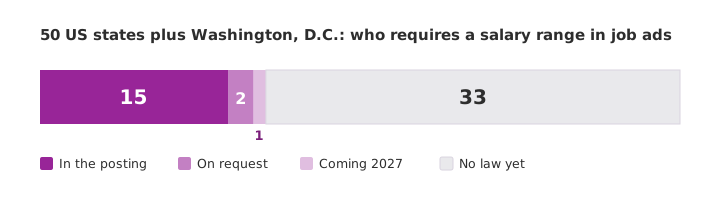
How many states require salary ranges in job postings?
- In the posting (14 states + D.C.)
- California, Colorado, Connecticut, Hawaii, Illinois, Maine, Maryland, Massachusetts, Minnesota, New Jersey, New York, Vermont, Virginia, Washington, and Washington, D.C. The salary range must appear in the job ad.
- On request (2)
- Nevada and Rhode Island require the range to be given to applicants, but do not require it in the posting itself.
- Coming in 2027 (1)
- Delaware has enacted a posting requirement that takes effect in 2027.
- No statewide law (33)
- The remaining states have no salary-range disclosure law, though some have salary-history bans, and several cities (New York City, Jersey City, Cleveland, Columbus) have their own posting ordinances.
The headline: 15 of the 51 jurisdictions now require a range in the posting, up from one in 2021. Roughly a third of the US workforce is already covered, and because the largest states (California, New York, Illinois) are in, most national employers are in scope somewhere.
Where does each state stand?
Every state and D.C. with a pay-transparency law, alphabetically. “Rule” says whether the range must be in the posting or only on request. Thresholds count employees, and reach beyond the state line where a role can be performed in-state. Statuses are cross-checked against the trackers listed under sources.
| State | Rule | Covered employers | In force / detail |
|---|---|---|---|
| California | In posting | 15 or more employees | Since 1 Jan 2023; pay scale also given to current staff on request, any size |
| Colorado | In posting | 1 or more in-state | Since 2021, the first US law; range plus a general benefits description |
| Connecticut | In posting | 1 or more employees | Posting required from 1 Oct 2026; was disclosure-on-request from 2021 |
| Delaware | Coming 2027 | More than 25 employees | Range plus benefits in postings; effective in 2027 (confirm the enacted date) |
| Hawaii | In posting | 50 or more employees | Since 1 Jan 2024; hourly rate or salary range in the posting |
| Illinois | In posting | 15 or more employees | Since 1 Jan 2025; range, or a link to a pay page; Illinois-tied roles |
| Maine | In posting | 10 or more employees | Effective 2026; range in postings for Maine openings |
| Maryland | In posting | All employers | Since 1 Oct 2024; range plus a general description of benefits |
| Massachusetts | In posting | 25 or more employees | Posting rule from 29 Oct 2025; plus wage-data reporting for 100-plus staff |
| Minnesota | In posting | 30 or more employees | Since 1 Jan 2025; range plus a general benefits description |
| Nevada | On request | All employers | Range given to applicants after an interview or at a conditional offer; not in the ad |
| New Jersey | In posting | 10 or more employees | Since 1 Jun 2025; range plus benefits in postings |
| New York | In posting | 4 or more employees | Since 17 Sep 2023; range in postings (NYC rule since Nov 2022) |
| Rhode Island | On request | All employers | Range on request and at hire; written pay notice for new hires from Jan 2026 (classification contested) |
| Vermont | In posting | 5 or more employees | Since 1 Jul 2025; range in postings for Vermont openings |
| Virginia | In posting | All employers | Since 1 Jul 2026; no size threshold; private right of action |
| Washington | In posting | 15 or more employees | Since 1 Jan 2023; range plus a list of benefits in the posting |
| Washington, D.C. | In posting | 1 or more in-District | Since Jun 2024; range in postings; salary-history questions banned |
In the posting, or only on request?
The distinction that matters most for a job ad is whether the range has to be in the posting or only handed over later.
- In the posting
- The default and the stronger form. The pay range, and in several states a benefits description, must appear in every covered job advertisement, internal and external, including postings run through a third party. This is the rule in all 14 states plus D.C. listed above.
- On request or at offer
- The lighter form. The employer must give the range when an applicant asks, or at a set point such as after an interview or at a conditional offer, but need not publish it. Nevada and Rhode Island sit here. It is where several states, including Connecticut, started before upgrading to a posting rule.
Who is covered, and does my company's location matter?
Scope follows the work, not the headquarters. Three things decide whether you are in:
- Where the role can be performed. Most laws cover any job that could be done in the state, which is why a remote posting open to several states triggers several regimes at once.
- The employee-count threshold, which ranges from one (Colorado, D.C.) to fifty (Hawaii), and in most states counts your total workforce, not just in-state staff.
- City ordinances on top. New York City, Jersey City, Cleveland and Columbus have their own posting rules that can bind employers even where the state rule is narrower.
A company headquartered outside the US that hires remote workers in covered states is in scope just the same. The trigger is the job's location, not the employer's.
What are the penalties?
Penalties are set state by state and are mostly per-violation, with each non-compliant posting counting separately. A few examples give the range: California carries civil penalties from $100 to $10,000 per violation; Colorado up to $10,000 per violation; Washington allows statutory damages and attorney's fees, and Virginia and several others add a private right of action. Enforcement has moved from warnings toward real fines, and class claims over missing ranges are now common. The exposure is less a single large fine than many small ones multiplied across every posting.
What should employers do now?
The patchwork rewards a single clean standard over fifty separate ones.
- Put a good-faith range in every posting, in every state. It is the simplest compliant default and removes the remote-posting trap entirely.
- Build a defensible pay structure and job architecture first, so the ranges you publish are consistent and you can explain pay differences objectively.
- Watch remote postings, which can trigger several states at once, and check city ordinances where you hire.
- Keep salary-history questions out of hiring; many of these states also ban them.
- Keep the range honest. A range so wide it is meaningless invites complaints and, in some states, penalties.
How is this tracker sourced and maintained?
There is no federal registry of pay-transparency laws, so status is tracked through law-firm and HR-advisory monitors and cross-checked against each state's statute and labor-department guidance. We led with the most recently updated trackers and verified effective dates and thresholds against the enacting laws. Last full review: November 2026.
- Primary trackers
- Jackson Lewis (2026 pay-transparency guidance), Ogletree Deakins, Brightmine US pay-transparency chart, the National Law Review new-laws roundups, and the Paycor and Paylocity state trackers.
- Contested classifications
- Rhode Island (on request vs in posting: sources differ, with a written pay-notice duty for new hires from January 2026); Massachusetts (posting-rule start date, reported as both July and October 2025); Delaware (effective date in 2027, reported variously). Reasonable readings differ.
- Cities, not just states
- Several cities (New York City, Jersey City, Cleveland, Columbus) have their own posting ordinances not captured in the state table. Confirm the local rule where you hire.
- What this is
- A maintained reference, not legal advice. These laws change almost every legislative session; always confirm the current state and city position before relying on the detail.
Free to cite with a link to this page. For the European companion, see our EU Pay Transparency Directive transposition tracker; for AI in hiring, our EU AI Act for hiring and HR tracker.
Frequently asked questions
Which US states require salary ranges in job postings?
As of November 2026, fourteen states plus Washington, D.C. require the salary range in the job posting: California, Colorado, Connecticut, Hawaii, Illinois, Maine, Maryland, Massachusetts, Minnesota, New Jersey, New York, Vermont, Virginia and Washington, plus D.C. Two more, Nevada and Rhode Island, require the range on request rather than in the ad, and Delaware's posting law takes effect in 2027. That is 15 of the 51 US jurisdictions requiring it in the posting, up from one (Colorado) in 2021.
Do I have to post a salary range for a remote job?
Usually yes, if the role can be performed in a state that requires it. These laws follow where the work can be done, not where the company is based, so a remote posting open to candidates in New York, Washington, Illinois or Colorado triggers all of those states' rules at once. For national remote hiring, the simplest compliant approach is to put a good-faith range in every posting rather than try to suppress it state by state.
What is the employee threshold for pay transparency laws?
It varies by state. Colorado and Washington, D.C. apply to employers with as few as one in-state employee; New York at four; California, Illinois and Washington at fifteen; Massachusetts at twenty-five; Minnesota at thirty; and Hawaii at fifty. Virginia and Maryland have no size threshold. Most states count your total workforce, not just in-state staff, so a large out-of-state employer is usually covered once it hires in the state.
Is there a federal pay transparency law in the US?
No. There is no national salary-range posting law, so the requirements are set state by state, and several cities add their own ordinances on top. That is why multi-state employers face a patchwork: fourteen states plus Washington, D.C. require a range in the posting as of November 2026, two require it on request, and the rest have no law, though many ban asking about salary history.
What are the penalties for not posting a salary range?
They are set state by state and are mostly per violation, so each non-compliant posting can count separately. California carries civil penalties from $100 to $10,000 per violation, Colorado up to $10,000, and Washington allows statutory damages and attorney's fees, while Virginia and several others add a private right of action. The real exposure is many small penalties multiplied across every posting, plus class claims over missing ranges.

Written by
Deepti GuptaCo-founder, Sageo
18+ years building people functions from the ground up at Myntra, Freshworks and Dream11, scaling teams from 100 to 2,500 people and designing company-wide performance and compensation systems. Sageo automates the frameworks she has built by hand throughout her career.

Reviewed by
Vinayak RaviCo-founder, Sageo
19+ years of B2B SaaS go-to-market leadership. He built the organic growth engine at Freshworks through its rise to a public company and has led demand generation at some of the sector's fastest-scaling software startups.
Product names and logos are trademarks of their respective owners, shown here for identification only and not as endorsements.
All research