Sageo Research
EU AI Act for Hiring and HR: Compliance Tracker
What the EU AI Act requires for recruitment and HR AI, and exactly when each duty applies. The Digital Omnibus pushed the high-risk deadline to 2 December 2027, but four obligations already bind employers today. Updated and sourced.



The state of play. The EU AI Act is the first broad law to put hiring and HR AI under hard rules, and in 2026 its timeline moved. The Digital Omnibus, Regulation (EU) 2026/1744, came into force on 27 July 2026 and delayed the Act's high-risk obligations, which is where recruitment and HR AI sit, from 2 August 2026 to 2 December 2027. That delay has been widely read as a reprieve. It is not. Four separate duties already apply to hiring AI today, including an outright ban on one common HR use. This tracker sets out what the Act requires for HR AI, what is live now, and what starts when, with the legal references named and sources dated.
The date everyone quotes, and the duties it does not cover
2 December 2027 is the new deadline for the Act's high-risk obligations, the full build-and-deploy regime for recruitment and HR AI. But the prohibited-practice rules and the AI literacy duty have applied since 2 February 2025, the transparency duty since 2 August 2026, and worker-consultation rules under national employment law already bite before any of these dates. A company that waits for December 2027 is already late on four fronts.
Cite this tracker
- The Digital Omnibus (Regulation (EU) 2026/1744) pushed the EU AI Act's high-risk duties for hiring and HR AI to 2 December 2027.
- But four obligations already apply to hiring AI today: AI literacy and prohibitions (since Feb 2025), transparency (since Aug 2026) and worker consultation.
Sageo, "EU AI Act for Hiring and HR: Compliance Tracker," November 2026. https://sageo.ai/research/eu-ai-act-hiring-trackerWhere does the EU AI Act stand for HR right now?
The AI Act (Regulation (EU) 2024/1689) entered into force in August 2024 and applies in phases. In 2026 the European Commission's Digital Omnibus simplification package amended it. The AI part, Regulation (EU) 2026/1744, was published in the Official Journal on 24 July 2026 and came into force on 27 July 2026. For HR, three things matter: it pushed the high-risk obligations for standalone Annex III systems (recruitment and HR AI) from 2 August 2026 to 2 December 2027; it pushed the high-risk obligations for AI built into regulated products from 2 August 2027 to 2 August 2028; and it left the transparency duties on their original 2 August 2026 schedule. It also adds two further prohibited practices that apply from 2 December 2026.
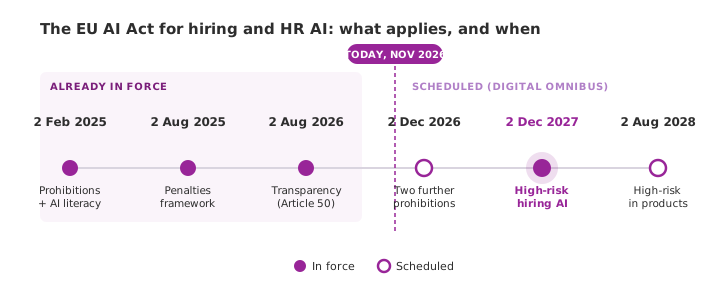
The EU AI Act timeline for hiring and HR AI
Every obligation that touches recruitment or HR AI, in date order, with what it means for an employer and whether it is live as of November 2026.
| Obligation | What it means for HR | Applies from | Status |
|---|---|---|---|
| AI literacy (Article 4) | Staff who use or oversee HR AI must be trained enough to understand what it does and its limits | 2 Feb 2025 | Live |
| Prohibited practices (Article 5) | Bans emotion recognition in the workplace, social scoring and manipulative systems outright | 2 Feb 2025 | Live |
| Penalties framework (Article 99) | National authorities can impose fines for breaches | 2 Aug 2025 | Live |
| Transparency (Article 50) | Tell candidates and employees when they interact with AI or receive AI-generated output | 2 Aug 2026 | Live |
| Two further prohibitions | Added by the Digital Omnibus; extends the Article 5 list | 2 Dec 2026 | Scheduled |
| High-risk duties, standalone (Annex III) | Full provider and deployer regime for recruitment and HR AI | 2 Dec 2027 | Delayed from 2 Aug 2026 |
| High-risk duties, in products (Annex I) | Full regime for high-risk AI embedded in regulated products | 2 Aug 2028 | Delayed from 2 Aug 2027 |
Is your hiring or HR AI high-risk under the Act?
The Act classifies most AI that makes or supports decisions about people at work as high-risk. Annex III, point 4 names two HR categories: AI used for recruitment or selection, and AI used to decide on or materially influence the working relationship. If a tool falls in either, the full high-risk regime applies to it from 2 December 2027. The table below maps common HR uses to the classification.
| HR AI use | High-risk? | Why |
|---|---|---|
| CV screening, parsing or ranking of applicants | Yes | Annex III 4(a): recruitment and selection |
| Automated candidate assessment, scored video or game-based interviews | Yes | Annex III 4(a): evaluating candidates |
| Targeted job advertising used to place or filter candidates | Yes | Annex III 4(a): recruitment |
| AI that decides or supports promotion, termination, pay or task allocation | Yes | Annex III 4(b): terms of the working relationship |
| AI that monitors or evaluates worker performance and behaviour | Yes | Annex III 4(b): monitoring and evaluation |
| HR chatbot answering policy questions, making no decision about a person | Usually no | Not a decision affecting a person, but the Article 50 transparency duty still applies |
| Payroll or scheduling automation with no evaluative decision | Usually no | Outside Annex III point 4, but confirm on the facts |
One HR use is banned outright, and the delay does not touch it
Since 2 February 2025, Article 5 has prohibited AI that infers the emotions of workers, and of candidates in a workplace setting, for example from facial expression, tone of voice or word choice in an interview. Narrow medical and safety uses are the only exceptions. This is a prohibition, not a high-risk duty, so the move to December 2027 has no effect on it. Emotion-scoring interview and monitoring features are already unlawful in the EU.
What already applies to HR AI today?
Four duties are live now, regardless of the high-risk delay. For most employers these, not the 2027 deadline, are the immediate work.
- AI literacy
- Since 2 February 2025. Anyone in your organisation who operates or oversees an HR AI tool must have enough training to understand how it works and where it fails. It applies whether you built the tool or bought it.
- Prohibited practices
- Since 2 February 2025. The workplace emotion-recognition ban is the one that catches HR directly; social scoring and manipulative or exploitative systems are also banned. There is no grace period and no high-risk paperwork route around a prohibition.
- Transparency
- Since 2 August 2026. Under Article 50 you must tell people when they are interacting with an AI system, and label AI-generated output. In hiring that means telling a candidate when AI takes part in screening or assessing them.
- Worker consultation
- Already, under national law. In most member states, works-council or employee-representative rules require you to inform and often consult worker representatives before you put an HR AI system into use. The Act's Article 26(7) points the same way. This does not wait for 2027.
What changes on 2 December 2027?
From that date, the full high-risk regime applies to recruitment and HR AI. The heavier build-time duties (risk management, data governance, conformity assessment, registration, CE marking) fall on the provider, usually your AI vendor. But an employer that uses a high-risk tool is a deployer, and carries its own obligations under Article 26.
- Human oversight
- Assign competent, trained people to oversee the system, with the authority to disregard, override or reverse its output. A human must own the decision.
- Use as instructed and monitor
- Operate the system in line with the provider's instructions, and monitor it in use. Flag risks or serious incidents to the provider and the authority.
- Keep logs
- Retain the system's automatically generated logs for the period set by the Act, so a decision can be reconstructed and audited.
- Inform workers
- Before putting a high-risk system into use at work, inform worker representatives and the affected workers that they will be subject to it (Article 26(7)).
- Tell the individuals
- Where an Annex III system makes or assists a decision about a person, that candidate or employee must be told they are subject to it (Article 26(11)).
- Assess the impact
- Run a data protection impact assessment, and where required a fundamental-rights impact assessment, before deployment.
What should employers do now?
The delay buys time on the high-risk paperwork, not on the duties that are already live. A readiness plan that starts in 2027 starts two years late. The practical work, in order:
- Inventory every HR and recruitment AI tool in use, including features inside your ATS, HRIS and assessment vendors, and tag which are Annex III high-risk.
- Train the people who use or oversee those tools. AI literacy is already law, not a 2027 task.
- Remove or disable any emotion-inference feature in interviews or monitoring. It is already prohibited.
- Add candidate-facing AI transparency notices now. The Article 50 duty is live.
- Build worker-representative consultation into your deployment process, as national law already requires.
- Put provider documentation (conformity, instructions for use, the high-risk classification) into procurement, so you are not left carrying a vendor's gap.
- Keep a named human decision-maker in the loop on every call about a person. That is the principle the Act is built on, and the one Sageo is built on.
What are the penalties?
The Act sets fines as the higher of a fixed sum or a percentage of global annual turnover. For an SME, the lower of the two applies. National market-surveillance authorities enforce, and the penalties framework has been live since 2 August 2025.
- Prohibited practices
- Up to 35 million euro, or 7% of total worldwide annual turnover for the preceding year. This is the tier that covers the workplace emotion-recognition ban.
- Breach of other obligations
- Up to 15 million euro, or 3% of turnover. Covers high-risk duties, transparency and most deployer obligations.
- Incorrect or misleading information
- Up to 7.5 million euro, or 1% of turnover, for supplying wrong information to an authority.
Does the Act apply to non-EU employers?
Yes, if your AI touches people in the EU. The Act reaches deployers established in the EU, and providers and deployers outside the EU where the system's output is used in the EU. If you use an AI tool to screen or assess a candidate located in an EU member state, you are in scope, wherever your company is headquartered. A business hiring across several member states is tracking one regulation, not 27 national laws, which is the one simplification the AI Act offers over the pay-transparency regime.
United Kingdom: not bound by the Act. The UK has no equivalent AI-in-hiring statute; AI in recruitment is governed through UK GDPR (automated-decision rules) and the Equality Act 2010. Employers hiring in both the UK and the EU should expect to meet the EU rules for their EU candidates regardless.
How is this tracker sourced and maintained?
This tracker reads the primary legal texts and cross-checks the dates against the major law-firm analyses published after the Digital Omnibus came into force. The AI Act timeline shifted in 2026 and could shift again, so every date here is tied to a named instrument. Last full review: November 2026.
- Primary legal texts
- Regulation (EU) 2024/1689 (the AI Act); Regulation (EU) 2026/1744 (the Digital Omnibus on AI), published in the Official Journal 24 July 2026, in force 27 July 2026.
- Secondary analysis
- Post-Omnibus guidance from Gibson Dunn, Morgan Lewis, DLA Piper, White and Case and Crowell, plus the European Commission's AI Act pages and high-risk classification guidelines.
- Contested points
- The exact scope of the two new prohibitions (from 2 December 2026) and the adjusted high-risk classification filter are still settling. Where the detail is unsettled, this tracker says so rather than guessing.
- What this is
- A maintained reference, not legal advice. Dates and classifications can change between updates; confirm the current position on EUR-Lex and with counsel before acting.
Free to cite with a link to this page. For the companion compliance tracker, see our EU Pay Transparency Directive transposition tracker; for the market picture, our State of AI in HR 2027 study.
Frequently asked questions
When does the EU AI Act apply to hiring and HR AI?
In phases. After the Digital Omnibus (Regulation (EU) 2026/1744, in force 27 July 2026), the full high-risk regime for recruitment and HR AI applies from 2 December 2027, pushed back from 2 August 2026. But four duties already apply: AI literacy and prohibited practices since 2 February 2025, transparency since 2 August 2026, and worker-consultation duties under national employment law. The delay covers the high-risk paperwork, not those live obligations.
Is recruitment AI high-risk under the EU AI Act?
Yes. Annex III, point 4 classifies AI used for recruitment or selection as high-risk, including CV screening, parsing and ranking, and automated or scored candidate assessment. It also covers AI used to decide on promotion, termination, pay, task allocation, or to monitor and evaluate worker performance. From 2 December 2027 the full high-risk regime applies to those tools; a chatbot that answers policy questions without deciding about a person is generally not high-risk, though the transparency duty still applies.
Did the Digital Omnibus delay the EU AI Act for employers?
It delayed one part. The Digital Omnibus (Regulation (EU) 2026/1744) moved the high-risk obligations for standalone Annex III systems, which include hiring and HR AI, from 2 August 2026 to 2 December 2027, and those for AI in regulated products to 2 August 2028. It did not move the prohibited practices (live since February 2025), the AI literacy duty (February 2025) or the transparency duty (August 2026). It also adds two further prohibitions from 2 December 2026.
Is AI emotion recognition in interviews banned in the EU?
Yes. Since 2 February 2025, Article 5 of the AI Act prohibits AI that infers the emotions of workers or of candidates in a workplace setting, for example from facial expression or tone of voice in an interview, with narrow exceptions for medical or safety use. It is a prohibition, not a high-risk duty, so the move to December 2027 does not affect it. Emotion-scoring interview features are already unlawful.
What must employers do to comply with the EU AI Act for HR AI?
Start now, not in 2027. Inventory your HR and recruitment AI and tag which tools are Annex III high-risk; train the people who use or oversee them (AI literacy is already law); remove any emotion-inference feature; add candidate-facing AI transparency notices; build worker-representative consultation into deployment; and get provider conformity documentation into procurement. From 2 December 2027, deployers also owe human oversight, logging and worker-notification duties under Article 26.
Does the EU AI Act apply to companies outside the EU?
Yes, if your AI touches people in the EU. The Act reaches deployers established in the EU, and providers and deployers outside the EU where the system's output is used in the EU. Using an AI tool to screen or assess a candidate located in an EU member state puts you in scope, wherever you are headquartered. Breaching a prohibition can cost up to 35 million euro or 7% of global turnover.

Written by
Deepti GuptaCo-founder, Sageo
18+ years building people functions from the ground up at Myntra, Freshworks and Dream11, scaling teams from 100 to 2,500 people and designing company-wide performance and compensation systems. Sageo automates the frameworks she has built by hand throughout her career.

Reviewed by
Vinayak RaviCo-founder, Sageo
19+ years of B2B SaaS go-to-market leadership. He built the organic growth engine at Freshworks through its rise to a public company and has led demand generation at some of the sector's fastest-scaling software startups.
Product names and logos are trademarks of their respective owners, shown here for identification only and not as endorsements.
All research