Sageo Research
EU Pay Transparency Directive: Transposition Tracker
Where all 27 EU member states stand on writing Directive (EU) 2023/970 into national law. The deadline passed on 7 June 2026; most countries missed it. Updated and sourced, country by country.



The state of play. The deadline for EU member states to write the Pay Transparency Directive (EU) 2023/970 into national law was 7 June 2026. It has passed, and most countries missed it. As of late October 2026, only five of the 27 (Greece, Italy, Lithuania, Malta and Slovakia) have a full implementing law in force. Four more have partial rules live, twelve are still working through draft bills, and six have no published draft at all. This tracker records where each one stands, with the national law or bill named and sources dated, so you can see the real picture rather than the directive's theory.
The clock the delays do not move
National legislation is late almost everywhere, but the directive's own reporting deadline is fixed. The first gender pay gap reports are still due 7 June 2027 for employers with 150 or more workers, based on 2026 pay data, the year that is already underway. A slow parliament does not buy employers more time to get their pay data in order.
Where does EU pay transparency transposition stand?
More than three years after the directive was adopted, and over four months after the deadline, implementation across the EU is a patchwork. A handful of countries legislated on time. The largest economies (Germany, France, Spain) are still drafting. A few have not published anything at all.
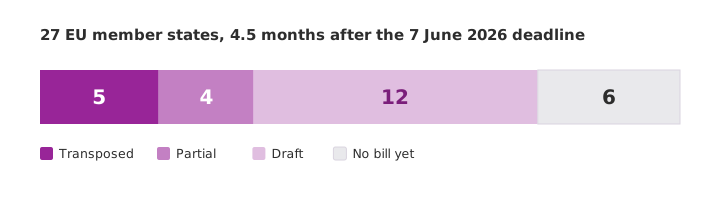
How many countries have transposed the directive?
- Transposed (5)
- Greece, Italy, Lithuania, Malta, Slovakia. Full implementing law adopted and in force.
- Partial (4)
- Belgium, Czechia, Estonia, Poland. Some obligations are live (often recruitment or pay-secrecy rules), but full transposition is still outstanding.
- Draft (12)
- Bulgaria, Cyprus, Denmark, Finland, France, Ireland, Latvia, Netherlands, Portugal, Romania, Spain, Sweden. A bill is published or in the legislative pipeline but not yet adopted.
- No bill yet (6)
- Austria, Croatia, Germany, Hungary, Luxembourg, Slovenia. No published draft as of October 2026.
The headline: 5 fully transposed, 22 missed the deadline and are still in progress. The European Commission has declined requests to “stop the clock” and warned that late states can face infringement proceedings.
Where does each EU member state stand?
Every member state, alphabetically. “Status” uses the four buckets above. Statuses are cross-checked against the trackers listed under sources; where a country's classification is genuinely contested, that is noted there.
| Country | Status | National law or bill | Where it stands |
|---|---|---|---|
| Austria | No bill yet | None published | Existing Equal Treatment Act applies; income reports already required for 150+ staff |
| Belgium | Partial | Public-sector decrees (FR community 2024; Flanders draft) | No federal private-sector law; asked the Commission for a six-month extension |
| Bulgaria | Draft | Bill amending the Anti-Discrimination Act and Labour Code | Approved by the Council of Ministers Sep 2026; before the National Assembly |
| Croatia | No bill yet | None published | Only a voluntary job-evaluation toolkit issued Sep 2026 |
| Cyprus | Draft | Draft from the Dept of Labour Relations | Consultation complete; heading to the Council of Ministers |
| Czechia | Partial | Pay-secrecy ban in force (2025); Labour Code amendment in draft | Full transposition expected ~1 Jan 2027 |
| Denmark | Draft | Bill amending the Equal Pay Act | Tabled Oct 2026; reporting extended down toward 50 to 99 staff |
| Estonia | Partial | Act 837 SE, in force 13 Jul 2026 | Recruitment and pay-secrecy rules live; full reporting deferred (sought ~2-year delay) |
| Finland | Draft | Government Proposal RP 129/2026 | In Parliament; targeted 1 Jan 2027; minimum transposition |
| France | Draft | Transposition bill | To Parliament Sep 2026; keeps the 50-employee threshold; phased to 2028 |
| Germany | No bill yet | Planned revision of the EntgTranspG | No public draft bill yet; reporting still due Jun 2027 |
| Greece | Transposed | Law 5316/2026 (in force 6 Jul 2026) | Most duties apply from 1 Nov 2026; 5% pay-gap trigger |
| Hungary | No bill yet | None published | Reportedly planned for autumn 2026; unconfirmed |
| Ireland | Draft | General Scheme 2025 + separate Pay Transparency Bill | Phased; deadline formally missed; not prioritised in the autumn 2026 programme |
| Italy | Transposed | Legislative Decree 96/2026 (in force 7 Jun 2026) | Reporting for 150+ from Jun 2027; 5% joint-assessment trigger |
| Latvia | Draft | Standalone draft 26-TA-700 (Ministry of Welfare) | Not yet enacted; target 1 Jan 2027; pay info in job ads |
| Lithuania | Transposed | Labour Code amendments (in force 7 Jun 2026) | Right-to-information from Jan 2027; pay reporting via social security |
| Luxembourg | No bill yet | None published | Long expected; nothing tabled |
| Malta | Transposed | Legal Notice 173 of 2026 (in force 5 Jun 2026) | Met the deadline; extends the pay-claim limitation period |
| Netherlands | Draft | Bill 36949 | Plenary debate scheduled Dec 2026 / Jan 2027; works-council consent rights |
| Poland | Partial | Recruitment rules in force Dec 2025; broader act in draft | Pay-gap reporting still to come; targeted Jan 2027 |
| Portugal | Draft | Partial-transposition bill (consultation Aug 2026) | Builds on existing Law 60/2018; no adoption date |
| Romania | Draft | Ministry of Labour draft | Rejected by the Senate Oct 2026; now with the Chamber of Deputies |
| Slovakia | Transposed | Equal Pay Act (in force 7 Jun 2026) | Fines up to €100,000; compliant pay structures due Jul 2026 |
| Slovenia | No bill yet | None published | Working group preparing; ZDR-1 already requires equal pay for equal work |
| Spain | Draft | Draft Royal Decree amending RD 902/2020 | Strong pre-existing pay-register and audit regime already in force |
| Sweden | Draft | Draft amendments prepared, then paused | Government opposes the directive and is seeking EU renegotiation; no bill before the Riksdag |
Which countries have fully transposed the directive?
Five member states had a full implementing law in force by October 2026. Four of them legislated right at the deadline; Greece followed a month later.
- Slovakia
- Act on the Application of the Principle of Equal Pay, in force 7 June 2026. A clean, minimum transposition. Compliant pay structures were required by 31 July 2026; the Labour Inspectorate enforces, with fines up to €100,000.
- Italy
- Legislative Decree No. 96 of 7 May 2026 (Official Gazette 1 June), in force 7 June 2026. Reporting for 250+ annually, 150 to 249 every three years (first due June 2027); joint pay assessment triggered at a 5% gap.
- Lithuania
- Labour Code amendments adopted 21 May 2026, in force 7 June 2026. Right-to-information from January 2027; pay reporting runs through the social-security system.
- Malta
- Legal Notice 173 of 2026 (Equal Pay Transparency and Reporting Regulations), in force 5 June 2026. Extends the limitation period for pay claims.
- Greece
- Law 5316/2026, in force 6 July 2026, with most operative duties applying from 1 November 2026. Reporting for 100+ employers; joint pay assessment at a 5% gap; enforced by the Ombudsman and Labour Inspectorate, fines €300 to €50,000.
Has Latvia transposed the directive?
Where Latvia stands
Latvia, where Sageo is incorporated, has not yet transposed. The Ministry of Welfare (Labklājības ministrija) published a standalone draft law, reference 26-TA-700, in spring 2026, but as of mid-October 2026 it is still moving through inter-ministerial reconciliation and the Cabinet toward the Saeima, and is not yet enacted. The target effective date is 1 January 2027. Reported specifics (not yet final): pay information in job ads rather than before interview, a gross or hourly figure permitted instead of a full range, and reporting duties starting at 100 employees. Verify the current Saeima reading stage before relying on the detail.
What should employers do now?
The uneven rollout is a trap. It is tempting to wait for your own country to legislate, but three things make that risky.
- The reporting clock is fixed. First reports are due June 2027 on 2026 pay data for employers with 150+ workers, whatever your national parliament does. The reference year is already running.
- Scope follows your people, not your headquarters. If you employ enough staff in an EU country, you are in that country's regime, even if you are headquartered in London, Bengaluru or San Francisco. A company with engineers in Germany, sales in France and support in Poland has three regimes to track.
- The direction is one-way. Several countries are gold-plating (lower thresholds, extra duties), and the Commission has refused to delay. Early movers are setting the ceiling, not the floor.
The practical readiness work is the same everywhere: get a defensible job architecture and pay structure in place, run a pay-gap analysis on 2026 data now, and be ready to explain pay differences objectively. For the full obligations, deadlines and a readiness plan, see our guide to the EU Pay Transparency Directive.
Related guideEU Pay Transparency Directive 2026: Rules, Deadlines & Equal PayThe full picture: what the directive requires, the June 2027 reporting deadline, the 5% pay-gap trigger, and how to get ready.Does the directive apply to the UK and EEA?
United Kingdom: not an EU member and not bound by the directive. The UK has its own, narrower regime (gender pay-gap reporting under the Equality Act 2010 for employers with 250 or more staff) with no equivalent of the directive's pay-range-in-ads or joint-assessment duties. Expansion to ethnicity and disability reporting has been signalled but not enacted.
EEA (Norway, Iceland, Liechtenstein): the directive is marked EEA-relevant but has not yet been incorporated into the EEA Agreement, so these states are not yet legally bound and the June 2026 deadline does not apply to them. Norway has begun preparatory work pending incorporation. Switzerland, outside the EEA, is unaffected.
How is this tracker sourced and maintained?
No official European Commission transposition table exists for this directive yet, so status is tracked through law-firm and HR-advisory monitors. We cross-checked each country against several, led by the most recently updated, and verified the five “transposed” states against their official law references. Last full review: 24 October 2026.
- Primary trackers
- beqom country tracker (updated 23 Oct 2026); Ius Laboris, “which countries have transposed” (30 Sep 2026); Pinsent Masons Out-Law guide (9 Jul 2026); Trusaic transposition update (3 Aug 2026); Littler, “Did member states meet the deadline?” (8 Jun 2026).
- Official law references
- Greece Law 5316/2026; Italy Legislative Decree 96/2026; Malta Legal Notice 173/2026; Lithuania Labour Code amendments of 21 May 2026; Slovakia Act on the Application of the Principle of Equal Pay.
- Contested classifications
- Czechia (partial vs draft: a pay-secrecy ban is in force but the main amendment is still a draft), Spain (partial vs draft: the directive-specific decree is draft, but a strong pay-register regime predates it), and Sweden (draft vs no bill: a draft was prepared then paused). Reasonable readings differ.
- What this is
- A maintained reference, not legal advice. Fast-moving countries (currently Cyprus, Germany, Hungary, Latvia, Romania) can change between updates; always confirm the current national position before acting.
Free to cite with a link to this page. For the market companion to this tracker, see our State of AI in HR 2026 search-demand study.
Frequently asked questions
How many EU countries have transposed the Pay Transparency Directive?
As of October 2026, 5 of the 27 member states have fully transposed Directive (EU) 2023/970 and have it in force: Greece, Italy, Lithuania, Malta, and Slovakia. Four more have partial rules live (Belgium, Czechia, Estonia, Poland), twelve are still working through draft bills, and six have no published draft. In short, 22 of 27 missed the 7 June 2026 deadline and are still in progress.
Which countries missed the EU Pay Transparency Directive deadline?
All but five. Only Greece, Italy, Lithuania, Malta, and Slovakia had a full implementing law in force by the 7 June 2026 deadline. The largest economies, Germany, France, and Spain, are still drafting, and Austria, Croatia, Germany, Hungary, Luxembourg, and Slovenia had no published bill at all as of October 2026.
Has Latvia transposed the EU Pay Transparency Directive?
Not yet. Latvia's Ministry of Welfare published a standalone draft law (reference 26-TA-700) in spring 2026, but as of October 2026 it is still moving through the legislative process and is not enacted. The target effective date is 1 January 2027, so Latvia missed the 7 June 2026 deadline.
Does the reporting deadline move if my country transposes late?
No. The directive's reporting clock is fixed regardless of national delays. The first gender pay gap reports are due 7 June 2027 for employers with 150 or more workers, based on 2026 pay data, so the reference year is already running even in countries that have not yet legislated.

Written by
Deepti GuptaCo-founder, Sageo
18+ years building people functions from the ground up at Myntra, Freshworks and Dream11, scaling teams from 100 to 2,500 people and designing company-wide performance and compensation systems. Sageo automates the frameworks she has built by hand throughout her career.

Reviewed by
Vinayak RaviCo-founder, Sageo
19+ years of B2B SaaS go-to-market leadership. He built the organic growth engine at Freshworks through its rise to a public company and has led demand generation at some of the sector's fastest-scaling software startups.
Product names and logos are trademarks of their respective owners, shown here for identification only and not as endorsements.
All research