Sageo Research
The State of AI in HR 2026
Two sides of the same story: what people are searching for, what the tools actually ship, and the gap in between. Built on live search data and a review of how the leading HR-tech vendors really use AI.


The short version. There are two stories in AI for HR, and they do not quite match. On the demand side, interest has exploded: searches for “AI in HR” have grown roughly 9x since 2021, advertisers now pay up to $19 a click, and 15 of the 18 core terms we examined return a Google AI Overview. On the supply side, the tools are real but lopsided. The AI that works today is concentrated in hiring and HR admin, the industry is racing into “agents that act,” and the places where AI tries to score and judge people are exactly where the lawsuits, the unreleased products, and the trust problems are piling up. This report covers both sides, and the gap between them.
What's inside
Part one, the demand side, is built on live search data: how fast the category grew, what it's worth, and how it's being consumed. Part two, the supply side, is a review of how 10 leading HR-tech vendors actually use AI today: what ships, what's hype, the legal risk building up, and the gap that is left in performance, competency and culture.
What does the data show?
Part one draws on search-demand data from Ahrefs Keywords Explorer, pulled on 24 October 2026: what people actually type into Google, measured over time, by commercial value and by country. Part two draws on our own competitor-research dossiers on ten AI-in-HR vendors (BambooHR, Deel, Eightfold, HireVue, Leena AI, Paradox, Phenom, Rippling, Skima and Textio), reviewed in late 2026. Where a vendor's adoption or ROI figure is a marketing claim we could not independently verify, we say so; lawsuit allegations are unproven. Full method and sources are at the end.
Part one · The demand side
1. When did AI in HR become a real category?
For most of 2021 and 2022, “AI in HR” was a quiet, flat line: a few hundred US searches a month, going nowhere. The category effectively did not exist in the public mind. Then generative AI went mainstream, and the line broke.
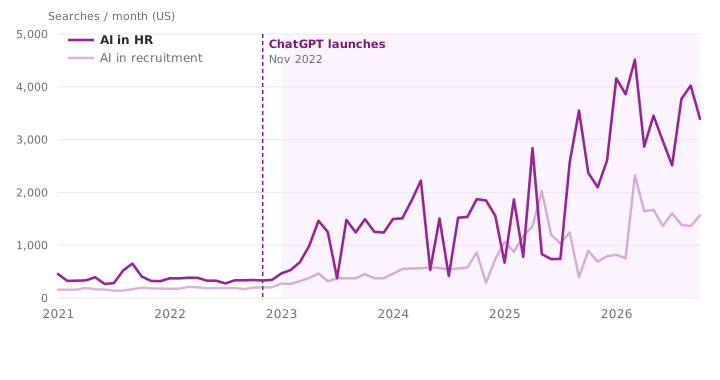
The inflection is impossible to miss. ChatGPT launched in November 2022; within six months, searches for “AI in HR” had tripled, and they have kept climbing since, peaking at 4,513 in a single month in early 2026. “AI in recruitment” traces the same curve. Averaged by year, the trajectory is stark:
| Year | Avg searches / month | vs 2021 |
|---|---|---|
| 2021 | 384 | baseline |
| 2022 | 341 | 0.9x |
| 2023 | 1,038 | 2.7x |
| 2024 | 1,488 | 3.9x |
| 2025 | 1,804 | 4.7x |
| 2026 (to Oct) | 3,552 | 9.3x |
This is not a slow-burn trend a planner could have smoothed out in advance. It is a step-change tied to one product moment, and HR sits squarely inside it: people-leaders went from barely searching the term to searching it nearly ten times as often in three years.
2. Is there real money in AI for HR?
Demand is one signal; willingness to pay is another. In paid search, advertisers bid against each other for clicks, and the price they are prepared to pay is a blunt but honest read on how commercially valuable a visitor is. On AI-in-HR terms, those prices are high, and in some cases extraordinary.
| Search term | Searches / mo (global) | Top cost per click | SEO difficulty /100 |
|---|---|---|---|
| ai employee engagement | 200 | $19.00 | 14 |
| ai agents for hr | 1,300 | $17.00 | 6 |
| ai talent acquisition | 1,200 | $11.00 | 54 |
| ai hr assistant | 800 | $10.00 | 0 |
| ai performance management | 300 | $10.00 | 31 |
| ai onboarding | 900 | $9.00 | 14 |
| ai in recruitment | 4,100 | $9.00 | 45 |
| generative ai in hr | 1,000 | $4.50 | 0 |
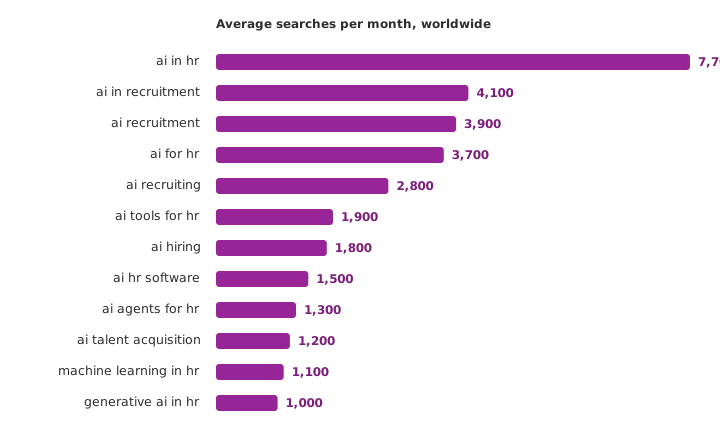
A $19 click is premium territory; many whole categories of B2B software sit well under $10. Vendors are treating AI-for-HR as a land-grab worth paying for. Yet the organic picture is the opposite: difficulty is near zero for several of these terms (“generative AI in HR” and “AI HR assistant” both score 0). The demand and the advertising money are here; authoritative, freely-ranking content mostly is not.
3. Do AI-in-HR searches return an AI Overview?
Here is the finding with the longest tail. Of the 18 core AI-in-HR terms we examined, 15 now return a Google AI Overview, the AI-generated summary that sits above the normal results. Every term with meaningful search volume triggers one; the only three that do not are the lowest-volume queries in the set.
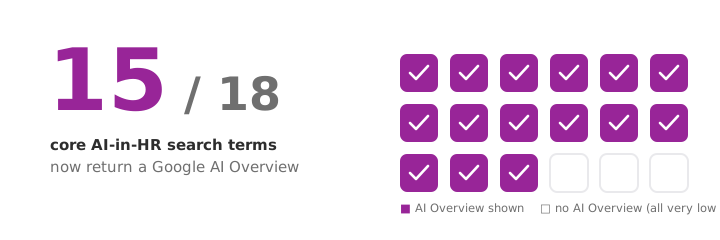
The irony is almost too neat: the people researching how to use AI in HR are themselves being handed an AI's answer first. For HR teams, the “research” phase increasingly happens inside a summary they never chose. For anyone publishing in this space, ranking #1 is no longer the finish line; being the source the AI Overview quotes is.
4. Where in the world is AI in HR searched?
Interest in AI for HR is worldwide, but not evenly distributed, and Europe looks different from the United States. The US dominates raw volume. Beyond it, demand splits across many national markets, each relatively small on its own.
| Country | Searches / month |
|---|---|
| United States | 3,300 |
| India | 1,100 |
| United Kingdom | 900 |
| France | 200 |
| Germany | 150 |
| Belgium | 150 |
| Netherlands | 150 |
| Italy | 150 |
| Sweden / Poland | 30 each |
This fragmentation is the European story in miniature. There is no single “European” search market; there are two dozen national ones, each in its own language and legal context. It is the same pattern we track on the regulatory side, where the EU Pay Transparency Directive is being written into law at 27 different speeds. A vendor that treats Europe as one market will misread both the demand and the rules.
Part two · The supply side
5. What does AI in HR actually do today?
So much for what people want. What do the tools actually do? We reviewed how ten leading HR-tech vendors use AI. Strip away the branding and their capabilities fall into six functional buckets, and the first thing you notice is where the weight sits. The centre of gravity of “AI in HR” today is hiring and operations, not performance or culture. Only three of the ten touch performance management at all, and thinly.
| Category | What the AI does | Who plays here | How mature |
|---|---|---|---|
| Admin automation | Runs payroll changes, scheduling, benefits, onboarding docs, ticket deflection | Rippling, Deel, BambooHR, Leena, Paradox | Working best of all: verifiable, reversible |
| Conversational Q&A | Answers employee and candidate questions, with cited sources | BambooHR (Ask BambooHR), Deel AI, Leena | Proven, in production |
| Screening & assessment | AI interviews, scores candidates to a rubric, runs skills/personality tests | HireVue, Paradox, Phenom, Skima, Eightfold | Maturing fast, pushed by litigation |
| Sourcing & skills matching | Infers skills, ranks candidates, maps internal mobility and succession | Eightfold, Phenom, Skima, Deel | Large data assets, contested accuracy |
| Writing & augmentation | Drafts job posts and performance feedback, flags biased language | Textio, Deel Engage, BambooHR | Mature idea, commercially fragile |
| Analytics & prediction | Predicts attrition, spots pay gaps, rates people from activity data | Rippling, Phenom, Eightfold, Deel | Reporting ships; people-rating unproven |
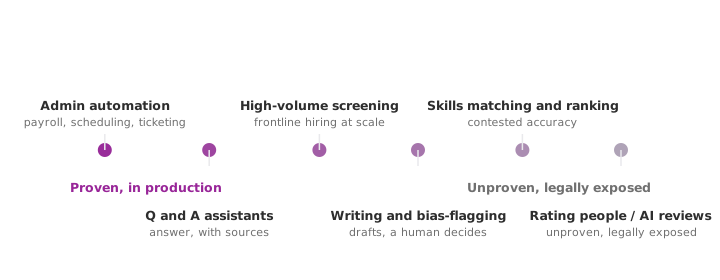
The pattern is consistent: AI works best where its output is verifiable and reversible (an admin task you can check, a question with a cited answer), and gets shakier the closer it comes to making a judgment about a person. BambooHR's CPO Brian Crofts put the governing philosophy bluntly: by his account, “most AI in HR delivers poor results without limits or controls,” which is why the serious players keep their AI on admin and keep a human on the decisions.
6. What are AI agents in HR, and are they real?
If 2023 was the chatbot year, 2026 is the year of the “agent.” Across the vendors we reviewed, the dominant positioning shifted from AI that answers to AI that acts: software that completes multi-step tasks inside real systems. The substance is real at the operational end and thinner elsewhere.
- Furthest along
- Rippling shipped seven AI launches between June and September 2026, with agents that build reports (returning auditable SQL, not free text) and run bulk payroll and access changes across 185+ countries, with every action requiring, by its own description, explicit human confirmation. Deel added named “AI Workforce” agents and a no-code agent builder. Leena's “AI colleagues” actually act inside Workday and SAP SuccessFactors; its investor Bessemer reports $20M+ ARR and roughly 60 to 70% ticket deflection.
- Agentic in hiring
- Paradox's assistant Olivia texts, screens and schedules high-volume frontline hiring at scale, and was acquired by Workday (reported ~$1bn) in late 2025. Eightfold and Phenom run fleets of recruiting agents, which is also exactly where the legal exposure is concentrated (see below).
- More positioning than product
- BambooHR's agent platform was announced in mid-2026 but remains in private beta with no public pricing; several vendors' “agent” launches are, as one analyst put it, incremental rather than a reinvention.
The honest read: the agent shift is real in administrative and operational HR (payroll, scheduling, access, ticketing, high-volume hiring), where the platform owns the data and actions are reversible or approval-gated. The serious players converge on one design principle: the agent proposes, a human disposes. The positioning gets ahead of reality in two places: performance and evaluation, where agents barely exist, and headcount-replacement claims, which are vendor marketing. There is also a consolidation wave: Workday bought Paradox, ServiceNow bought Moveworks (announced ~$2.85bn), and SAP bought SmartRecruiters, as suites absorb the agentic point tools.
7. Where does AI in HR work, and where is it hype?
Netting it out, honestly.
- Genuinely working
- Administrative automation and cited-source Q&A (verifiable, reversible, high-volume). High-volume frontline scheduling and screening (Paradox is the evidenced leader, but it breaks on senior, nuanced roles). Bias-aware writing assistance with a human in the loop (Textio's decade of language research is the strongest evidence base in the set). Rubric-based, transcript-only interview scoring with published audits (HireVue, after years of controversy, now scores the transcript of what a candidate says, not their face or tone, backed by its own count of 1,300+ validation studies).
- Overclaimed or risky
- AI that rates and ranks individual people from inferred signals; AI-written performance reviews (employees discount a review they believe “didn't come from my boss”); “agent replaces headcount” claims (one vendor's “reduced the need for ~600 employees” is unverified marketing); and voice or avatar interview agents, which candidates still describe as robotic and which drive drop-off.
8. What are the risks of AI in HR?
The most important supply-side finding is where the trouble clusters. It is not random. The legal, regulatory and reputational scars land almost entirely on tools that score, rank or decide about people with opaque AI: the evaluative end of the spectrum.
- The first FCRA suit against an AI hiring tool
- A proposed class action filed in January 2026 (Kistler v. Eightfold AI) alleges that Eightfold's 0-to-5 “Match Score” makes it an unregistered consumer reporting agency under the US Fair Credit Reporting Act. Legal commentators call it the first FCRA challenge aimed at AI hiring. The allegations are unproven and Eightfold calls them without merit, but the theory, if it lands, reaches any vendor scoring candidates.
- AI performance-rating is trust-blocked
- Rippling's Talent Signal rates new hires at 90 days from their actual work product (code, tickets, call transcripts) and has sat in early access since 2024 with no general release. Bloomberg reported in late 2025 that JPMorgan bars AI from assigning performance scores, and Wharton's Peter Cappelli warned employees discount a review they think an AI, not their manager, wrote.
- People data is a security target
- In mid-2025, researchers reportedly accessed McDonald's hiring admin tools (built on Paradox) through a test account with the password “123456,” exposing up to 64 million applicant records. It was fixed within a day, but it made “how does this vendor handle people data” a standing buying criterion.
- The EU AI Act raises the stakes
- Most AI used in hiring and in evaluating or monitoring workers is classified high-risk under the [EU AI Act](/guides/eu-ai-act), with real obligations attached. That is a live product-design constraint for screening agents, match scores, AI-written feedback and worker-monitoring features alike, not a hypothetical.
The data point every HR leader should know
Textio's own research found that 76% of high-performing women receive negative feedback in performance reviews, versus just 2% of high-performing men, and that women are 11 times more likely to be called “abrasive.” It is the sharpest evidence in the whole set that the problem with reviews is not a lack of AI drafting. It is a lack of fairness and structure. Pointing an AI at a broken review process scales the bias faster.
9. What can AI in HR not do yet?
Put the two sides together and a white space appears. The market has built strong AI for getting people hired and running HR admin, and is racing into agents that act. What it has largely left alone is everything that happens after someone is hired and that depends on a company's own standards.
- Performance management is a near-vacuum. Only three of the ten vendors have a performance module at all, and the AI in each is thin or unreleased: one only summarises feedback, another's performance module lists no AI features, a third's is generic with no proof base.
- Competency frameworks tied to a company's own values are absent. The sophisticated tools infer skills from other people's careers or map generic skill libraries. None builds a framework from a specific company's values and level expectations. Skills tell you who can do the job; values tell you who will do it your way.
- Culture is reduced to recognition, not measurement. Recognition tools reinforce values, but no tool in the set measures behaviour against articulated cultural values.
- Calibration is rare and un-AI'd. Few tools even list calibration; none offers AI-supported calibration to reduce rating inflation and bias across managers.
- The mid-market is unserved. The impressive AI is enterprise-only: six-figure, four-to-seven-month implementations. The SMB suites have reach but thin performance depth. A company of 10 to 1,000 that wants values-based, AI-assisted, human-reviewed performance management is not well served by anyone in this set.
This is the space Sageo is built for, and we are deliberate about which side of the line we sit on. Sageo is not a hiring engine, an ATS or a payroll system, the places where today's AI is strongest. It is the performance and culture layer: AI drafts a competency framework from your company's values, then your managers run 360 reviews, development plans, goals and monthly 1:1s on top of it, with calibration and an audit trail. The AI does the drafting and the structuring; people make the calls about other people. Given where the risk ledger lands, that is not a limitation. It is the point.
10. What does AI in HR mean for HR teams and vendors?
For HR and people teams: the pressure to “do something with AI” is real and rising, but the category is young and lopsided. Start where AI reduces grunt work and keeps a human in the decision: drafting, structuring, summarising, answering. Treat any tool that scores, ranks, screens or rates people as high-risk until proven otherwise, and ask every vendor for its fairness audit, its human-review step, and its audit trail before it touches an evaluation.
For HR-tech vendors: the demand curve and the ad prices confirm the opportunity, and the content terms are cheap to compete on precisely because few have published anything an answer engine wants to quote. But the durable wins will come from the under-served, lower-risk end of the map (performance, competency, culture, done with a human in the loop), not from racing competitors into the scoring-people arena where the lawsuits already are.
Related guideBest AI Tools and Software for HR in 2026A practical, vendor-by-vendor look at where AI actually helps across the HR stack, and where it does not.Where does this data come from?
Part one (demand) is from Ahrefs Keywords Explorer, pulled on 24 October 2026. “Searches per month” is Ahrefs' estimate of average monthly search volume over the trailing 12 months; the growth series uses monthly US volume from January 2021 to October 2026; “global” volume sums all countries in Ahrefs' database; cost per click is the average top-of-page Google Ads bid in USD; SEO difficulty is Ahrefs' 0 to 100 estimate; AI Overview presence is read from Ahrefs' SERP-feature data.
Part two (supply) is Sageo's own review of how ten vendors (BambooHR, Deel, Eightfold, HireVue, Leena AI, Paradox, Phenom, Rippling, Skima and Textio) use AI, based on their product documentation, release notes and public claims as of late 2026.
- On vendor claims
- Adoption, revenue and ROI figures are the vendors' own unless stated otherwise, and single-customer “savings” anecdotes are flagged as marketing. Lawsuit allegations (Eightfold) and prior enforcement history are unproven claims, not findings. Pre-release products are described as such.
- What this is
- A market analysis of demand and supply. It is not a survey, and it does not rank or endorse vendors. It maps what the category is doing and where the gaps are.
- Who made it
- Compiled by the team at Sageo, culture-first performance management software built in the EU. We publish research like this because the HR-tech category is being reshaped by AI, and clear, sourced analysis beats hype.
Free to cite with a link to this page. For the regulatory companion, see our live EU Pay Transparency transposition tracker and our guide to the EU AI Act for workplaces.
Frequently asked questions
How fast is AI in HR growing?
Search demand for “AI in HR” has grown roughly 9x since 2021. It was flat at around 380 US searches a month through 2021 and 2022, then climbed steeply after ChatGPT launched in late 2022, averaging about 3,550 a month in 2026 and peaking at 4,513 in a single month in early 2026.
Do AI-in-HR searches trigger Google AI Overviews?
Yes, overwhelmingly. Of the 18 core AI-in-HR terms examined in October 2026, 15 return a Google AI Overview, and every term with meaningful search volume does. The research phase for AI in HR increasingly happens inside an AI-generated summary before the searcher reaches any vendor.
How much do AI HR keywords cost in advertising?
A lot. Top-of-page Google Ads bids reach $19 per click for “AI employee engagement,” $17 for “AI agents for HR,” and $11 for “AI talent acquisition,” premium prices that signal a vendor land-grab, even though organic SEO difficulty for many of these terms is near zero.
What does AI in HR actually do today?
In practice it clusters into six buckets: administrative automation (payroll, scheduling, benefits, ticketing), conversational Q&A, candidate screening and assessment, sourcing and skills matching, writing and bias-flagging, and analytics and prediction. The value is concentrated in hiring and HR operations, where outputs are verifiable and reversible. It is far thinner in performance management, competency frameworks and culture.
Where is AI in HR genuinely working, and where is it hype?
Working: admin automation, cited-source Q&A, high-volume frontline screening and scheduling, bias-aware writing with a human in the loop, and rubric-based interview scoring with published audits. Overclaimed or risky: AI that rates and ranks people from inferred signals, AI-written performance reviews, and 'agent replaces headcount' claims. The legal and trust problems cluster almost entirely on tools that score or decide about people with opaque AI.
Is this report based on a survey?
No. The demand side is an analysis of public search-demand data from Ahrefs Keywords Explorer (24 October 2026); the supply side is a review of how ten leading vendors use AI, based on their product documentation and public claims. Vendor adoption and ROI figures are the vendors' own and flagged as such; lawsuit allegations are unproven.

Written by
Deepti GuptaCo-founder, Sageo
18+ years building people functions from the ground up at Myntra, Freshworks and Dream11, scaling teams from 100 to 2,500 people and designing company-wide performance and compensation systems. Sageo automates the frameworks she has built by hand throughout her career.

Reviewed by
Vinayak RaviCo-founder, Sageo
19+ years of B2B SaaS go-to-market leadership. He built the organic growth engine at Freshworks through its rise to a public company and has led demand generation at some of the sector's fastest-scaling software startups.
Product names and logos are trademarks of their respective owners, shown here for identification only and not as endorsements.
All research