Sageo Research
Gender Pay Gap Reporting by Country: Obligations Tracker
Which countries make employers report or publish their gender pay gap, who is covered, and how often. Most of the developed world now requires it, with the EU moving to a single standard in 2027. Updated and sourced, country by country.


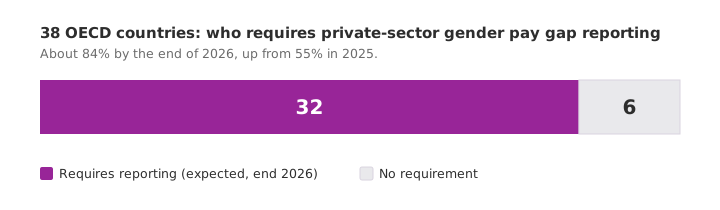
The state of play. Gender pay gap reporting has gone from a handful of countries to most of the developed world in under a decade. The OECD expects about 32 of its 38 member countries to require private-sector gender pay gap reporting by the end of 2026, up from 55 percent a year earlier. But there is no single global standard. Thresholds run from ten employees to several hundred, frequency from annual to once every four years, and some countries publish each employer's gap while others only collect it. This tracker records where the major economies stand, with the threshold and frequency named and sources dated, so a multinational can see the real set of obligations rather than the trend line.
A multinational tracks a dozen regimes at once
There is no world standard to comply with once. A company operating in the UK, France, Australia, Japan and the EU faces a different threshold, a different metric, a different deadline and a different public-versus-private rule in each. The UK publishes your gap on a government site at 250 employees; France scores you out of 100 at 50; Japan discloses at 301; the EU harmonises its own members from 2027. Reporting is one obligation in name and many in practice.
Cite this tracker
- About 32 of 38 OECD countries require private-sector gender pay gap reporting by the end of 2026, up from 55% in 2025.
- Thresholds range from 10 to 500+ employees, and reporting frequency from annual to once every four years.
Sageo, "Gender Pay Gap Reporting by Country: Obligations Tracker," November 2026. https://sageo.ai/research/gender-pay-gap-reporting-by-countryWhere does gender pay gap reporting stand globally?
The UK's 2017 rules were the template many copied: a fixed headcount threshold, a set of standard metrics, and public disclosure. Since then Ireland, Australia, Japan, and most of the EU have built their own versions, and the EU is now moving its 27 members onto a single harmonised standard from 2027. The direction is one-way; no country that adopted reporting has repealed it, and several are lowering their thresholds to pull in smaller employers.
How many countries require gender pay gap reporting?
- About 32 of 38 OECD countries
- Expected to require private-sector gender pay gap reporting by the end of 2026, up from 55 percent of members in 2025. Reporting has become the norm across the developed world, not the exception.
- Thresholds from 10 to 500+
- The employee count that triggers reporting varies enormously: as low as ten (Canada, Sweden) and as high as several hundred, with the EU directive setting a baseline of 100 and many states going lower.
- Frequency from annual to four-yearly
- The UK, France, Ireland, Australia and Sweden report annually; Austria, Belgium, Italy and Norway every two years; Switzerland every four. The reporting burden is not comparable across borders.
- Public gap vs filed report
- Some countries publish each employer's gap on a public register (UK, Ireland, France, Australia, Japan); others collect a report or require a pay audit without publishing a headline number (Germany, Belgium, Switzerland).
Where does each country stand?
The major economies with a gender pay gap reporting or pay-audit obligation, alphabetically. “Threshold” is the employee count that brings an employer into scope; frequency and the year the duty began follow. Statuses are cross-checked against the trackers listed under sources.
| Country | Required? | Threshold | Frequency / detail |
|---|---|---|---|
| Australia | Yes, public | 100 or more employees | Annual report to WGEA; employer-level gaps published since 2024 |
| Austria | Yes | 150 or more employees | Biennial income reports under the Equal Treatment Act |
| Belgium | Yes | 50 or more employees | Biennial analysis of the pay structure by gender |
| Canada (federal) | Yes | Federally regulated employers | Pay Equity Act plus employment-equity reporting; some provinces add pay transparency |
| Finland | Yes | 30 or more employees | Pay survey within the mandatory equality plan |
| France | Yes, public | 50 or more employees | Annual Index Egapro, a public score out of 100; penalty up to 1% of payroll |
| Germany | Partial | 200+ (info right); 500+ (report) | Report on equal-pay measures, not a gap figure; EU directive not yet transposed |
| Iceland | Yes, certified | 25 or more employees | Equal Pay Certification to the ÍST 85 standard, renewed every three years |
| Ireland | Yes, public | 50 or more employees | Annual; lowered from 150+ in 2024 to 50+ from June 2025 |
| Italy | Yes | 50 or more employees | Biennial gender equality report (Legislative Decree 198/2006) |
| Japan | Yes, public | 301 or more employees | Disclose the wage gap since 2022; being extended to smaller employers from 2026 |
| Norway | Yes | 50+ (20+ on request) | Biennial gender pay mapping under the activity-and-reporting duty |
| Spain | Yes | All (register); 50+ (audit) | Salary register for all employers; equality plan and pay audit at 50 or more |
| Sweden | Yes | All (documented at 10+) | Annual pay survey across the workforce |
| Switzerland | Yes | 100 or more employees | Equal-pay analysis every four years, reviewed by an independent body |
| United Kingdom | Yes, public | 250 or more employees | Annual mean and median hourly and bonus gap; action plans from April 2027 |
| United States | No federal rule | n/a | No national report; California requires a pay-data report at 100+ employees |
| European Union (27) | Harmonising | 100 to 250+ (directive) | Single EU standard from June 2027 (see our transposition tracker) |
What changes in the EU in 2027?
Until now, EU countries have reported, or not, under their own national rules, which is why France, Spain, Italy and Austria all look different above. The EU Pay Transparency Directive (2023/970) replaces that patchwork with one standard: employers with 250 or more workers report annually and those with 150 to 249 every three years, with the first reports due in June 2027, extending to employers with 100 to 149 workers from 2031. National transposition is running late almost everywhere, but the reporting clock is fixed to the directive, not to each parliament.
Companion trackerEU Pay Transparency Directive: Transposition TrackerWhere all 27 EU member states stand on writing the directive into national law, country by country, and what the June 2027 reporting deadline means.What counts as gender pay gap reporting?
Not every obligation is the same thing. Three forms sit under the same name.
- Public gap reporting
- The employer calculates standard metrics (usually a mean and median gap) and they are published, often on a government register anyone can search. The UK, Ireland, France, Australia and Japan work this way. It is the most visible and the most reputationally exposed.
- Filed reporting or pay audit
- The employer produces a report or runs a pay-structure analysis for the authority or worker representatives, without a public headline number. Germany, Belgium, Switzerland and several others sit here. Lower profile, but the analysis work is often heavier.
- Certification
- The employer must be certified as meeting an equal-pay standard, not just report a number. Iceland's ÍST 85 Equal Pay Certification is the clearest example, renewed on a cycle.
Who is covered, and does my company's base matter?
Scope follows where you employ people, not where you are headquartered. Three things decide your obligations:
- Headcount in each country, measured against that country's threshold. The same global employer can be in scope in France (50) and Australia (100) but out of scope in Japan (301), depending on local headcount.
- Local entity and workforce, not the group total in most regimes, so a small subsidiary can still trigger a local duty.
- The metric and format, which differ by country, so one global pay-equity analysis rarely satisfies every national filing without local adjustment.
The underlying readiness work is the same everywhere: a defensible job architecture and pay structure, and a clean gender-coded pay dataset you can analyse on demand. The reporting format changes; the data foundation does not.
What should employers do now?
For any multinational, the efficient move is to build once and report many times.
- Map your headcount against each country's threshold, and note the metric, frequency and deadline for every country you are in scope in.
- Build one defensible pay structure and job architecture, so the gaps you report are consistent and explainable rather than surprising.
- Run a gender pay gap analysis on current data now, before a deadline forces it, so there are no surprises in a public number.
- Prepare to explain, not just publish. Several regimes (France, the EU from 2027) require action or justification once a gap crosses a trigger.
- Watch the EU shift. If you employ in the EU, the 2027 standard will change or add to whatever national rule you report under today.
How is this tracker sourced and maintained?
There is no single global registry of gender pay gap reporting laws, so status is tracked through the OECD's pay-transparency review and the main law-firm and advisory monitors, and cross-checked against national regimes. We led with the most recent sources and flagged the countries whose thresholds or dates are still moving. Last full review: November 2026.
- Primary sources
- OECD, Pay Transparency in Progress (2026); DLA Piper gender-pay global guide; Brightmine global gender pay gap reporting comparative table; Seyfarth Global Equal Pay Desktop Reference; Australia's WGEA; and national labour-ministry guidance.
- Contested or moving points
- Japan's extension of reporting to employers below 301; Austria's threshold (reported at 150, with a 100/50 short-and-full-form split elsewhere); Germany's 200 and 500 thresholds and its pending directive transposition; and the EU's staggered 2027 to 2031 dates.
- National vs EU standard
- For EU states, the national regime shown here will be overlaid by the EU Pay Transparency Directive from 2027. Where both apply, confirm which governs a given report.
- What this is
- A maintained reference, not legal advice. These regimes change almost every year; always confirm the current national position before relying on the detail.
Free to cite with a link to this page. For the regional companions, see our EU Pay Transparency Directive transposition tracker and our US pay transparency laws by state tracker.
Frequently asked questions
Which countries require gender pay gap reporting?
Most of the developed world now does. As of November 2026, the OECD expects about 32 of its 38 member countries to require private-sector gender pay gap reporting, up from 55 percent a year earlier. Among the major economies: the UK (250+ employees), Ireland (50+), France (50+), Australia (100+), Japan (301+), Spain, Italy, Austria, Belgium, Switzerland, Sweden, Finland, Norway, Iceland and Canada all have a reporting or pay-audit duty, and the EU is moving its 27 members onto a single standard from 2027.
What is the employee threshold for gender pay gap reporting?
It varies enormously by country, from as few as ten employees (Canada, Sweden) to several hundred. The UK requires it at 250 employees, Australia at 100, Japan at 301, Switzerland at 100, Austria at 150, and France, Ireland, Belgium, Italy and Spain's audit duty at 50. Iceland's equal-pay certification starts at 25. The EU Pay Transparency Directive sets a baseline of 100 from 2027, and several countries go lower.
How often do companies have to report their gender pay gap?
Frequency differs by country. The UK, Ireland, France, Australia and Sweden report annually; Austria, Belgium, Italy and Norway every two years; and Switzerland every four. Some countries publish each employer's gap on a public register (UK, Ireland, France, Australia, Japan), while others collect a report or require a pay audit without a public headline number (Germany, Belgium, Switzerland).
Does the EU require gender pay gap reporting?
It will, on a single standard, from 2027. The EU Pay Transparency Directive (2023/970) requires employers with 250 or more workers to report annually and those with 150 to 249 every three years, with the first reports due June 2027 and the duty reaching employers with 100 to 149 workers from 2031. Until then, EU countries report under their own national rules, which is why France, Spain, Italy and Austria currently look different from one another.
Does gender pay gap reporting apply to multinational companies?
Yes, country by country. The obligation follows where you employ people, not where you are headquartered, and is usually measured on the local entity's headcount against that country's threshold. The same global employer can be in scope in France (50 employees) and Australia (100) but out of scope in Japan (301). One global pay-equity analysis rarely satisfies every national filing, because the metric and format differ by country.

Written by
Deepti GuptaCo-founder, Sageo
18+ years building people functions from the ground up at Myntra, Freshworks and Dream11, scaling teams from 100 to 2,500 people and designing company-wide performance and compensation systems. Sageo automates the frameworks she has built by hand throughout her career.

Reviewed by
Vinayak RaviCo-founder, Sageo
19+ years of B2B SaaS go-to-market leadership. He built the organic growth engine at Freshworks through its rise to a public company and has led demand generation at some of the sector's fastest-scaling software startups.
Product names and logos are trademarks of their respective owners, shown here for identification only and not as endorsements.
All research