Mid-Year Review
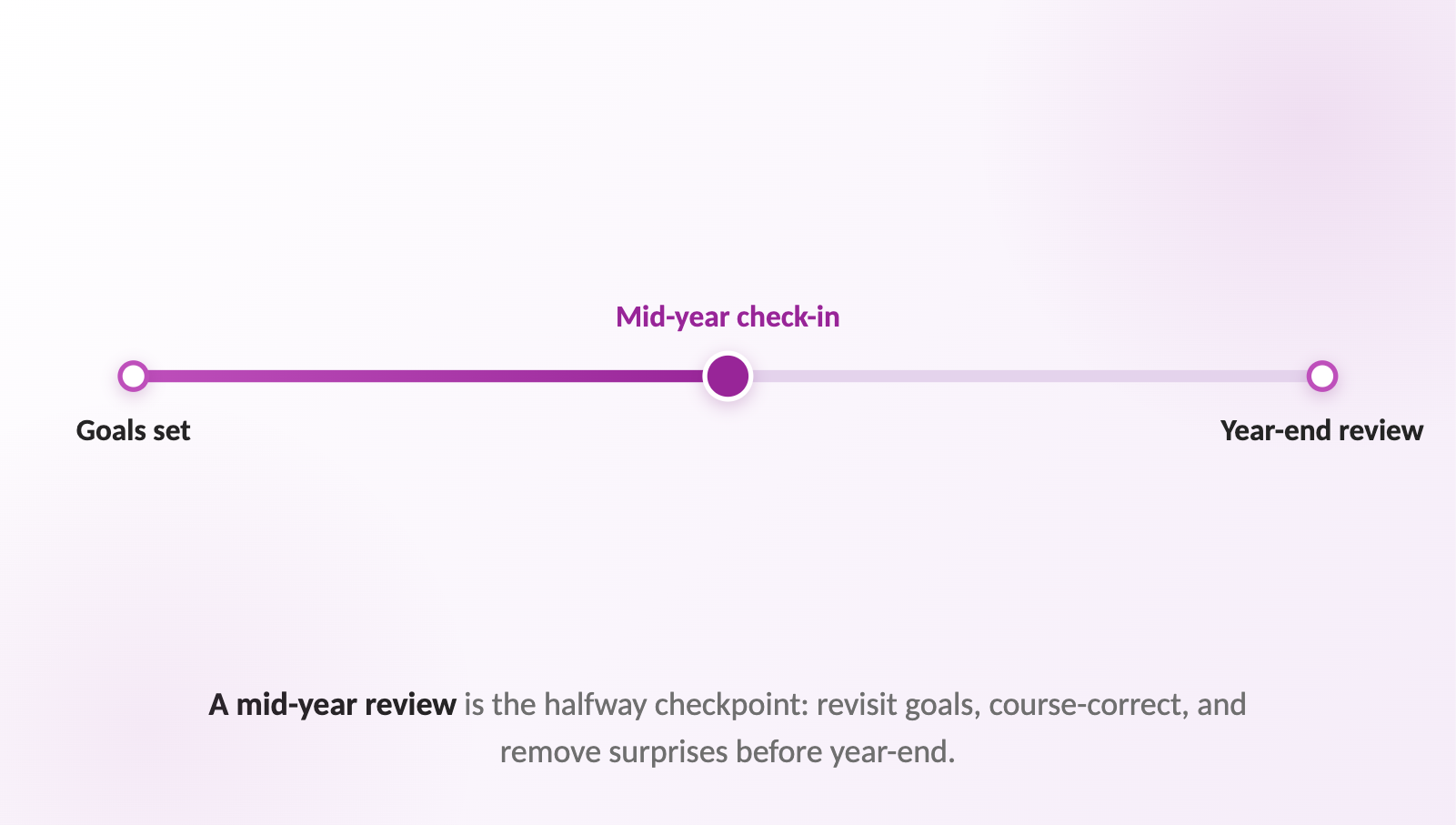
A mid-year review is a structured check-in halfway through the performance year, where a manager and employee look at progress on goals, share feedback and adjust priorities for the rest of the year. It is usually lighter than the annual review and often has no rating. Its purpose is course correction: making sure nothing in the year-end review comes as a surprise and that goals still reflect what the business needs.
Also known as: mid-year performance review, mid-year check-in, mid-year appraisal, half-year review, interim review
Reviewed
Key takeaways
- A mid-year review is a halfway check on goals, feedback and priorities.
- It is usually lighter than the year-end review, often without a rating.
- Its main job is to adjust goals and remove surprises before year-end.
- Prepare with a short self-assessment and evidence from 1:1s.
At a glance
- When
- Around months 6 to 7 of the performance year
- Length
- 30 to 60 minutes
- Covers
- Goal progress, feedback both ways, development, next 6 months
- Related
- Performance review, self-assessment, one-on-one meeting
Why do mid-year reviews matter?
Six months is long enough for priorities to change and for small problems to grow. A mid-year review gives both sides a planned moment to reset: retire goals that no longer matter, flag concerns while there is still time to act, and recognise progress. Teams that hold regular 1:1s will find the mid-year review quick, because most of the content is already known.
Mid-year review template
| Section | Questions |
|---|---|
| Goals | Which goals are on track, at risk or no longer relevant? |
| Wins | What are you proudest of from the first half? |
| Challenges | What got in the way, and what would help? |
| Feedback | One thing to keep doing, one thing to change, both directions |
| Development | Progress on the development plan; what to focus on next |
| Next 6 months | Updated goals and priorities |
Mid-year review questions
- Which of your goals are on track, and which need to change?
- What has gone better than expected this year?
- What is getting in the way of your best work?
- What feedback do you have for me as your manager?
- Which skill do you most want to build in the second half?
- If the year ended today, how would you rate it, and why?
How do you run a mid-year review?
- Send the template a week ahead and ask for a short self-assessment.
- Review evidence from goals, 1:1 notes and feedback received.
- Open with their view, then share yours.
- Be clear about concerns now; year-end is too late to raise them for the first time.
- Update goals in writing for the second half.
- Agree next steps on development and when you will check in again.
Worked example
At her mid-year review, a marketing manager is on track for two of three goals. The third, launching in Germany, has been paused by leadership. Her manager replaces it with a goal to grow the partner channel by 20%. He also flags that two campaign launches slipped and agrees a weekly check-in until the next launch. At year-end, she is rated against the updated goals, and no point in the review is new to her.
Frequently asked questions
- What is a mid-year review?
- A halfway check-in on the performance year to review progress, give feedback and update goals for the remaining months.
- Do mid-year reviews include a rating?
- Often not. Many companies keep ratings for year-end and use the mid-year review purely for feedback and goal adjustment.
- How long should a mid-year review take?
- 30 to 60 minutes is typical. With regular 1:1s, 30 minutes is often enough.
- What should I write in my mid-year self-assessment?
- Progress on each goal with evidence, your main wins and challenges, what you need from your manager, and what you want to focus on next.
- What is the difference between a mid-year review and an annual review?
- A mid-year review is lighter and forward-looking, focused on adjusting the year. An annual review is a formal assessment of the whole year, often tied to pay.
- When should mid-year reviews happen?
- Around months 6 to 7 of your performance year; for calendar-year companies, that is usually June or July.
Sources
- Marcus Buckingham and Ashley Goodall, "Reinventing Performance Management", *Harvard Business Review* (April 2015)
See it in practice
Compare performance review software
Related reading
Related terms