Continuous Performance Management
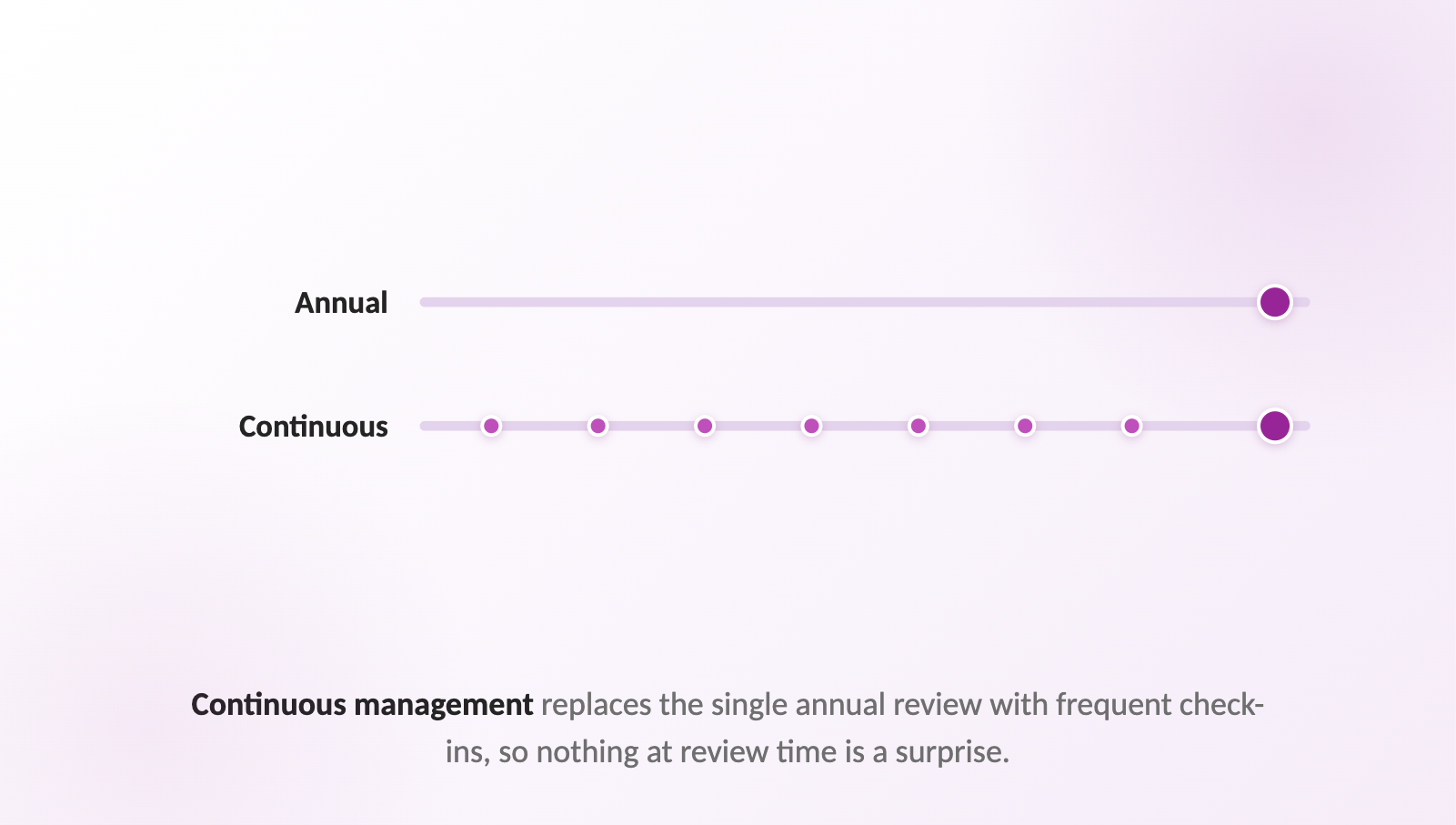
Continuous performance management is an approach where goals, feedback and coaching happen throughout the year instead of being saved for a single annual review. Managers and employees hold regular check-ins, update goals as priorities change, and exchange feedback close to the work. Formal reviews still happen, but they summarise conversations that have already taken place, so nothing in them is a surprise.
Also known as: continuous performance management (CPM), continuous feedback, ongoing performance management, check-in model
Reviewed
Key takeaways
- Continuous performance management swaps one big annual event for frequent, lighter conversations.
- Its building blocks are regular 1:1s, living goals, timely feedback and periodic reviews.
- It does not remove reviews or ratings; it makes them a summary, not a surprise.
- It only works if managers have the time, skills and simple tools to keep it going.
At a glance
- Rhythm
- Weekly to monthly check-ins; quarterly goal resets
- Building blocks
- 1:1s, goals or OKRs, feedback, recognition, reviews
- Replaces
- Feedback saved for one annual appraisal
- Related
- One-on-one meeting, performance review, OKR, employee feedback
Why does continuous performance management matter?
Annual reviews look back over twelve months, and memory is unreliable over that span: recent events crowd out earlier ones. They also cost a lot of time for little change in behaviour. When Deloitte reviewed its own process in 2015, it estimated the firm spent close to 2 million hours a year on it. Adobe dropped annual reviews in 2012 in favour of regular "check-ins". Feedback given close to the moment is easier to act on, and goals that change with the business stay relevant.
Continuous vs annual performance management
| Annual review model | Continuous model | |
|---|---|---|
| Feedback | Once or twice a year | Weekly to monthly |
| Goals | Set in January, reviewed in December | Reviewed and reset quarterly |
| Manager's role | Judge | Coach |
| Data for reviews | Manager's memory | Notes from check-ins, feedback and goals |
| Surprises at review time | Common | Rare |
How do you move to continuous performance management?
- Start with 1:1s. Get every manager holding regular, documented check-ins.
- Make goals live. Move to quarterly goals or OKRs that can be updated.
- Make feedback easy through short, regular prompts rather than long forms.
- Keep a lighter formal review once or twice a year, built from the year's notes.
- Calibrate so ratings stay fair across teams.
- Train managers in coaching and feedback, the skills this model depends on.
Worked example
A 300-person company replaces its annual appraisal with monthly 1:1s, quarterly goals and a twice-yearly review. Before each review, managers pull from their 1:1 notes and feedback received, so writing a review takes about 30 minutes instead of half a day. In the first cycle, the share of employees who say their review "held no surprises" rises noticeably, and managers report spending less total time on reviews.
Frequently asked questions
- What is continuous performance management?
- A way of managing performance through regular check-ins, ongoing feedback and flexible goals throughout the year, rather than only through an annual review.
- Does continuous performance management get rid of ratings?
- Not necessarily. Many companies keep ratings for pay and promotion decisions, but base them on a year of documented conversations.
- How often should check-ins happen?
- Weekly or fortnightly for most teams, with a deeper monthly conversation about growth.
- What are the benefits of continuous performance management?
- Faster course correction, fewer review-time surprises, fairer ratings based on evidence rather than memory, and stronger manager-employee relationships.
- What are the challenges?
- It asks more of managers week to week. Without simple tools and training, check-ins get cancelled and the model falls back to a once-a-year review.
- Is continuous performance management the same as continuous feedback?
- Continuous feedback is one part of it. Continuous performance management also covers goals, development and periodic reviews.
Sources
- Marcus Buckingham and Ashley Goodall, "Reinventing Performance Management", *Harvard Business Review* (April 2015)
See it in practice
Compare performance management software
Related reading
Related terms