Individual Development Plan (IDP)
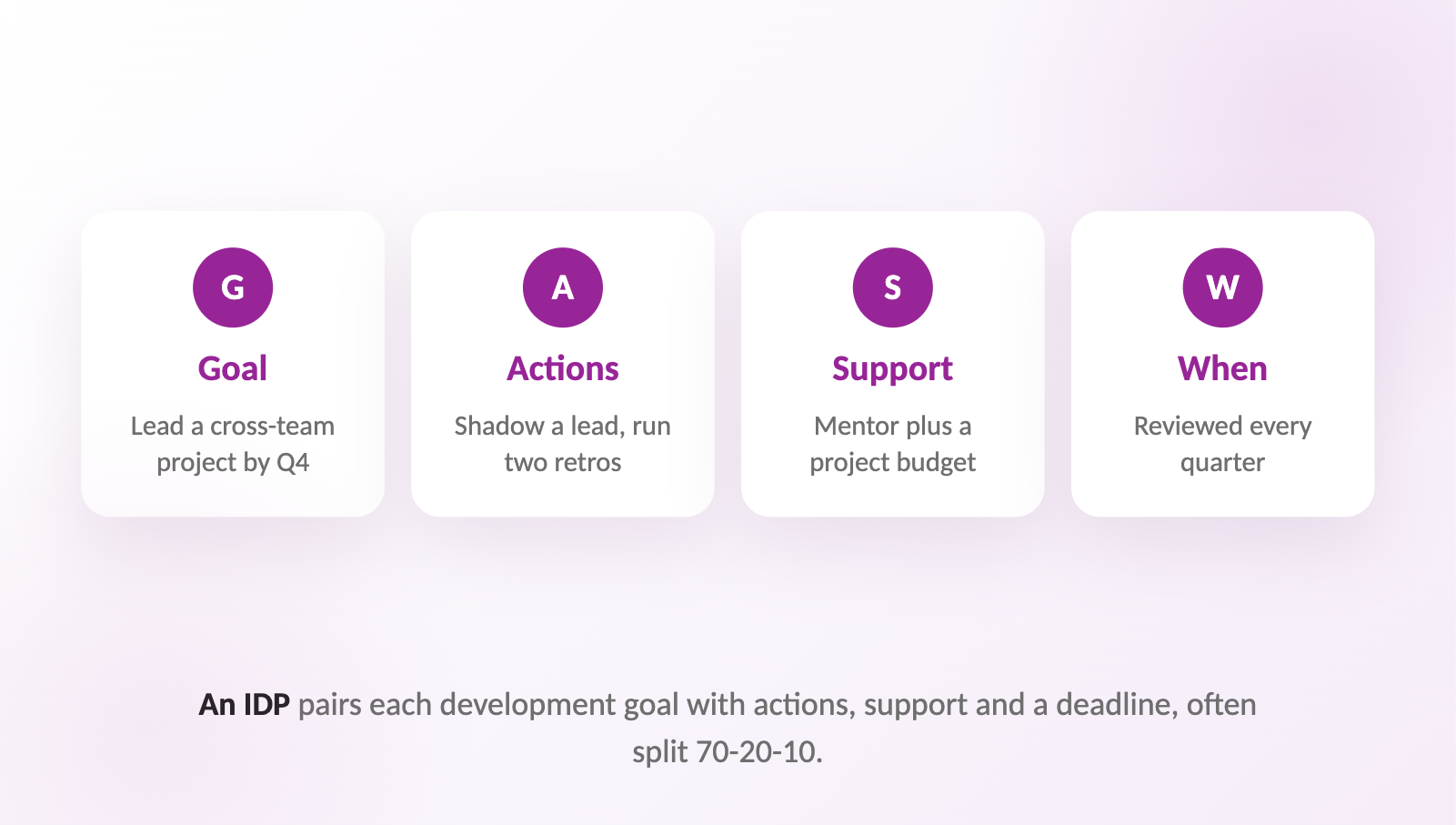
An individual development plan (IDP) is a written plan, agreed between an employee and their manager, that sets out how the employee will build skills and progress in their career. It names a small number of development goals, the actions to reach them (projects, coaching, courses), the support needed and target dates. A good IDP is reviewed regularly in 1:1s rather than filed away after the annual review.
Also known as: IDP, employee development plan, personal development plan (PDP), career development plan, growth plan
Reviewed
Key takeaways
- An IDP is a shared, written plan for an employee's growth, owned by the employee.
- Limit it to 2 or 3 development goals, each tied to a competency or career step.
- Most learning should come from real work: stretch projects, feedback and coaching.
- Review progress in 1:1s every month or so, not just once a year.
At a glance
- Owner
- The employee, supported by their manager
- Contains
- 2 to 3 goals, actions, support, dates, measures
- Review
- Monthly in 1:1s; refreshed every 6 to 12 months
- Related
- Competency framework, professional goals, one-on-one meeting
Why does an individual development plan matter?
People stay where they can see themselves growing. An IDP turns vague career conversations into specific steps with dates, so both sides can tell whether progress is happening. It also helps managers spend training budget on the skills that matter most, and builds the pipeline of people ready for bigger roles.
What should an IDP include?
- Career aspiration. Where the employee wants to be in 1 to 3 years.
- Strengths to build on and gaps to close, linked to the competency framework.
- 2 or 3 development goals, written as SMART goals.
- Actions for each goal. A common guide is the 70-20-10 model: about 70% from on-the-job experience, 20% from other people (feedback, mentoring) and 10% from formal training.
- Support needed from the manager or company, such as budget, time or a mentor.
- Target dates and how progress will be measured.
Individual development plan template
| Goal | Linked competency | Actions | Support | Target date | Evidence of progress |
|---|---|---|---|---|---|
| Present confidently to senior leaders | Communication | Present the quarterly update twice; get feedback after each | Manager reviews slides beforehand | End of Q2 | Leadership feedback; second presentation runs to time |
| Lead a small project end to end | Ownership | Lead the onboarding revamp with two colleagues | Weekly 15-minute check-in | End of Q3 | Project shipped on time; team retro |
Worked example
Aisha is a mid-level product designer who wants to become a design lead within two years. Her IDP has two goals: lead a feature from discovery to launch, and mentor a junior designer. Actions include owning the next checkout redesign, pairing weekly with a new hire, and a short facilitation course. Her manager agrees to bring her into roadmap meetings. They review the plan in every monthly 1:1 and rewrite it after six months.
Frequently asked questions
- What is the purpose of an individual development plan?
- To give an employee a clear, agreed path to build the skills they need for their current role and the next one, with support from their manager.
- Who writes the IDP, the employee or the manager?
- The employee should draft it, because they own their career. The manager adds input, checks it fits the business and commits to support.
- How is an IDP different from a performance improvement plan?
- An IDP is about growth and is for everyone. A performance improvement plan (PIP) is a formal process to fix a specific performance gap within a deadline.
- How often should an IDP be updated?
- Check progress monthly in 1:1s and rewrite it every 6 to 12 months, or when someone changes role.
- What are good development goals?
- Goals tied to a real competency gap or career step, with a clear action and outcome. For example, "Run three client workshops by June and get feedback from each" rather than "get better at facilitation".
- What is the 70-20-10 model?
- A rule of thumb from the Center for Creative Leadership that most development comes from experience (70%), then relationships (20%), then formal learning (10%).
Sources
- Michael Lombardo and Robert Eichinger, *The Career Architect Development Planner* (Lominger, 1996), origin of the 70-20-10 model
See it in practice
Compare talent management software
Related reading
Related terms