Competency Framework
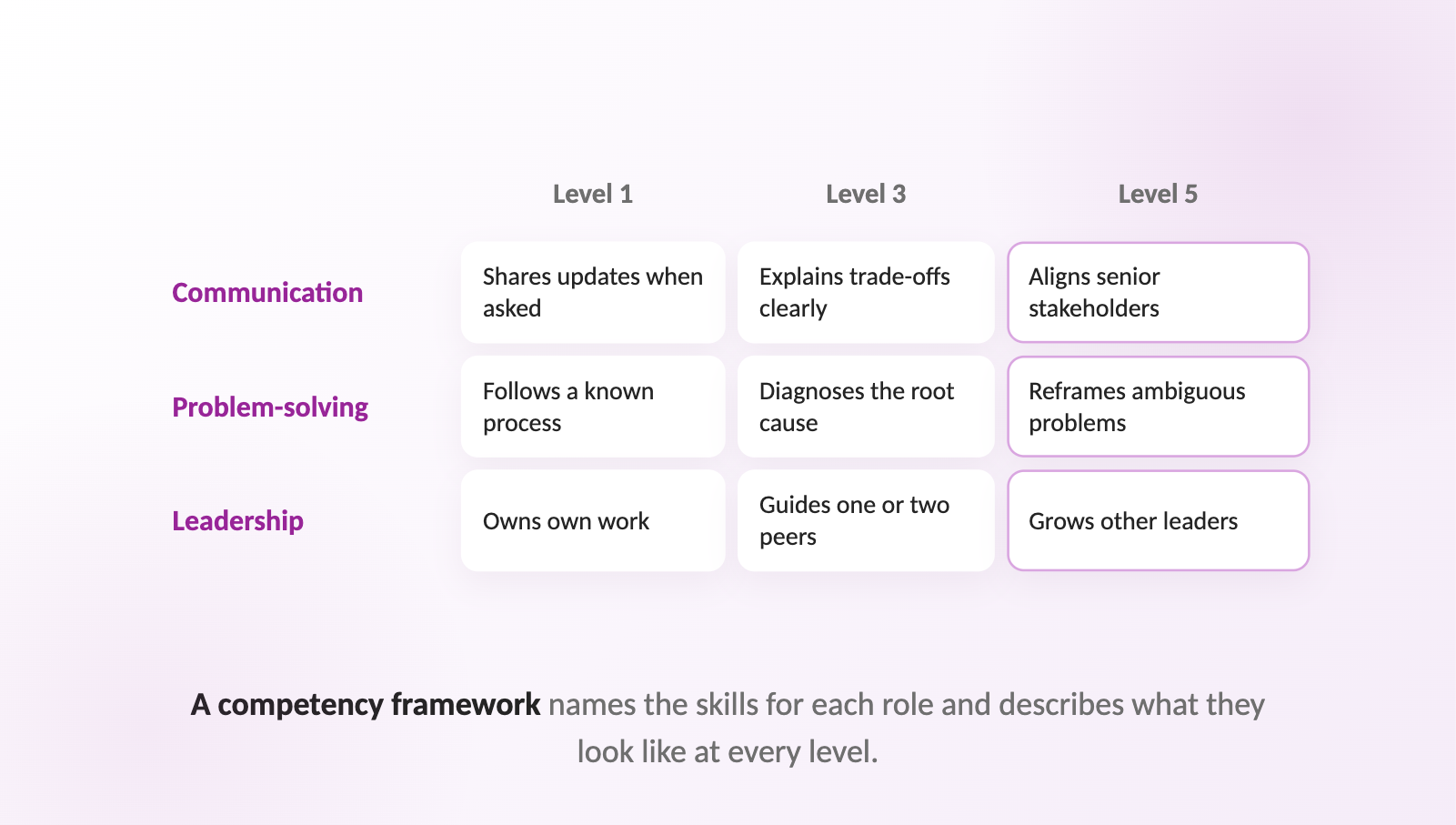
A competency framework is a structured set of the skills, knowledge and behaviours an organisation expects from its people, usually described at each level of seniority. It gives managers and employees a shared language for what "good" looks like. Companies use it to hire, review performance, plan development and decide promotions consistently. Most frameworks mix core competencies for everyone (often tied to company values) with role-specific ones.
Also known as: competency model, competencies framework, competency matrix, behavioural framework
Reviewed
Key takeaways
- A competency framework turns "what good looks like" into clear, observable behaviours.
- Most combine core (company-wide) competencies with role or function-specific ones.
- Each competency should have level descriptions, so growth is visible.
- Keep it short: fewer than 10 competencies per role is easier to use and review against.
At a glance
- Contains
- Competencies, definitions, behaviours per level
- Types
- Core, functional (role-specific), leadership
- Used for
- Hiring, reviews, development plans, promotion
- Related
- Individual development plan, performance review, company culture
Why does a competency framework matter?
Without a framework, every manager judges against their own idea of good performance. That makes reviews inconsistent and promotions feel political. A framework sets one standard, so ratings can be calibrated, development plans can target specific gaps, and employees can see exactly what the next level requires. It is also how values move off the wall and into everyday decisions.
Competency framework examples
| Competency | Type | Level 1 (developing) | Level 3 (senior) |
|---|---|---|---|
| Ownership | Core | Delivers own tasks reliably and flags risks early | Owns outcomes across teams and fixes problems without being asked |
| Communication | Core | Shares updates clearly with their team | Explains complex trade-offs to leaders and adjusts to the audience |
| Technical depth (engineering) | Functional | Writes working code with guidance | Designs systems others build on and reviews for quality |
| Developing others | Leadership | Shares knowledge when asked | Coaches people into bigger roles and builds a strong bench |
Competency framework vs competency model
The terms are often used interchangeably. Where a difference is drawn, a competency model describes the competencies for one role or job family, and the competency framework is the overall structure that holds all of the models together.
How do you build a competency framework?
- Start from strategy and values. What behaviours will make the company succeed?
- Pick a small set. 4 to 6 core competencies, plus 2 to 4 per function.
- Write observable behaviours for each level, not adjectives like "strong" or "excellent".
- Test with managers by rating a few real people against it.
- Connect it to reviews, development plans and promotion criteria.
- Review yearly as roles and strategy change.
Worked example
A 120-person software company defines four core competencies from its values (ownership, candour, customer focus, learning) and three per function. For the sales team, "customer focus" at the senior level reads: "Uses customer insight to shape the product roadmap and influences at least one product decision per half." In the next review cycle, managers rate against these descriptions, and each employee's development plan targets their lowest-rated competency.
Frequently asked questions
- What is a competency framework in HR?
- It is a structured description of the skills and behaviours expected in each role and level, used across hiring, performance reviews, development and promotion.
- What are the types of competencies?
- Commonly core competencies (for everyone), functional or technical competencies (for a role or team), and leadership competencies (for people managers).
- How many competencies should a framework have?
- Keep each role to fewer than 10 in total. More than that and managers stop using it properly.
- What is the difference between a skill and a competency?
- A skill is a specific ability, like writing SQL. A competency is broader and includes behaviour, like using data to make sound decisions.
- Who created the idea of competencies?
- Psychologist David McClelland popularised competency-based assessment in a 1973 paper arguing that competencies predict job success better than intelligence tests.
- How do you use a competency framework in performance reviews?
- Rate each competency against the level descriptions, back each rating with examples, and calibrate across managers.
Sources
- David McClelland, "Testing for competence rather than for intelligence", *American Psychologist* (1973)
See it in practice
Compare talent management software
Related reading
Related terms