Behaviourally Anchored Rating Scale (BARS)
A behaviourally anchored rating scale (BARS) is a performance rating method where each point on the scale is described by a specific example of behaviour, rather than a vague label like "good" or "excellent". For a competency such as customer service, a 1 might be "argues with customers about policy" and a 5 "anticipates the customer's next issue and solves it before they ask". Anchoring ratings to observable behaviour makes them more consistent across managers and easier to explain.
Also known as: BARS, behaviorally anchored rating scale, behavioural rating scale, BARS method of performance appraisal
Reviewed
Key takeaways
- BARS describes each rating level with a concrete example of behaviour.
- It reduces vague, inconsistent ratings because everyone uses the same anchors.
- It takes time to build, since anchors must come from real examples in each role.
- It works best for a small number of core competencies, not every task.
At a glance
- What it is
- A rating scale with a behaviour example at each level
- Typical scale
- 5 to 7 points per competency
- Main benefit
- More consistent, explainable ratings
- Related
- Competency framework, performance review bias, calibration
Why does BARS matter?
Most rating scales use labels such as "meets expectations" that each manager interprets differently. That is a major source of performance review bias. BARS replaces interpretation with shared examples, so two managers looking at the same work are more likely to give the same rating. Patricia Smith and Lorne Kendall introduced the method in 1963 to make ratings more reliable.
BARS example
Competency: Collaboration (5-point scale)
| Rating | Behavioural anchor |
|---|---|
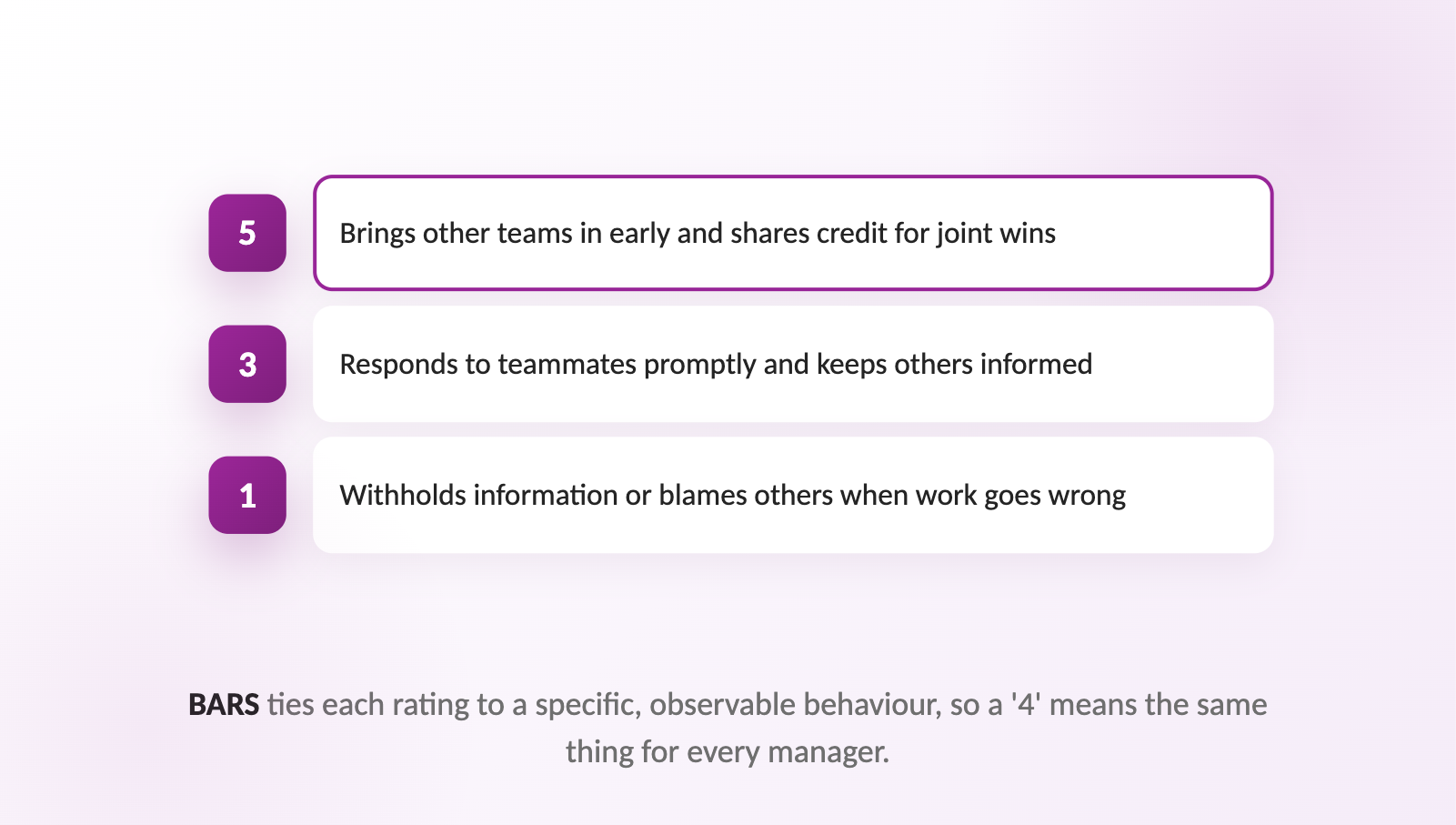
| 5 | Brings other teams in early, resolves conflicts between groups and shares credit for joint wins |
| 4 | Proactively shares information and offers help to colleagues on other projects |
| 3 | Responds to requests from teammates promptly and keeps others informed |
| 2 | Shares information only when asked; sometimes misses commitments to others |
| 1 | Withholds information or blames others when joint work goes wrong |
How do you build a BARS?
- Pick the competencies that matter most for the role, ideally from your competency framework.
- Collect critical incidents: real examples of excellent and poor behaviour from managers and high performers.
- Sort the examples into the competencies they describe.
- Have a panel rate each example on the scale, and keep the ones with strong agreement.
- Write the final anchors, one or two per level.
- Test with real reviews and refine.
Pros and cons of BARS
| Pros | Cons |
|---|---|
| More consistent ratings across managers | Time-consuming to build for each role |
| Clear, observable expectations for employees | Needs updating as roles change |
| Easier to explain and defend ratings | Real behaviour may not match any anchor exactly |
| Reduces halo, leniency and central tendency | Works less well for highly varied or creative roles |
Worked example
A support team's managers rate "customer focus" very differently: one gives everyone 4s, another mostly 2s. HR runs a workshop where each manager brings three real examples of great and poor customer handling. The group writes five anchors from those examples. In the next cycle, ratings across the two managers' teams move much closer, and employees say they finally understand what a 5 looks like.
Frequently asked questions
- What is a behaviorally anchored rating scale?
- A rating method where each level on the scale is described by a specific example of on-the-job behaviour, making ratings more objective.
- What is an example of BARS?
- For "communication", a 5 might be "explains complex trade-offs clearly to senior leaders and adjusts to the audience" and a 1 "sends updates that leave stakeholders unsure of next steps".
- What are the advantages of BARS?
- Ratings are more consistent across managers, expectations are clearer, and reviews are easier to explain because they rest on behaviour.
- What are the disadvantages of BARS?
- It takes time and expertise to create and maintain, and it is harder to apply to roles where good work looks very different from case to case.
- How is BARS different from a graphic rating scale?
- A graphic rating scale uses labels or numbers alone (such as 1 to 5, "poor" to "excellent"). BARS adds a description of behaviour to each level.
- Who created BARS?
- Patricia Cain Smith and Lorne Kendall introduced the method in a 1963 paper in the *Journal of Applied Psychology*.
Sources
- Patricia C. Smith and L. M. Kendall, "Retranslation of expectations", *Journal of Applied Psychology* (1963)
See it in practice
Compare performance review software
Related reading
Related terms