Performance Review Bias
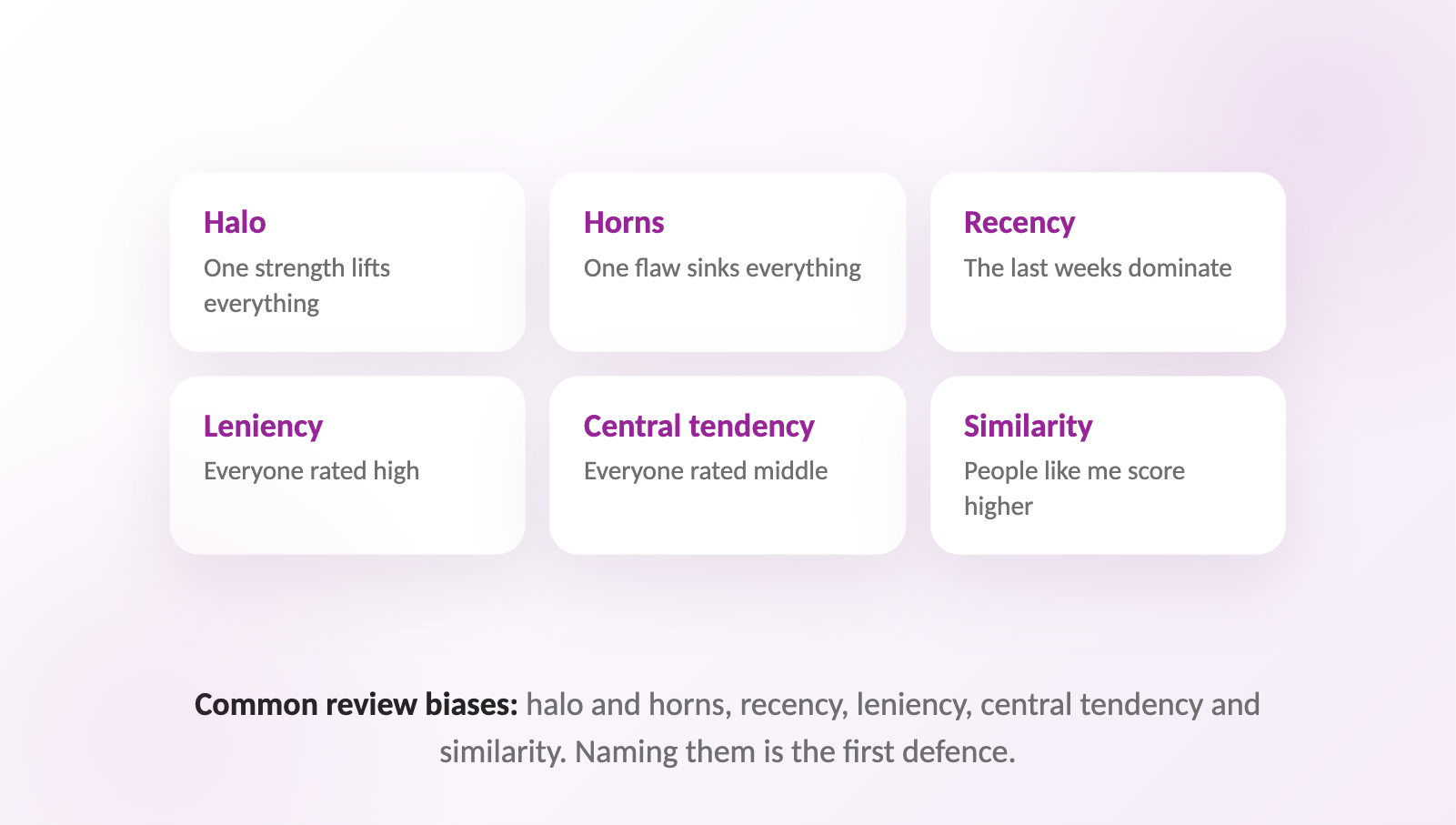
Performance review bias is any systematic error that makes a rating reflect the person doing the rating, or factors unrelated to the work, rather than the employee's actual performance. Common types include recency bias, the halo and horns effects, central tendency, leniency, strictness and similarity bias. Bias makes reviews unfair, distorts pay and promotion decisions, and can lead to discrimination claims. Most of it is unconscious, so the fix is better process rather than better intentions.
Also known as: rater bias, rating bias, appraisal bias, unconscious bias in performance reviews
Reviewed
Key takeaways
- Review bias is when ratings reflect the rater, not the work.
- Research suggests the rater's own tendencies can explain more of a rating than the employee's performance.
- Most bias is unconscious, so process fixes work better than training alone.
- Clear criteria, evidence for every rating and calibration are the core defences.
At a glance
- Most common types
- Recency, halo, horns, central tendency, leniency, similarity
- Root cause
- Memory, mental shortcuts, unclear criteria
- Main fixes
- Written criteria, evidence, multiple raters, calibration
- Related
- Recency bias, horns effect, performance calibration
Why does performance review bias matter?
Scullen, Mount and Goff (2000) found that more of the variance in job performance ratings came from the rater's own tendencies than from the performance being rated. When ratings drive pay, promotion and exits, that error compounds. Bias also tends to fall hardest on people who are less like their manager, which can widen gender and race gaps.
9 common types of performance review bias
| Bias | What happens | Example |
|---|---|---|
| Recency bias | Recent events outweigh the full period | A strong December hides a weak year |
| Primacy bias | First impressions stick | A slow first month defines the year |
| Halo effect | One strength inflates all ratings | A great presenter is rated high on analysis too |
| Horns effect | One weakness lowers all ratings | One missed deadline drags down every competency |
| Central tendency | Everyone is rated in the middle | A manager avoids "exceeds" and "below" entirely |
| Leniency bias | Ratings are too generous | A whole team rated "exceeds" to avoid conflict |
| Strictness bias | Ratings are too harsh | A manager believes nobody truly "exceeds" |
| Similarity (affinity) bias | People like the rater score higher | Same background or interests leads to higher ratings |
| Contrast effect | People are rated against each other, not the standard | An average performer looks weak next to a star |
How do you reduce performance review bias?
- Define each rating level with clear, observable descriptions.
- Require evidence for every rating, from across the whole period.
- Capture notes all year through 1:1s and feedback, so memory is not the main source.
- Use more than one view: self-assessment, peer and 360 feedback.
- Calibrate across managers and look at rating patterns by team, gender and other groups.
- Separate the conversations about growth and pay where possible.
Worked example
Before calibration, HR shares each manager's rating distribution. One manager has rated 11 of 12 people "meets", a sign of central tendency. Another has rated every engineer from her former company "exceeds", a possible similarity bias. Both are asked to bring one piece of evidence per rating. Four ratings change, and the company adds written rating descriptions for the next cycle.
Frequently asked questions
- What is performance review bias?
- Any consistent error that makes a performance rating reflect something other than the employee's actual work, such as the rater's habits or impressions.
- What is central tendency bias?
- Rating most people in the middle of the scale, avoiding high and low ratings, which hides real differences in performance.
- What is leniency bias?
- Rating people more generously than their performance deserves, often to avoid conflict or protect the team.
- What is similarity bias in performance reviews?
- Rating people more favourably because they share the rater's background, interests or working style. It is also called affinity bias.
- Can AI reduce performance review bias?
- It can help by flagging patterns, such as rating gaps between groups or language differences in written reviews, but people still need to make and own the decisions.
- How do you prove a performance review is biased?
- Look for patterns: ratings that do not match evidence, consistent gaps between groups, or a manager's ratings that differ sharply from peers' views of the same people.
Sources
- Scullen, Mount and Goff, "Understanding the latent structure of job performance ratings", *Journal of Applied Psychology* (2000)
- Edward L. Thorndike, "A constant error in psychological ratings", *Journal of Applied Psychology* (1920)
See it in practice
Compare performance review software
Related reading
Related terms