Horns Effect
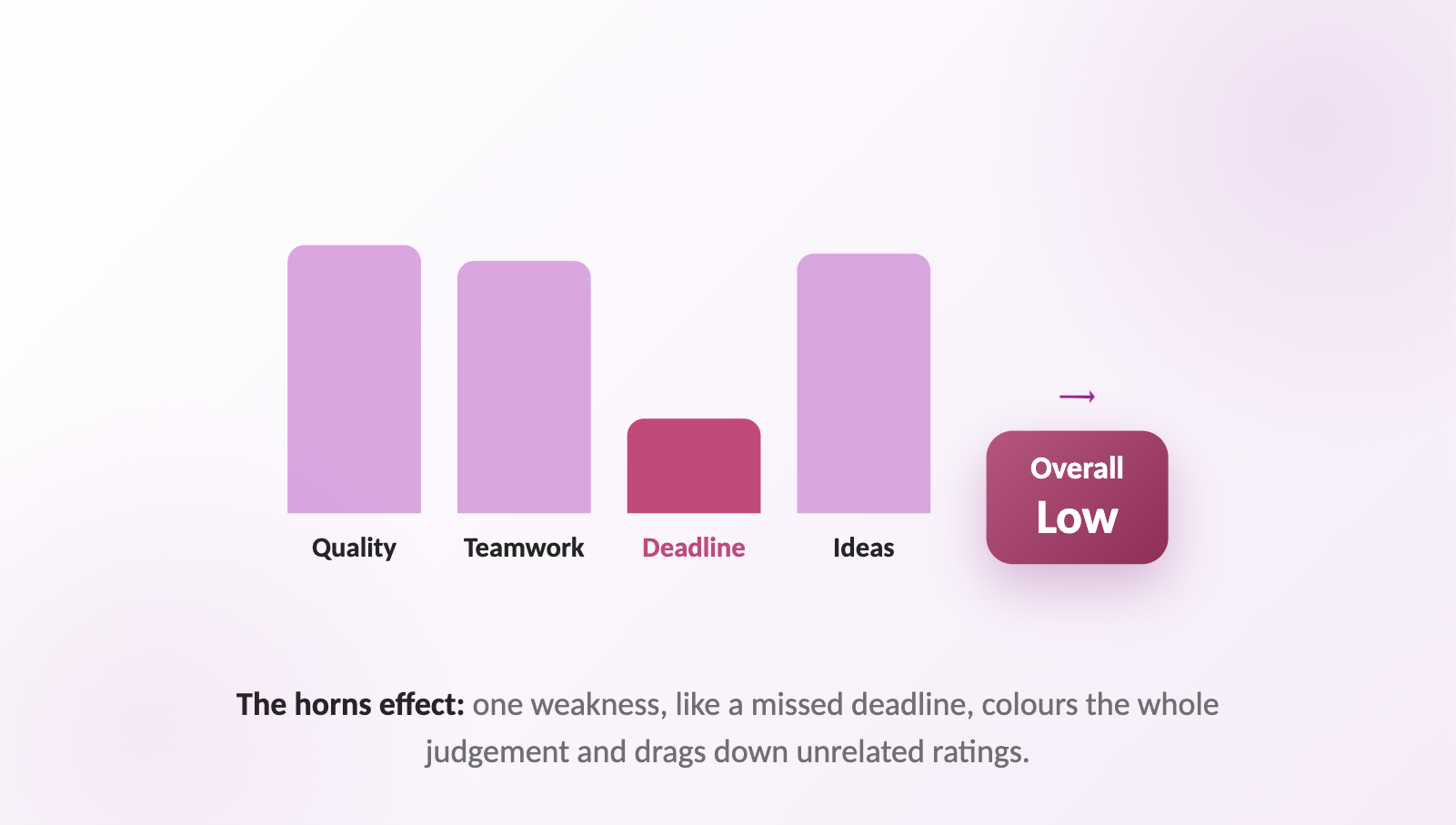
The horns effect is a bias where one negative trait or event makes us judge everything else about a person more harshly. At work, a single missed deadline, an awkward first meeting or a disliked habit can drag down how a manager rates someone's skills, attitude and potential. It is the opposite of the halo effect, where one positive trait makes everything else look better. Both lead to unfair ratings that do not match the evidence.
Also known as: horn effect, reverse halo effect, devil effect
Reviewed
Key takeaways
- The horns effect lets one negative impression spread to unrelated judgements.
- The halo effect is the same error in the positive direction.
- In reviews, it shows up as low ratings across every competency because of one issue.
- Rating each competency separately, with evidence, is the main defence.
At a glance
- What happens
- One negative trait lowers all other judgements
- Opposite
- Halo effect
- Where it shows up
- Hiring, performance reviews, promotion decisions
- Related
- Recency bias, performance review bias, calibration
Why does the horns effect matter?
When one negative impression colours everything, ratings stop reflecting what someone actually did. A capable person can be rated poorly across the board, miss out on pay rises and development, and eventually leave. The effect is hard to notice in yourself, which is why structured ratings and calibration matter.
Horns effect vs halo effect
| Horns effect | Halo effect | |
|---|---|---|
| Direction | Negative | Positive |
| Trigger | One weakness or bad moment | One strength or good impression |
| Result | Ratings too low across the board | Ratings too high across the board |
| Example | Often late, so rated weak on quality too | Great presenter, so rated strong on analysis too |
The halo effect was first described by psychologist Edward Thorndike in 1920, after he found that military officers' ratings of soldiers were too consistent across unrelated traits.
Examples of the horns effect at work
- A candidate stumbles on the first interview question, and the interviewer scores every later answer lower.
- An engineer who pushes back in meetings is rated low on teamwork, quality and leadership, though only one is fair.
- A new hire's slow first month sets a reputation that follows them through the year.
How do you reduce the horns effect?
- Rate each competency separately against written descriptions.
- Require an example for every rating, especially low ones.
- Use structured interviews with the same questions and scoring for every candidate.
- Collect input from several people, such as peers and 360 feedback.
- Challenge flat ratings in calibration: "they are rated low on everything; what is the evidence for each?"
Worked example
In calibration, a manager rates an analyst "below" on all five competencies. A peer manager asks for one example per competency. The manager has clear evidence on communication (missed updates to stakeholders) but cannot point to problems in analysis quality, which colleagues rate highly. The final review rates communication "below" and the other four "meets" or "exceeds".
Frequently asked questions
- What is the horns effect?
- A bias where one negative trait or experience causes someone to judge a person negatively in other, unrelated areas.
- What is the difference between the halo and horns effect?
- The halo effect inflates judgements because of one positive trait; the horns effect lowers them because of one negative trait.
- What is an example of the horns effect?
- Rating an employee poorly on every review competency because they were once late for an important client meeting.
- How does the horns effect affect hiring?
- Interviewers may mark down a candidate on every criterion after one weak answer or a poor first impression, missing strong candidates.
- Who discovered the halo effect?
- Edward Thorndike described it in a 1920 paper on errors in psychological ratings. The horns effect is the negative version of the same bias.
- How do you avoid the horns effect in performance reviews?
- Rate competencies independently, back each rating with evidence, gather multiple views and calibrate across managers.
Sources
- Edward L. Thorndike, "A constant error in psychological ratings", *Journal of Applied Psychology* (1920)
See it in practice
Compare performance review software
Related reading
Related terms