Pulse Survey
A pulse survey is a short employee survey, usually 5 to 15 questions, run frequently (weekly to quarterly) to track how people feel about their work. It complements the longer annual engagement survey: the annual survey gives depth, and pulse surveys show whether things are getting better or worse between those points. Because they are quick, response rates stay high and teams can act on results while they are still relevant.
Also known as: pulse check, employee pulse survey, pulse engagement survey, check-in survey
Reviewed
Key takeaways
- A pulse survey is short (5 to 15 questions) and frequent (weekly to quarterly).
- It tracks trends between full engagement surveys rather than replacing them.
- Repeat a few core questions every time so results can be compared.
- Share results and one action quickly; otherwise people stop responding.
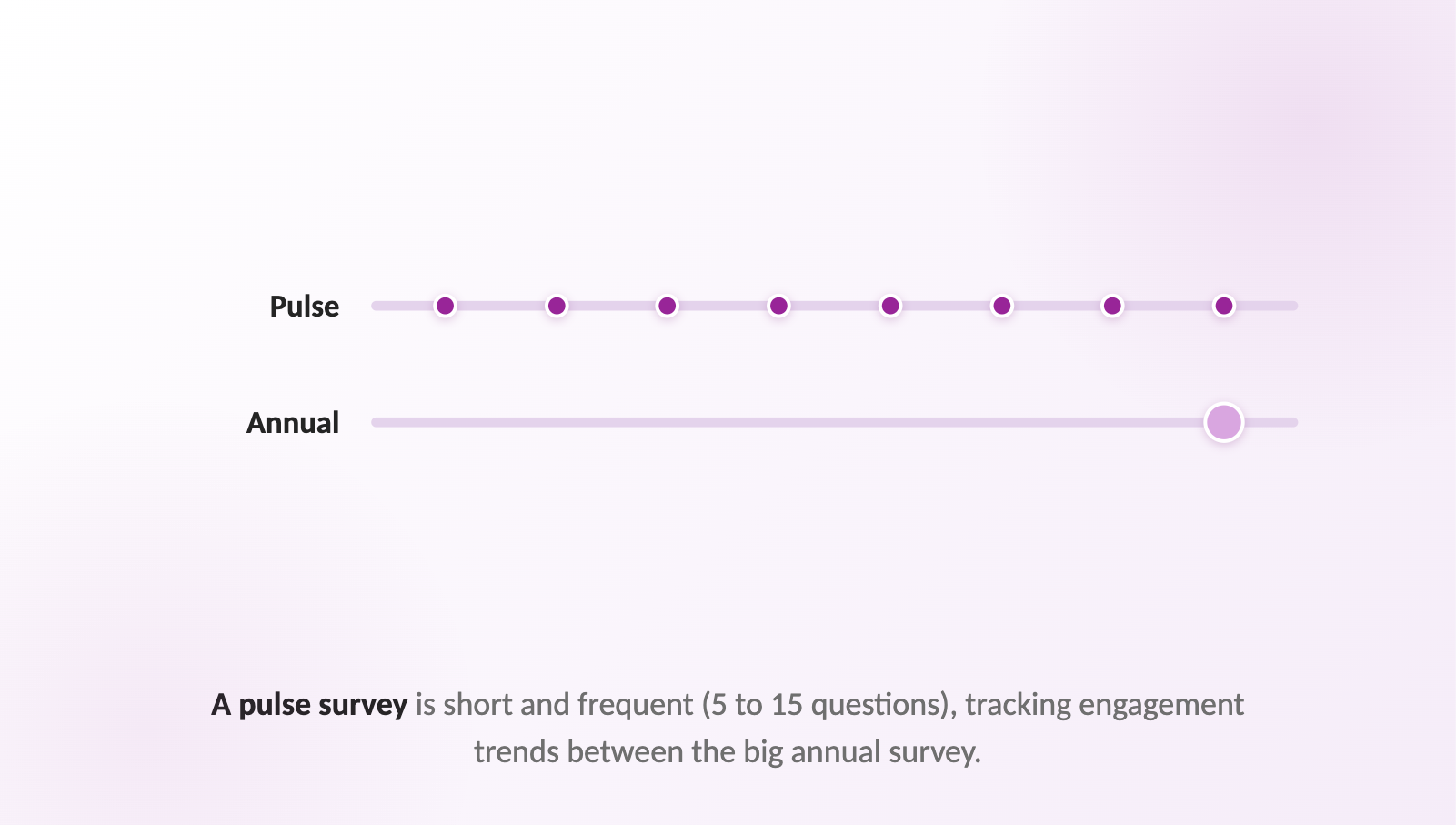
At a glance
- Length
- 5 to 15 questions; 2 to 5 minutes
- Frequency
- Weekly, monthly or quarterly
- Format
- Mostly rating scales, plus one open question
- Related
- Employee engagement survey, eNPS, employee engagement metrics
Why do pulse surveys matter?
An annual survey is a snapshot that is out of date within weeks. Pulse surveys catch changes as they happen, such as falling morale after a reorganisation or rising workload during a busy quarter. They also make listening a habit rather than an event, which only works if people see their answers lead to action.
Pulse survey vs annual engagement survey
| Pulse survey | Annual engagement survey | |
|---|---|---|
| Length | 5 to 15 questions | 30 to 60+ questions |
| Frequency | Weekly to quarterly | Once a year |
| Purpose | Track trends and spot issues early | Deep diagnosis across many drivers |
| Time to act | Days to weeks | Months |
Pulse survey questions
Use a 1 to 5 or 0 to 10 scale for most questions, and keep a core set the same each time.
- How likely are you to recommend this company as a place to work? (eNPS, 0 to 10)
- I have the resources I need to do my job well.
- My workload is manageable.
- I received useful feedback in the last two weeks.
- I understand how my work contributes to company goals.
- I see opportunities to grow here.
- Open question: What is one thing we could improve right now?
How do you run a pulse survey?
- Pick a rhythm you can act on; monthly is a common starting point.
- Keep it short and repeat a core set of questions.
- Protect anonymity by only reporting teams above a minimum group size, such as 5 people.
- Share results within two weeks, with one clear action.
- Rotate one or two extra questions to explore a topic, such as a recent change.
- Watch trends, not single readings.
Worked example
A 150-person company runs a monthly six-question pulse. In March, "My workload is manageable" drops from 3.9 to 3.2 in the support team while staying flat elsewhere. The support lead brings in two contractors for the busy season and pauses a non-urgent project. By May the score is back to 3.8, and the lead shares the before-and-after numbers with the team.
Frequently asked questions
- What is a pulse survey?
- A short, frequent employee survey used to track engagement and sentiment over time and spot issues early.
- How often should you run pulse surveys?
- Monthly or quarterly suits most organisations. Weekly can work for very short surveys of one to three questions, but only if you can act on the results that often.
- How many questions should a pulse survey have?
- Between 5 and 15. Fewer questions mean higher response rates.
- Should pulse surveys be anonymous?
- Usually, yes, or at least confidential with results reported only for groups large enough to protect individuals.
- What is a good pulse survey response rate?
- Aim for 70% or more. Falling response rates often mean people do not see action on previous results.
- What is the difference between eNPS and a pulse survey?
- eNPS is a single question. A pulse survey often includes the eNPS question alongside a few others.
Sources
- Gallup, *Q12 Employee Engagement Survey* (question design reference)
See it in practice
Compare employee engagement software
Related reading
Related terms