eNPS (Employee Net Promoter Score)
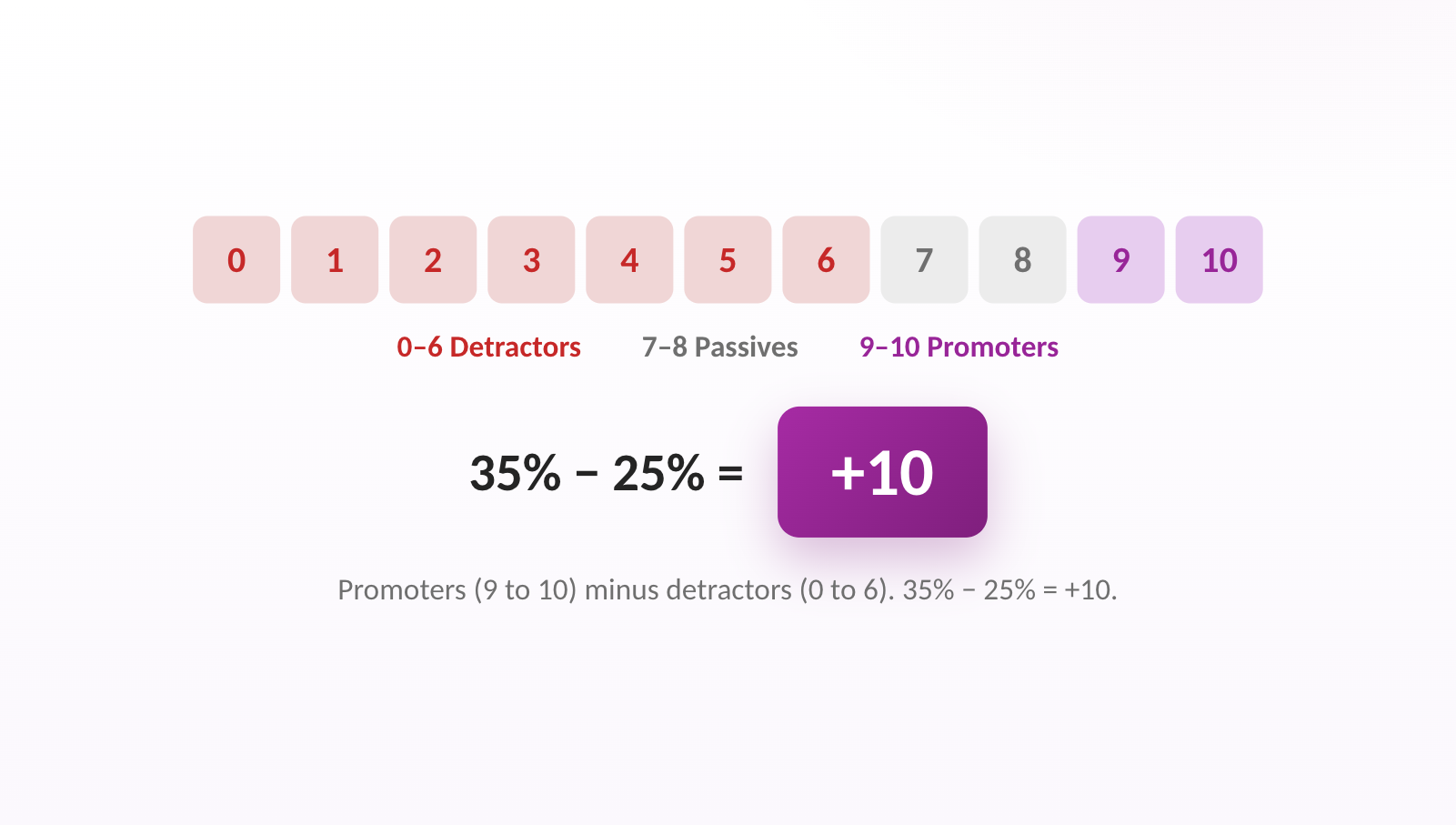
eNPS (employee net promoter score) is a one-question measure of employee loyalty. Employees answer "How likely are you to recommend this company as a place to work?" on a scale from 0 to 10. The score is the percentage of promoters (9 to 10) minus the percentage of detractors (0 to 6). It ranges from −100 to +100. It is adapted from the customer Net Promoter Score.
Also known as: employee net promoter score, enps score, enps meaning
Reviewed
Key takeaways
- eNPS is a one-question measure: how likely are you to recommend this company as a place to work (0 to 10)?
- Score = % promoters (9–10) minus % detractors (0–6); it runs from −100 to +100.
- It is a fast pulse between deeper engagement surveys, not a full diagnosis.
- Always add a “why?” follow-up; the score tells you how people feel, not why.
At a glance
- Question
- Would you recommend us as a place to work? (0–10)
- Formula
- % promoters (9–10) − % detractors (0–6)
- Range
- −100 to +100; above 0 is net positive
- Related
- Employee engagement, engagement survey
Free calculator
eNPS calculator
eNPS = % promoters (9–10) − % detractors (0–6). Passives (7–8) count toward the total but neither group. The score runs from −100 to +100; always pair it with a 'why?' follow-up.
Why does eNPS matter?
It is fast, easy to repeat, and easy to compare over time. That makes it a good pulse metric between longer engagement surveys. On its own, it tells you how people feel, not why, so always add a follow-up question.
How do you calculate eNPS?
eNPS = % promoters (9–10) − % detractors (0–6)
Passives (7–8) count toward the total responses but not toward either group.
Worked example
120 employees respond. 42 score 9 or 10 (35%). 48 score 7 or 8 (40%). 30 score 0 to 6 (25%).
eNPS = 35 − 25 = +10.
Good follow-up questions
"What is the main reason for your score?" and "What is one thing we could change to make this a better place to work?"
Frequently asked questions
- What is a good eNPS?
- Anything above zero means more promoters than detractors. Your own trend over time matters more than an external benchmark.
- How often should you run eNPS?
- Monthly or quarterly as a pulse. Keep it anonymous and report results by team only when group sizes protect anonymity.
- How do you calculate eNPS?
- Subtract the percentage of detractors (0–6) from the percentage of promoters (9–10). Passives (7–8) count toward the total but neither group. 35% − 25% = +10.
- What is a good eNPS score?
- Anything above 0 means more promoters than detractors. Your own trend over time matters more than an external benchmark.
- What is the difference between eNPS and NPS?
- NPS measures customer loyalty; eNPS adapts the same method to employees, asking whether they would recommend the company as a place to work.
- What questions should follow an eNPS survey?
- “What's the main reason for your score?” and “What's one thing we could change?” The score alone does not tell you why.
Sources
- Fred Reichheld, the Net Promoter Score (Harvard Business Review, 2003)
See it in practice
Compare employee engagement software
Related reading
Related terms