Employee Engagement
Employee engagement is the level of emotional commitment and energy employees bring to their work and their organisation. Engaged employees care about outcomes, put in discretionary effort, and want to stay. It is different from satisfaction: a person can be satisfied with their pay and perks and still not care much about the work.
Also known as: staff engagement, workforce engagement, engagement at work
Reviewed
Key takeaways
- Employee engagement is how committed, motivated, and connected people feel to their work.
- It is distinct from satisfaction: you can be comfortable but not engaged.
- It predicts retention, productivity, and quality, so it is measured and tracked over time.
- Managers are the single biggest driver of their team's engagement.
At a glance
- Measured by
- Surveys, eNPS, behaviour (attrition, absence)
- Cadence
- Annual survey + regular pulses
- Biggest driver
- Manager quality
- Related
- eNPS, engagement survey, engagement metrics
Why does employee engagement matter?
Engagement is linked to productivity, quality, customer outcomes, and retention. It is also one of the earliest signals of trouble. Engagement usually drops long before people resign.
What drives employee engagement?
Common drivers across engagement research: a good relationship with the direct manager, clarity on what is expected, growth opportunities, recognition, meaningful work, and trust in leadership.
How do you measure employee engagement?
Engagement surveys (annual plus short pulses), and eNPS (employee net promoter score).
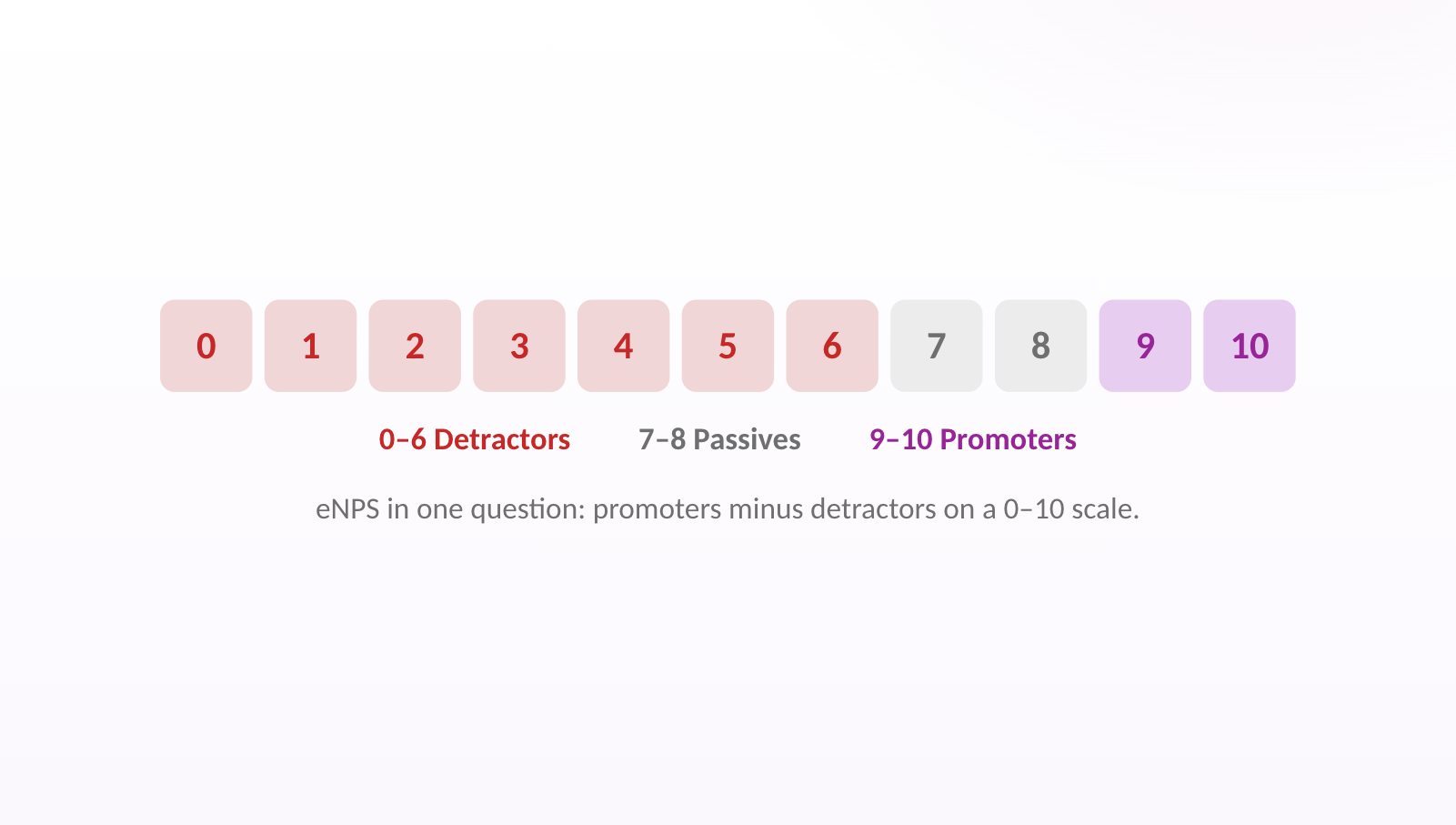
eNPS asks: "How likely are you to recommend this company as a place to work?" on a 0 to 10 scale.
eNPS = % promoters (9 to 10) − % detractors (0 to 6)
Worked example
100 employees answer the eNPS question. 45 score 9 or 10, 35 score 7 or 8, and 20 score 0 to 6.
eNPS = 45% − 20% = +25.
Frequently asked questions
- Engagement vs satisfaction?
- Satisfaction is whether people are content. Engagement is whether they are committed and putting in effort.
- What is a good eNPS?
- Anything above zero means more promoters than detractors. Track your own trend over time rather than chasing a benchmark.
- How do you measure employee engagement?
- With engagement surveys and eNPS, backed by behavioural signals like attrition, absenteeism, and participation. No single number tells the whole story.
- What is the difference between engagement and satisfaction?
- Satisfaction is how content people are; engagement is how committed and willing to give discretionary effort. Satisfied employees are not always engaged.
- What drives employee engagement?
- Clear expectations, a good manager, growth, recognition, meaningful work, and believing action follows feedback. Manager quality is the biggest lever.
- How do you improve employee engagement?
- Act on survey results visibly, invest in managers, make workload sustainable, recognise good work, and show people a path forward.
See it in practice
Compare employee engagement software
Related reading
Related terms