Employee Engagement Metrics
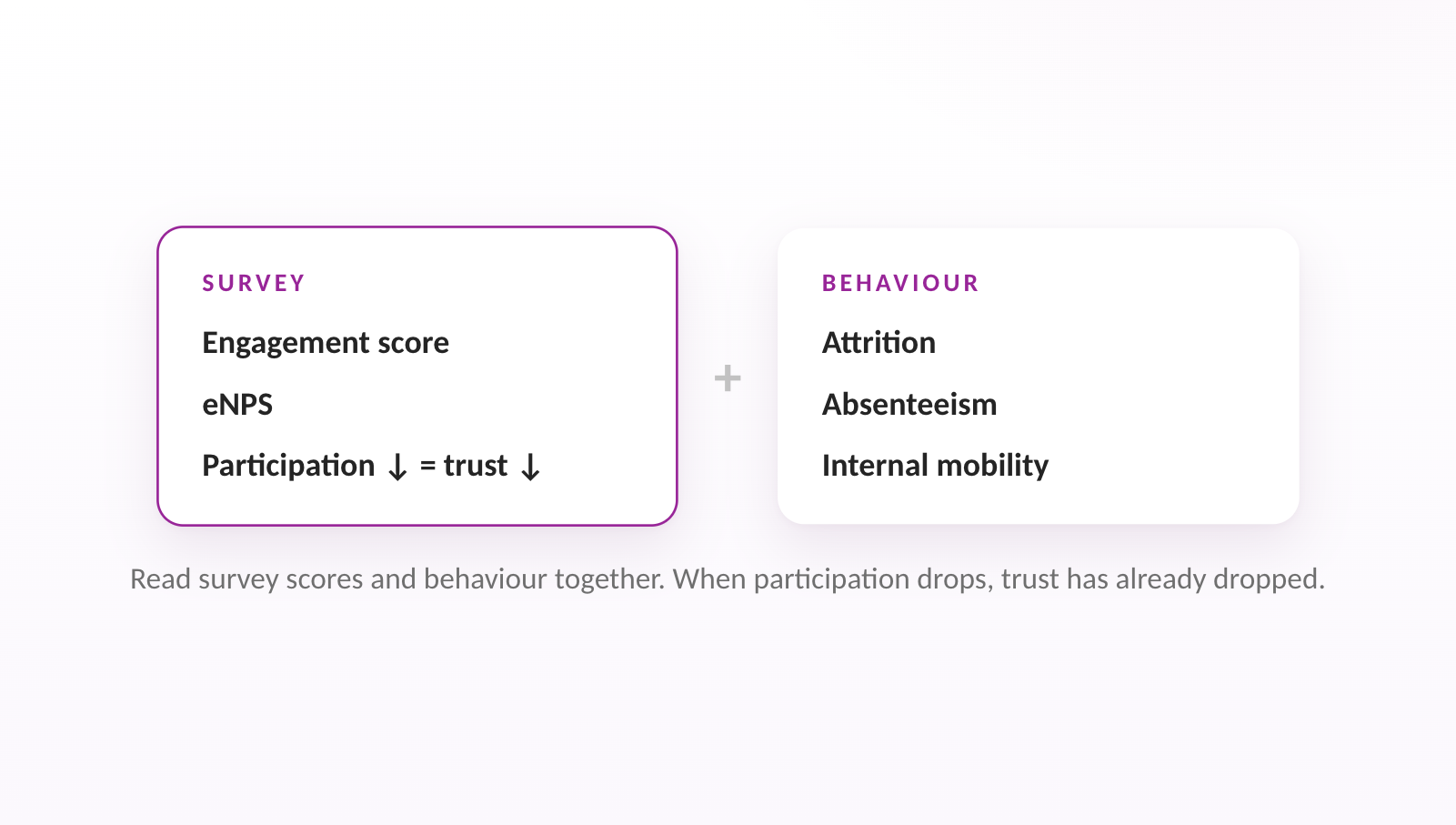
Employee engagement metrics are the measures a company uses to track how committed, motivated, and connected employees are. They combine survey-based measures, like engagement scores and eNPS, with behavioural measures, like retention, absenteeism, and participation. No single metric tells the full story, so they are read together and tracked over time.
Also known as: measuring employee engagement, engagement KPIs, engagement score
Reviewed
Key takeaways
- Engagement metrics combine survey measures (score, eNPS) with behaviour (attrition, absence, participation).
- No single metric tells the full story; read them together and over time.
- Watch survey participation: when it falls, people have stopped believing feedback matters.
- Always slice by team and manager; the company average hides the problems.
At a glance
- Survey metrics
- Engagement score, eNPS, participation
- Behaviour metrics
- Attrition, absenteeism, internal mobility
- Cadence
- Annual survey + pulses
- Related
- eNPS, engagement survey, employee engagement
Why do employee engagement metrics matter?
Engagement drops quietly. By the time it shows up in resignations, it has usually been falling for months. Tracking a small set of metrics monthly or quarterly gives managers an early warning they can act on.
8 metrics worth tracking
| Metric | What it tells you |
|---|---|
| Engagement score | Average of core engagement survey items |
| eNPS | Would people recommend working here |
| Survey participation rate | Whether people believe surveys lead to change |
| Voluntary attrition rate | Who is choosing to leave |
| 90-day new hire attrition | Whether onboarding works |
| Absenteeism rate | Early sign of burnout or disengagement |
| Internal mobility rate | Whether people see a future here |
| 1:1 frequency | Whether managers are actually connecting |
How to read them together
A falling eNPS plus falling participation is worse than a falling eNPS alone, because it means people have stopped believing feedback matters. Slice everything by team and manager.
Worked example
Company-wide engagement holds steady at 72. Sliced by team, one group of 30 has dropped from 74 to 58 in two quarters, with survey participation down from 90% to 55%. That team gets a skip-level conversation within a week.
Frequently asked questions
- What is a good employee engagement score?
- It depends on the survey provider and scale. Compare against your own trend and the provider's benchmark.
- How often should you measure engagement?
- A full survey once or twice a year, plus short pulse surveys monthly or quarterly.
- What engagement metrics should you track?
- A small set: engagement score, eNPS, survey participation, voluntary attrition, 90-day new-hire attrition, absenteeism, internal mobility, and 1:1 frequency.
- How do you benchmark engagement metrics?
- Compare against your own trend first, then against your survey provider's industry benchmark. Absolute numbers vary by scale and vendor, so direction of travel matters most.
- How do you measure employee engagement?
- Combine survey scores with behavioural signals, track them over time, and always break them down by team and manager.
- Why is survey participation an engagement metric?
- Falling participation signals that people have stopped believing the survey leads to change, which is itself a warning sign, so watch it alongside the score.
See it in practice
Compare employee engagement software
Related reading
Related terms