Employee Engagement Survey
An employee engagement survey is a questionnaire that measures how committed, motivated, and connected employees feel about their work and organisation. It usually combines rating-scale questions with a few open questions, is run anonymously, and is repeated over time so trends can be tracked. The results only matter if leaders share them and act on them.
Also known as: engagement survey, pulse survey, employee survey, engagement survey questions
Reviewed
Key takeaways
- An engagement survey measures how committed and motivated employees feel.
- Run it anonymously, repeat it over time, and keep it under 15 minutes.
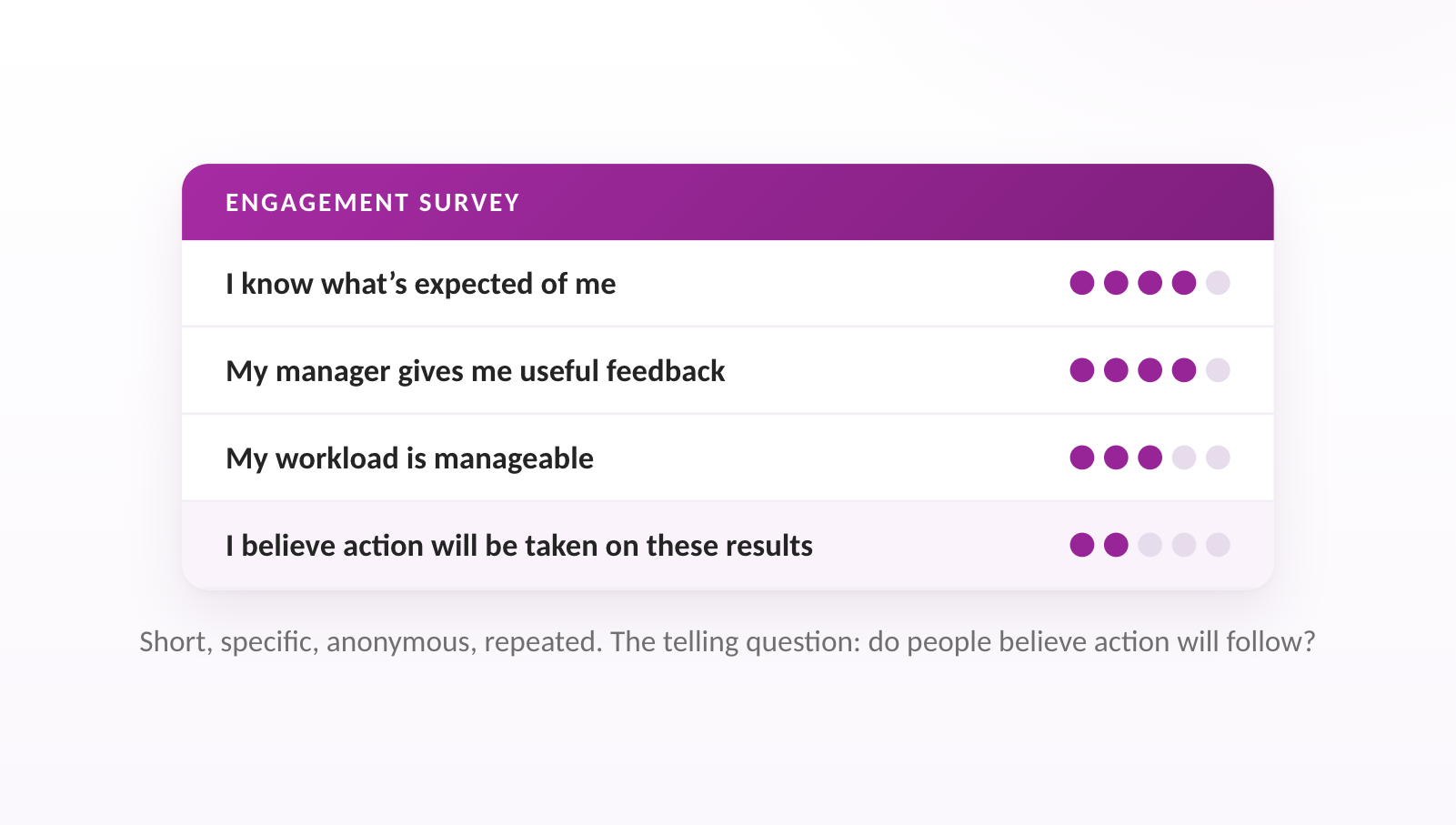
- The question that predicts success: “I believe action will be taken on these results.”
- Share results fast and pick two or three actions; the follow-through is the hard part.
At a glance
- What it is
- Anonymous, repeated engagement questionnaire
- Cadence
- Full survey 1–2x/year + pulses
- Key question
- “I believe action will be taken”
- Related
- eNPS, engagement metrics, employee engagement
Why do employee engagement surveys matter?
Engagement surveys are the most direct way to hear from everyone at once, including people who would never raise an issue in a meeting.
15 example questions (5-point agree scale)
Engagement: 1. I am proud to work here. 2. I would recommend this company as a great place to work. 3. I see myself working here in two years.
Manager: 4. My manager gives me useful feedback. 5. My manager cares about me as a person.
Growth: 6. I have opportunities to learn and grow here. 7. I understand what I need to do to progress.
Clarity: 8. I know what is expected of me at work. 9. I understand how my work contributes to company goals.
Recognition: 10. I receive recognition when I do good work.
Wellbeing: 11. My workload is manageable. 12. I can switch off after work.
Voice: 13. I believe action will be taken on the results of this survey.
Open: 14. What is one thing we should keep doing? 15. What is one thing we should change?
What are the best practices for employee engagement surveys?
Keep it under 15 minutes. Guarantee anonymity with a minimum group size before showing team results. Share results within a few weeks. Pick two or three actions, not twenty.
Worked example
Results show "I understand what I need to do to progress" at 38% favourable, the lowest item. Leadership publishes career levels for every function within the quarter. The next survey shows 61%.
Frequently asked questions
- How often should you run an engagement survey?
- A full survey once or twice a year, plus short pulses in between.
- What is a good response rate?
- Higher is better. A falling rate is itself a signal that people do not believe the survey leads to change.
- What questions should an employee engagement survey include?
- A mix of engagement (“I'm proud to work here”), manager, growth, clarity, recognition, wellbeing, and voice items, plus one or two open questions.
- What is a good engagement survey response rate?
- Higher is better. A falling rate is itself a signal that people do not believe the survey leads to change.
- Should employee engagement surveys be anonymous?
- Yes, responses are almost always anonymised and aggregated above a minimum group size. Anonymity is what makes people answer honestly; reporting that could identify small teams breaks trust.
- What should you do after an engagement survey?
- Share results within a few weeks, pick two or three concrete actions, and report back on them so people see that feedback leads to change.
See it in practice
Compare employee engagement software
Related reading
Related terms