Quiet Firing
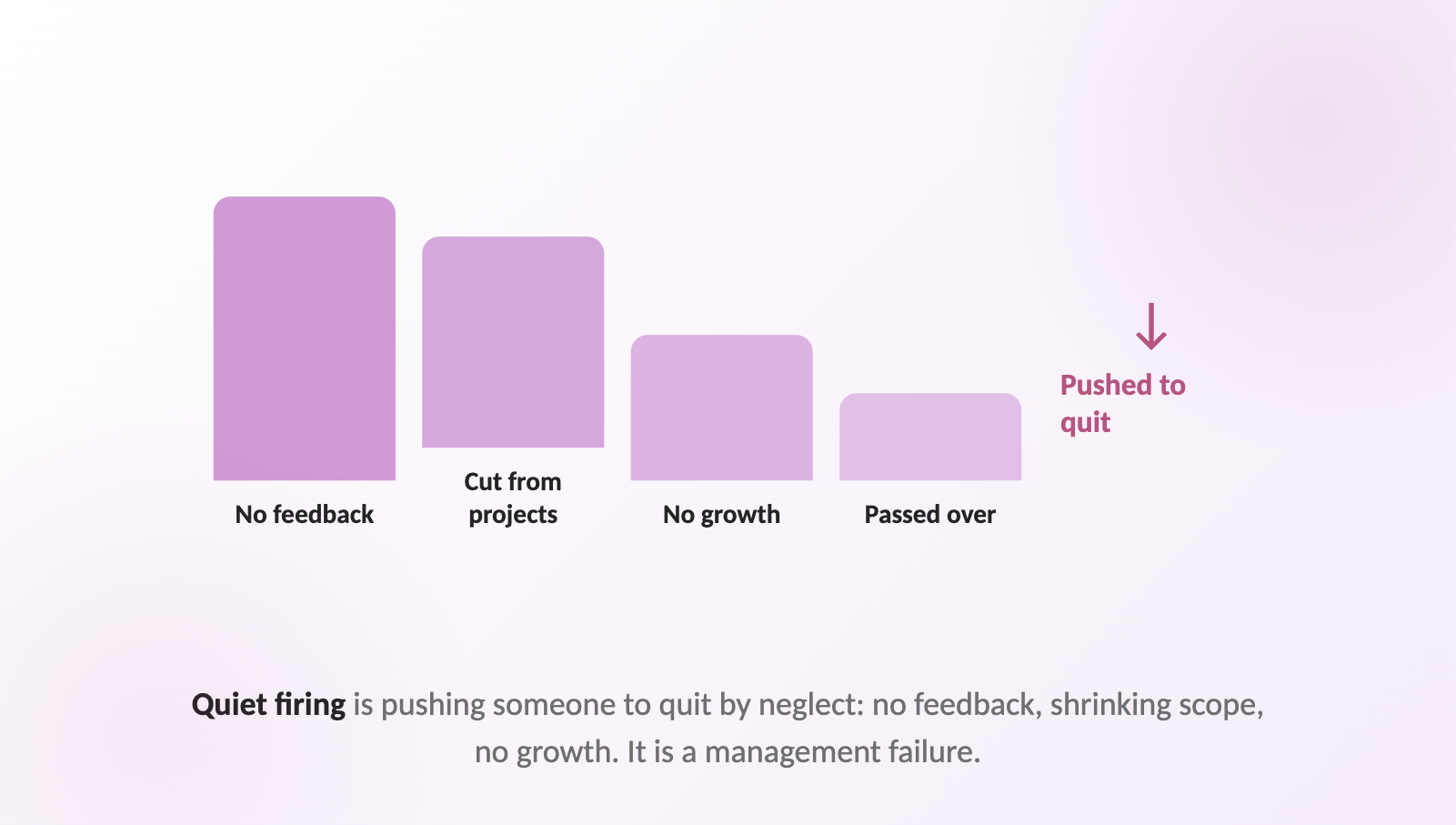
Quiet firing is when a manager or company pushes an employee towards leaving by making their job steadily less rewarding, instead of addressing the problem openly. Common tactics include withholding pay rises and development, cutting someone out of meetings and interesting work, and cancelling 1:1s. It is the employer-side counterpart to quiet quitting. It avoids a hard conversation in the short term, but it damages trust, hurts the wider team and can carry legal risk.
Also known as: silent firing, quiet cutting (when roles are reshaped to push people out), managing out, constructive dismissal (when it crosses a legal line)
Reviewed
Key takeaways
- Quiet firing pushes someone out by neglect or exclusion rather than an honest conversation.
- Signs include no feedback, no raise, no development and being left out of key work.
- It harms trust across the whole team, not just for the person targeted.
- The fix is direct: clear expectations, documented feedback and, if needed, a fair exit process.
At a glance
- What it is
- Making a job worse so someone leaves on their own
- Common signs
- Cancelled 1:1s, no raise, no growth, exclusion
- Risk
- Lost trust; possible constructive dismissal claims
- Related
- Quiet quitting, managing underperformance, performance improvement plan
Why does quiet firing matter?
Quiet firing usually happens because a manager wants to avoid a difficult conversation about performance or fit. The employee rarely knows what is wrong, so nothing improves. Colleagues notice, and they learn that problems are handled by freezing people out rather than by honest feedback. In the UK, making someone's position untenable can amount to constructive dismissal; in the US, a similar idea is called constructive discharge. Either can lead to a legal claim.
Signs of quiet firing
- 1:1s are regularly cancelled or cut short.
- No useful feedback, positive or negative, for months.
- Passed over for raises or promotion without explanation.
- Development requests and training are refused or ignored.
- Removed from projects, meetings or communications without reason.
- Goals keep moving or become impossible to meet.
How do you prevent quiet firing?
- Hold regular 1:1s and make cancelling them the exception.
- Give specific feedback early, including when performance is slipping.
- Write down expectations so both sides know what success looks like.
- Use a fair process for underperformance, such as a performance improvement plan with real support.
- Check patterns in calibration: who has had no raise, no feedback or no development for a long time, and why?
- Coach managers on difficult conversations, since avoidance is the root cause.
Worked example
During calibration, HR notices that one analyst has had no pay rise in two years, no development plan and three cancelled 1:1s in a row. Her manager admits he is unhappy with her work but has never said so. HR coaches him to set clear expectations in a documented conversation. Two months later her work has improved on two of three goals, and the third is moved to a teammate whose skills fit it better.
Frequently asked questions
- What is quiet firing?
- Pushing an employee to quit by making their job less rewarding, such as withholding feedback, raises or development, rather than addressing the issue directly.
- What is the difference between quiet firing and quiet quitting?
- Quiet quitting is an employee doing only the minimum required. Quiet firing is the employer side: a manager doing the minimum for an employee in the hope they leave.
- Is quiet firing illegal?
- Not in itself, but it can become constructive dismissal (UK) or constructive discharge (US) if conditions are made so bad that a reasonable person would feel forced to resign. It can also overlap with discrimination if it targets a protected group.
- How do I know if I am being quietly fired?
- Look for a pattern: cancelled 1:1s, no feedback, no raise, being left out of work you used to do. Ask your manager directly for feedback and clear goals, and keep a record.
- Why do managers quietly fire people?
- Usually to avoid conflict. Some lack the skills or support for honest performance conversations; others want to avoid severance or a formal process.
- What should HR do about quiet firing?
- Look for warning signs in data (missed 1:1s, long gaps without feedback or pay changes), coach managers on direct conversations, and make the formal underperformance process clear and fair.
Sources
- Jack Zenger and Joseph Folkman, "Quiet Quitting Is About Bad Bosses, Not Bad Employees", *Harvard Business Review* (August 2022)
See it in practice
Compare employee engagement software
Related reading
Related terms