Managing Underperforming Employees
Managing underperformance is the process a manager follows when an employee consistently falls short of agreed expectations. It starts with finding the cause, moves through clear expectations, support, and regular check-ins, and only escalates to a formal performance improvement plan if things don't improve. The goal is to fix the performance, not build a paper trail.
Also known as: managing underperforming employees, managing poor performance, underperformance
Reviewed
Key takeaways
- Managing underperformance is a fair process to close the gap between agreed expectations and actual performance.
- It starts with finding the cause, not jumping to a PIP.
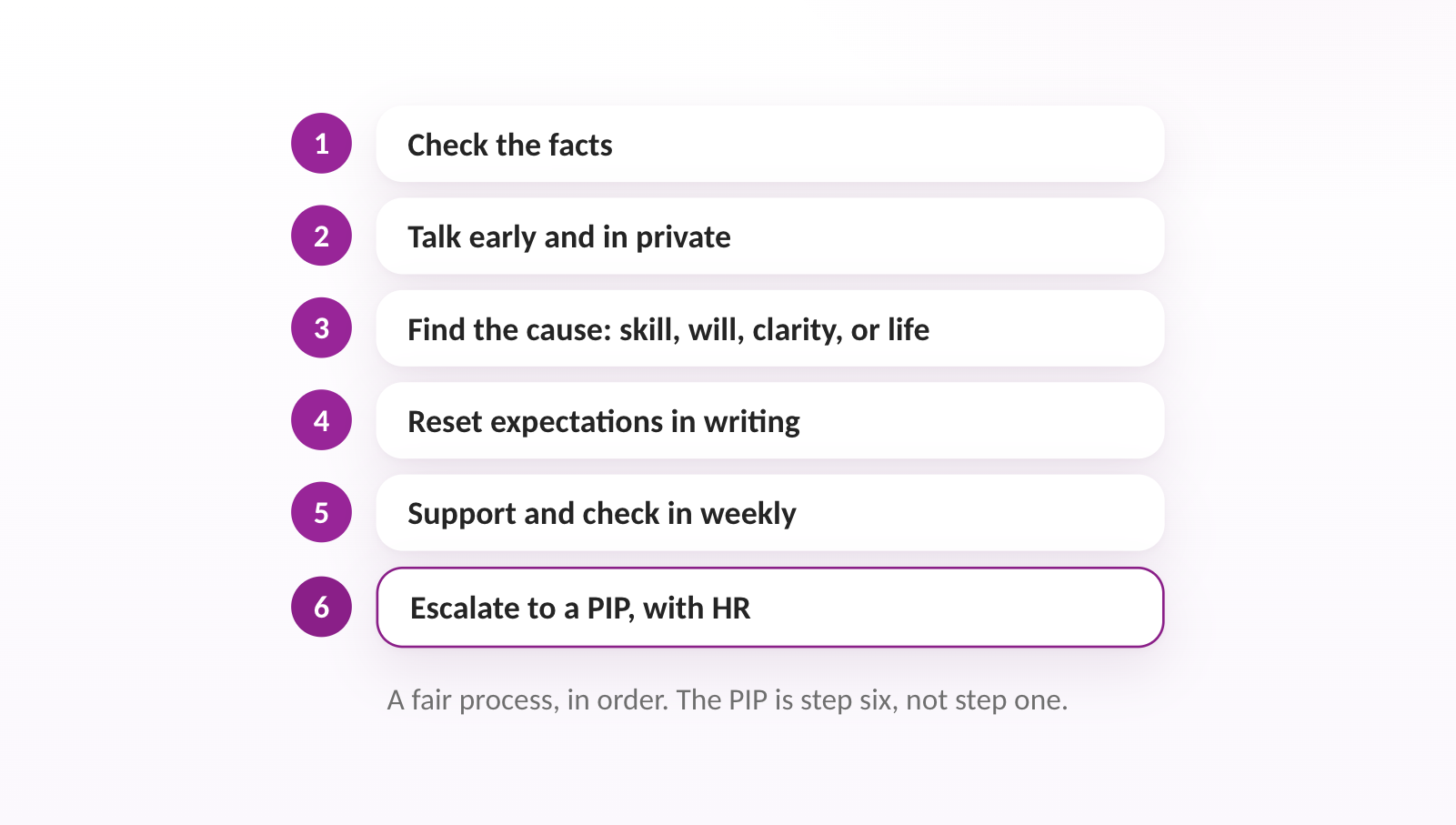
- Six steps: check facts, talk early and privately, find the cause, reset expectations, support and check in, then escalate.
- Many cases are at least partly about the role or manager, not only the person.
Why does underperformance matter?
Ignoring underperformance hurts the person, who doesn't get a chance to fix it, and the team, who carry the extra load and watch to see whether standards are real. Handling it badly creates legal and morale risk.
What causes underperformance?
Unclear expectations, skill gaps, wrong role fit, personal circumstances, poor tools or processes, and disengagement. Many cases are at least partly about the role or the manager, not only the person.
A 6-step process
- Check the facts. What exactly is falling short, compared with what was agreed?
- Talk early and privately. Describe what you see, then ask what is going on.
- Find the cause. Skill, will, clarity, or circumstances?
- Reset expectations in writing, with measurable goals.
- Support and check in weekly for a set period.
- Escalate if needed to a formal PIP, with HR involved.
Worked example
A previously strong analyst starts missing deadlines. In a private conversation, she explains she has been covering a vacant role. The manager reprioritises her work, sets two clear weekly deliverables, and checks in every Friday. Within four weeks, she is back on track. No PIP needed.
Frequently asked questions
- When should a manager use a PIP?
- After informal steps have not worked and the gap is clear, documented, and discussed. A PIP should never be the first conversation.
- What should managers avoid?
- Waiting until review season, discussing it in public, and assuming the cause before asking.
- How do you manage an underperforming employee?
- Check the facts, talk early and in private, find the cause (skill, will, clarity, or circumstances), reset expectations in writing, support with weekly check-ins, and only then escalate to a PIP.
- What are the causes of underperformance?
- Unclear expectations, skill gaps, wrong role fit, personal circumstances, poor tools or process, and disengagement. Often it is the role or manager, not just the person.
- When should you start a PIP?
- After informal steps have not worked and the gap is clear, documented, and discussed. A PIP should never be the first conversation.
- What should managers avoid with underperformance?
- Waiting until review season, raising it in public, and assuming the cause before asking.
See it in practice
Compare performance management software
Related reading
Related terms