SBI Feedback Model
The SBI feedback model is a simple way to give clear, specific feedback in three parts: the **Situation** (when and where it happened), the **Behaviour** (what the person did, described objectively) and the **Impact** (the effect it had). Developed by the Center for Creative Leadership, it keeps feedback focused on observable actions instead of personality or assumptions. It works for both positive and constructive feedback.
Also known as: SBI model, Situation-Behaviour-Impact, Situation-Behavior-Impact, SBII (with Intent)
Reviewed
Key takeaways
- SBI stands for Situation, Behaviour, Impact.
- Describe what you saw or heard, not what you think the person meant.
- It works for praise as well as constructive feedback.
- Follow up with a question, so feedback becomes a conversation.
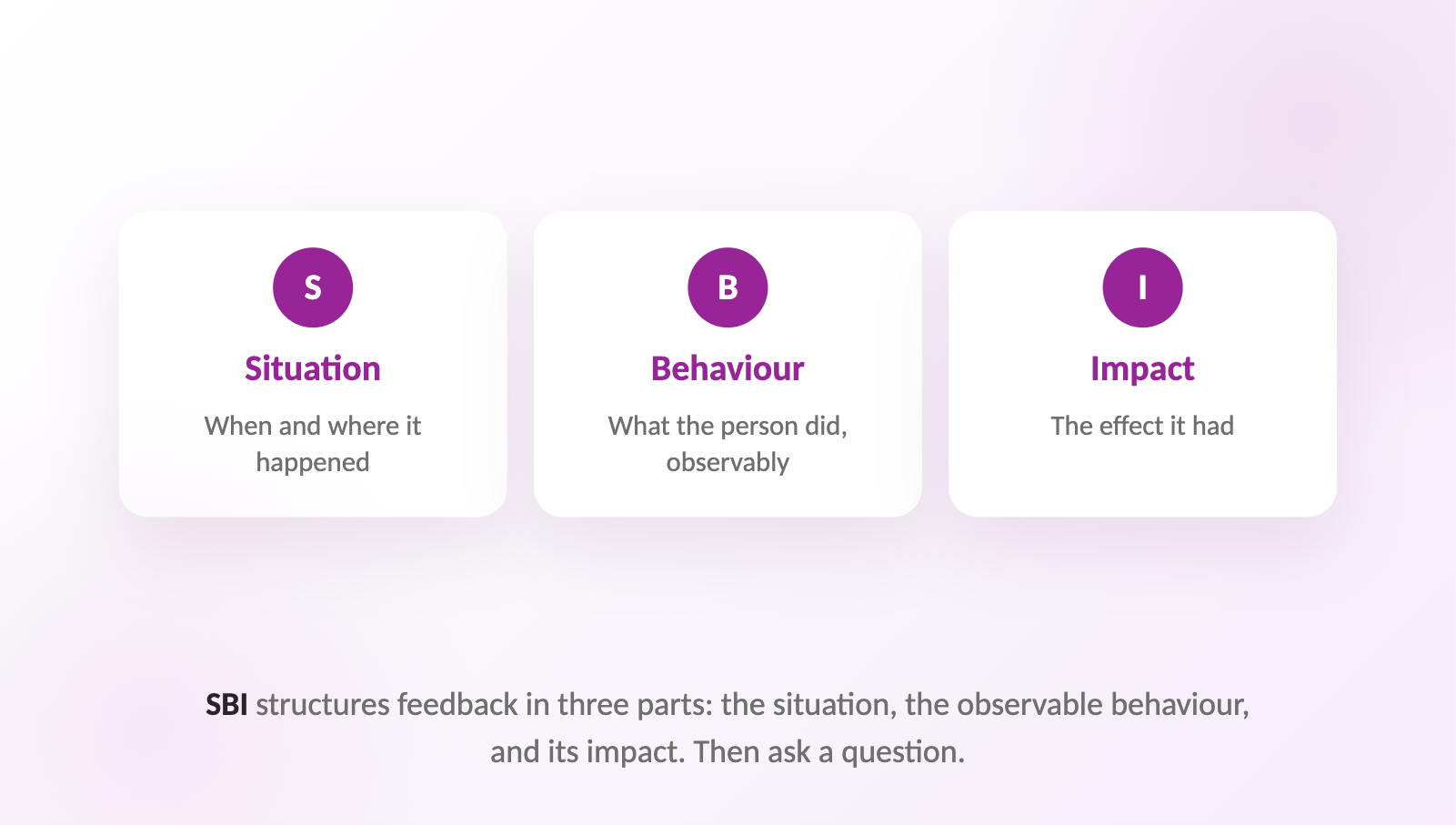
At a glance
- Situation
- When and where it happened
- Behaviour
- What the person did or said, observably
- Impact
- The effect on you, the team, the customer or results
- Related
- Employee feedback, positive feedback, GROW model
Why does the SBI model matter?
Vague feedback such as "great job" or "you need to be more proactive" gives people nothing to act on and can feel personal. SBI forces the giver to be specific and to separate what happened from their interpretation. That makes feedback easier to hear, easier to act on and fairer, because it rests on evidence.
How to use the SBI feedback model
- Situation. Anchor it in time and place: "In Tuesday's client call..."
- Behaviour. Describe the action itself: "...you shared the revised timeline before they asked..."
- Impact. Explain the effect: "...which reassured them, and they approved the budget on the call."
- Then ask: "How did it feel from your side?" or "What could we do differently next time?"
Some teams add a fourth step, Intent, asking what the person was trying to achieve before discussing the impact (SBII).
SBI feedback examples
| Positive | Constructive | |
|---|---|---|
| Situation | In yesterday's sprint review | In this morning's leadership meeting |
| Behaviour | You walked through the trade-offs of each option with data | You interrupted Sam twice while he was presenting |
| Impact | The team agreed on a decision in ten minutes instead of the usual hour | Sam didn't finish his point, and we missed the risk he was raising |
| Follow-up | Could you share that format with the other leads? | What was going on for you in that moment? |
Common mistakes with SBI
- Judging instead of describing: "You were rude" is a judgement; "You interrupted Sam twice" is a behaviour.
- Being vague about the situation, so the person cannot recall it.
- Overstating the impact, or guessing at other people's feelings.
- Waiting too long; feedback lands best within a day or two.
Worked example
A team lead wants to address a report who often misses stand-ups. Instead of "You're not committed to the team", she says: "In three of last week's five stand-ups (situation), you joined after we had finished updates (behaviour). That meant the team made two decisions without your input on the API work (impact). What's getting in the way in the mornings?" The report explains a recurring client call, and they move stand-up 30 minutes later.
Frequently asked questions
- What does SBI stand for?
- Situation, Behaviour, Impact: describe where and when, what the person did, and the effect it had.
- Who created the SBI feedback model?
- The Center for Creative Leadership (CCL) developed and popularised the model.
- Can SBI be used for positive feedback?
- Yes. Specific praise using SBI tells people exactly what to keep doing, which makes it more useful than general compliments.
- What is the difference between SBI and the GROW model?
- SBI is for giving feedback on a specific event. GROW (Goal, Reality, Options, Will) is a coaching model for helping someone work through a goal or problem.
- What is SBII?
- An extended version that adds Intent: asking what the person intended before discussing the impact, to avoid assuming bad motives.
- How do you write SBI feedback in a performance review?
- Use one or two SBI examples per competency to back up each rating, drawn from across the review period.
Sources
- Center for Creative Leadership, Situation-Behavior-Impact (SBI) feedback model (ccl.org)
See it in practice
Compare 360 feedback software
Related reading
Related terms