Exit Interview
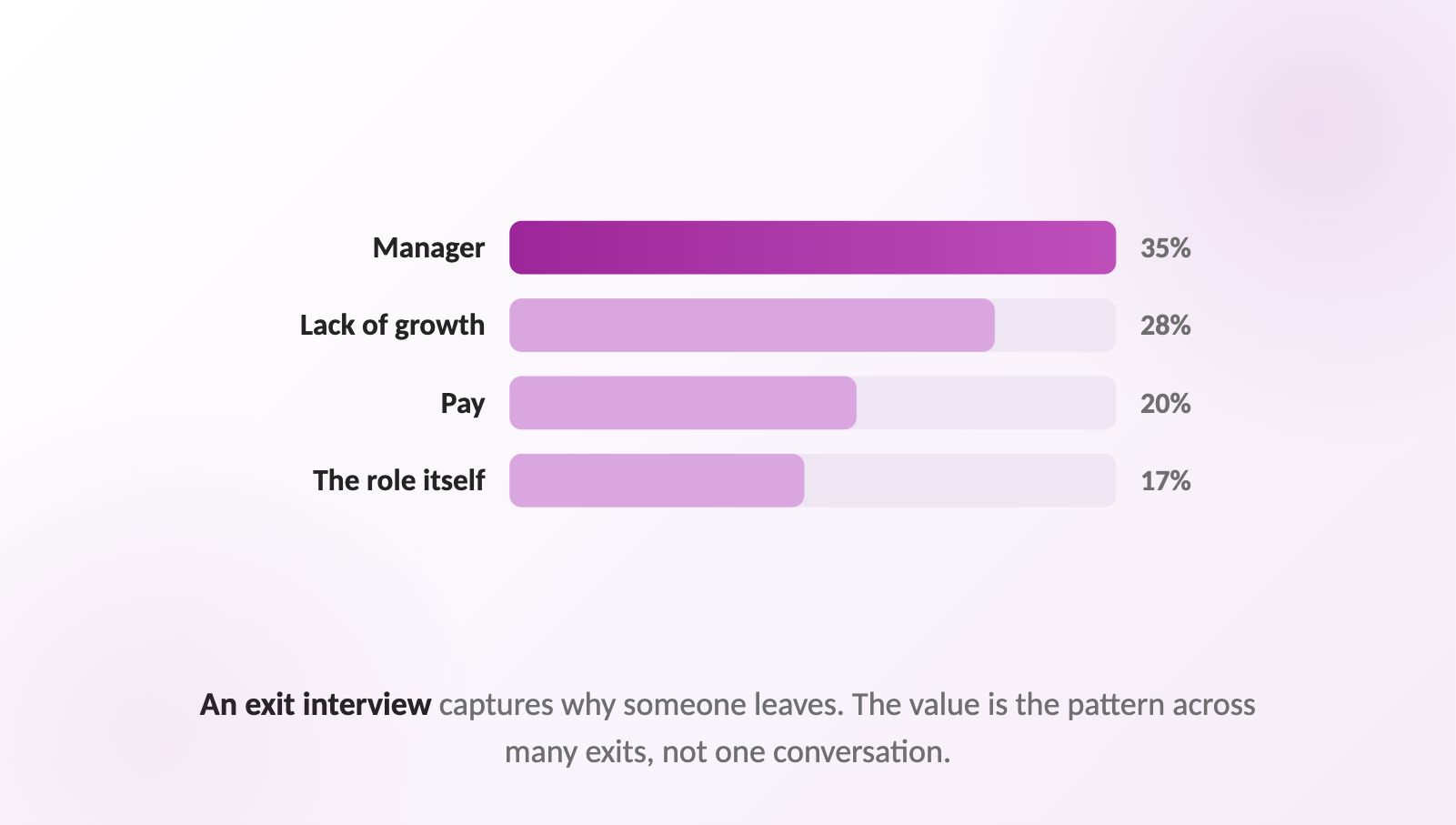
An exit interview is a conversation, survey or both, held with an employee who is leaving, to understand why they are going and what the organisation could do better. It is usually run by HR rather than the person's manager, in the final week or two of employment. Individually, answers explain one departure; across many leavers, they reveal patterns in management, pay, workload or career growth that drive turnover.
Also known as: exit survey, leaver interview, departure interview, exit conversation
Reviewed
Key takeaways
- An exit interview asks leavers why they are going and what would have kept them.
- Have HR or a neutral person run it, not the departing employee's manager.
- Look for patterns across many exits, not lessons from a single one.
- Exit interviews explain past turnover; pair them with stay interviews to prevent it.
At a glance
- Who
- Departing employee and HR (or a neutral third party)
- When
- Final one to two weeks; some add a follow-up survey 2 to 3 months later
- Format
- Interview, survey, or both
- Related
- Stay interview, employee turnover, attrition rate
Why do exit interviews matter?
Leavers are often the most candid voices in a company because they have little to lose. Their answers show why turnover is happening, which teams or managers it clusters around, and what competitors are offering. In a 2016 Harvard Business Review article, Everett Spain and Boris Groysberg found many companies run exit interviews but few act on them. They recommend clear goals, consistent questions, analysis across leavers and sharing results with leadership. Without that follow-through, exit interviews become a box-ticking exercise.
Exit interview questions
- What prompted you to start looking for a new role?
- What is the main reason you are leaving?
- Was there a moment you decided to leave? What happened?
- How would you describe your relationship with your manager?
- Did you have the tools and support to do your job well?
- Did you feel your work was recognised?
- Did you see a path to grow your career here?
- What does your new role offer that we did not?
- What could we have done to keep you?
- Would you consider coming back, or recommend us to a friend?
How do you run an exit interview?
- Choose a neutral interviewer, usually HR, so people feel safe being honest.
- Schedule it early in the notice period, not on the last afternoon.
- Explain how answers will be used and who will see them.
- Use the same core questions for everyone so results can be compared.
- Record answers in a consistent format and tag reasons (pay, manager, growth, workload).
- Report themes to leadership every quarter and agree actions.
Worked example
An HR team reviews 40 exit interviews from the past year. 18 leavers cite "no clear promotion path", and 12 of those came from two product teams. The company introduces career levels for product roles and starts stay interviews in those teams. The following year, product turnover falls from 22% to 14%, and promotion path drops to the third most common exit reason.
Frequently asked questions
- What is the purpose of an exit interview?
- To understand why an employee is leaving and gather honest feedback that helps reduce future turnover.
- Are exit interviews mandatory?
- No. Employees can decline. Make clear that taking part is optional and will not affect references.
- Who should conduct an exit interview?
- HR or a neutral third party. Departing employees are rarely candid with the manager they are leaving.
- Should exit interviews be anonymous?
- The interview itself cannot be anonymous, but results should be reported in aggregate so individuals cannot be identified.
- What should you not say in an exit interview?
- As a leaver, stick to specific, constructive points and avoid personal attacks. As an interviewer, avoid arguing, defending decisions or trying to change their mind on the spot.
- What is the difference between an exit interview and a stay interview?
- An exit interview is with someone already leaving and looks back. A stay interview is with a current employee and looks ahead to prevent them leaving.
Sources
- Everett Spain and Boris Groysberg, "Making Exit Interviews Count", *Harvard Business Review* (April 2016)
See it in practice
Compare employee engagement software
Related reading
Related terms