Employee Wellbeing
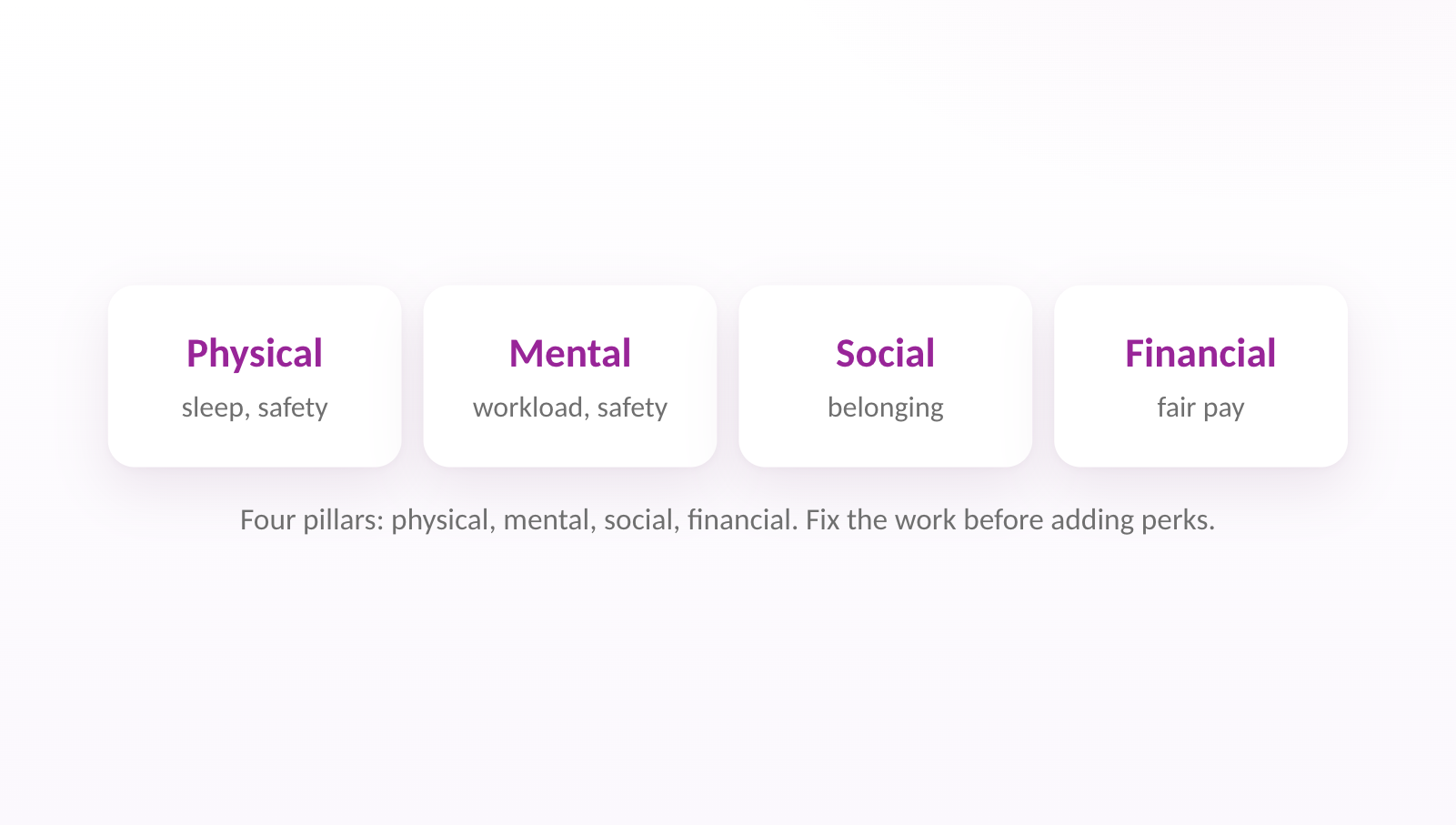
Employee wellbeing is the overall health and quality of life of employees, as shaped by their work and workplace. It usually covers four pillars: physical, mental, social, and financial wellbeing. It is broader than a wellness programme. Workload, manager behaviour, flexibility, and pay all affect wellbeing more than perks do.
Also known as: workplace wellbeing, employee wellness, staff wellbeing
Reviewed
Key takeaways
- Employee wellbeing is the overall health and quality of life of people as shaped by their work.
- It spans four pillars: physical, mental, social, and financial.
- The biggest drivers are workload, manager behaviour, flexibility, and fair pay, not perks.
- Fix the work before adding a wellness app.
At a glance
- Four pillars
- Physical, mental, social, financial
- Biggest drivers
- Workload, managers, flexibility, pay
- Measure with
- Pulse questions (“my workload is manageable”)
- Related
- Occupational wellness, burnout, presenteeism
Why does employee wellbeing matter?
Low wellbeing shows up as absenteeism, presenteeism, burnout, and turnover. High wellbeing supports focus, judgement, and the energy people bring to their work.
The four pillars
- Physical: sleep, movement, ergonomics, safe working conditions
- Mental: manageable workload, psychological safety, access to support
- Social: good relationships at work, belonging, inclusion
- Financial: fair pay, clear benefits, freedom from money stress
What can employers do about employee wellbeing?
Fix the work before adding perks. Set realistic workloads, train managers to notice early warning signs, protect time off, offer flexibility where the role allows, and make support easy to access. Then measure with pulse questions like "My workload is manageable."
Worked example
A company launches a meditation app, but wellbeing scores don't move. A pulse survey shows the real driver is after-hours messaging. Leadership sets a norm of no non-urgent messages after 7pm and schedules messages by default. Three months later, "I can switch off after work" rises from 41% to 63%.
Frequently asked questions
- Wellbeing vs wellness?
- Wellness usually means programmes and activities. Wellbeing is the broader outcome: how people actually are.
- Who is responsible for employee wellbeing?
- Shared. Employers shape the conditions. Managers have the biggest day-to-day influence. Individuals own their choices within those conditions.
- What are the pillars of employee wellbeing?
- Commonly four: physical (sleep, safety), mental (manageable workload, psychological safety), social (belonging), and financial (fair pay, freedom from money stress).
- How do you improve employee wellbeing?
- Fix the work first: realistic workloads, manager training, protected time off, and flexibility. Then measure with short pulse questions and act on them.
- How do you measure employee wellbeing?
- Pulse-survey questions like “I can switch off after work” and “my workload is manageable,” alongside absenteeism, presenteeism, and turnover signals.
- What is the difference between wellbeing and wellness?
- Wellness usually means programmes and activities; wellbeing is the broader outcome, how people actually are, which is shaped mostly by the work itself.
See it in practice
Compare employee engagement software
Related reading
Related terms