Employee Burnout
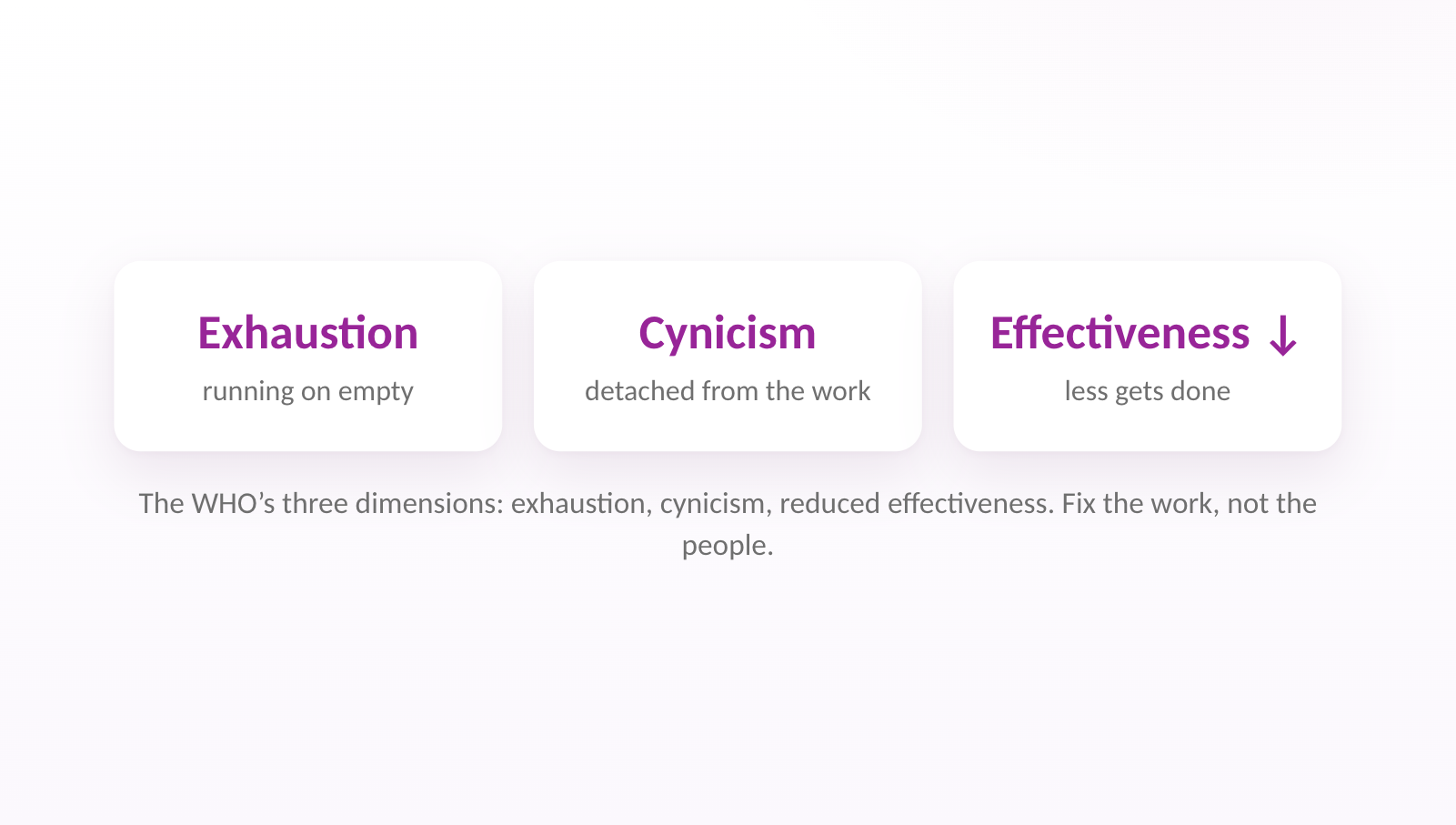
Employee burnout is a state caused by chronic workplace stress that has not been successfully managed. The World Health Organization describes it as an occupational phenomenon with three dimensions: exhaustion, increased mental distance from or cynicism about one's job, and reduced professional effectiveness. It builds over time and is driven mostly by how work is designed, not by individual weakness.
Also known as: employee burnout signs, signs of employee burnout, workplace burnout, burnout symptoms
Reviewed
Key takeaways
- Burnout is a state of chronic, unmanaged workplace stress, not individual weakness.
- The WHO defines three dimensions: exhaustion, cynicism, and reduced effectiveness.
- It is driven mostly by how work is designed, so the fix is usually workload and role design.
- Watch for it in your most committed people, and act on the team pattern, not just the individual.
Why does burnout matter?
Burnout drives absenteeism, presenteeism, mistakes, and resignations, often from the people who cared most. It is far cheaper to prevent than to recover from.
What are the signs of burnout?
- Constant tiredness, even after time off
- Growing cynicism or detachment from the work and team
- Falling quality or missed deadlines from a usually reliable person
- Irritability or withdrawal in meetings
- More sick days, or the opposite: never switching off
What causes burnout?
Unmanageable workload, lack of control over how work is done, too little recognition, unfair treatment, unclear expectations, and values conflicts.
What can managers do about burnout?
Ask directly and privately how the person is doing. Look at workload together and remove or delay something real. Protect time off. Make support easy to reach. Then look for the pattern across the team, because burnout rarely affects only one person.
Worked example
Two engineers on the same team go on leave within a month. A review shows the team has absorbed on-call for a second product without extra headcount. The manager splits the on-call rota with another team and pauses one roadmap item. Overtime drops by half the next quarter.
Frequently asked questions
- Is burnout a medical condition?
- WHO classifies burnout as an occupational phenomenon, not a medical condition. Anyone with symptoms should talk to a health professional.
- Burnout vs stress?
- Stress is often short-term and tied to specific pressure. Burnout is the result of chronic stress that has not been managed, and it includes cynicism and reduced effectiveness.
- What are the main causes of burnout?
- Unmanageable workload, little control over how work is done, too little reward or recognition, unfairness, unclear expectations, and values conflicts. Most are features of the work, not the person.
- Can burnout be reversed?
- Yes, but rest alone rarely fixes it if the conditions remain. Sustainable recovery usually needs real changes to workload, control, and support, which is why managers should fix the work, not just offer time off.
- What are the early signs of burnout?
- Persistent exhaustion that survives time off, growing cynicism or detachment, and a drop in effectiveness from a usually reliable person. More sick days, or the opposite of never switching off, are also common signals.
- Who is responsible for preventing burnout?
- Responsibility is shared, but employers and managers shape most of the drivers: workload, control, recognition, and fairness. Because burnout is mostly about how work is designed, the biggest levers sit with the organisation, not the individual.
Sources
- World Health Organization: Burn-out an occupational phenomenon (ICD-11)
- Maslach & Leiter, the three-dimension burnout model (Maslach Burnout Inventory)
See it in practice
Compare employee engagement software
Related reading
Related terms