Clan Culture
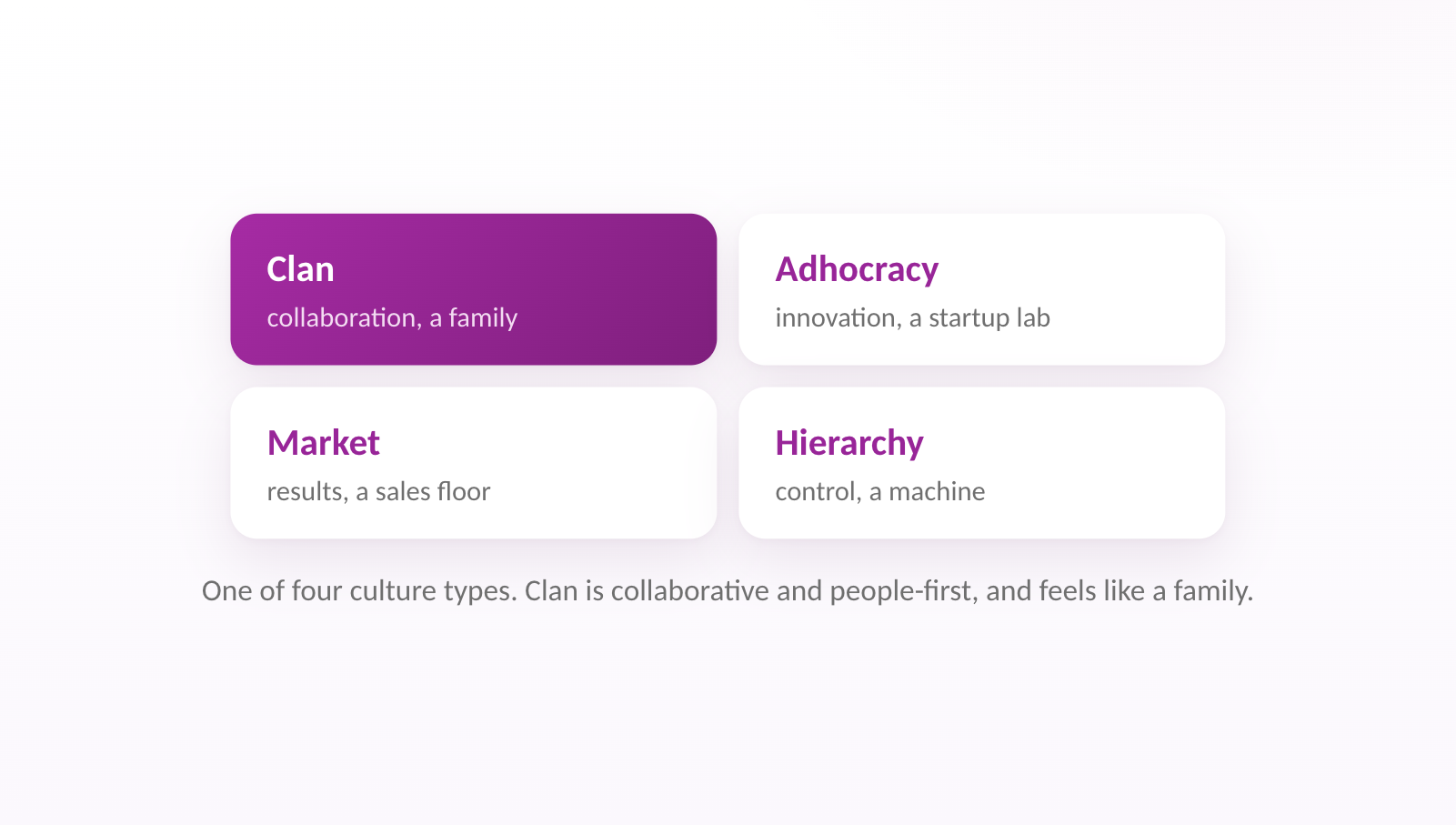
Clan culture is a type of organisational culture that is collaborative, people-focused, and feels like an extended family. Leaders act as mentors, loyalty and teamwork are highly valued, and decisions are often made by consensus. It is one of four culture types in the Competing Values Framework developed by Kim Cameron and Robert Quinn, alongside adhocracy, market, and hierarchy cultures.
Also known as: family culture, collaborative culture, competing values framework
Reviewed
Key takeaways
- Clan culture is collaborative and people-first; it feels like an extended family.
- Leaders mentor, loyalty and teamwork are prized, and decisions are often by consensus.
- It is one of four types in the Competing Values Framework (clan, adhocracy, market, hierarchy).
- Strong at retention and collaboration; weak at making hard calls and setting boundaries.
At a glance
- Type
- Collaborative, people-first (“like a family”)
- Framework
- Competing Values Framework (1 of 4)
- Strength / risk
- Loyalty & trust / avoids hard calls
- Related
- Company culture, employee engagement
Why does clan culture matter?
Knowing your culture type helps you see what your organisation is naturally good at, and where it will struggle. Clan cultures are strong at retention and collaboration. They can be slow to make hard calls.
The four culture types
| Type | Focus | Feels like |
|---|---|---|
| Clan | Collaboration, people | A family |
| Adhocracy | Innovation, risk-taking | A startup lab |
| Market | Results, competition | A sales floor |
| Hierarchy | Control, process | A well-run machine |
Pros and cons of clan culture
Pros: high trust, strong loyalty, low turnover, good mentoring.
Cons: avoiding conflict, slow decisions, tolerating underperformance, and "family" language that makes it hard to set boundaries or let people go.
Worked example
A 60-person agency has run as a clan culture since founding. Retention is excellent, but two underperformers have been carried for a year because nobody wants to have the conversation. The founders keep the collaborative core but add clear performance goals and quarterly reviews, adding a little "market" to the mix.
Frequently asked questions
- Is clan culture good?
- It is a strength in early-stage companies and people-heavy businesses. It needs balancing with clear standards as the company grows.
- What is an example of clan culture?
- Many founder-led startups, family businesses, and close-knit professional services firms lean toward clan culture.
- What are the four culture types in the Competing Values Framework?
- Clan (collaboration, people), adhocracy (innovation, risk-taking), market (results, competition), and hierarchy (control, process).
- What are the pros and cons of clan culture?
- Pros: high trust, loyalty, low turnover, strong mentoring. Cons: conflict avoidance, slow decisions, tolerating underperformance, and “family” language that makes boundaries hard.
- How do you balance a clan culture as you scale?
- Keep the collaborative core but add clear performance goals, calibrated reviews, and accountability, so loyalty does not become a reason to carry underperformance.
- Is clan culture the same as a flat organisation?
- No. Clan describes values (collaboration, loyalty, people-first); flat describes structure (few management layers). A clan culture can exist in a hierarchical org, and a flat org can still be competitive rather than clan.
Sources
- Cameron & Quinn, the Competing Values Framework
See it in practice
Compare employee engagement software
Related reading
Related terms